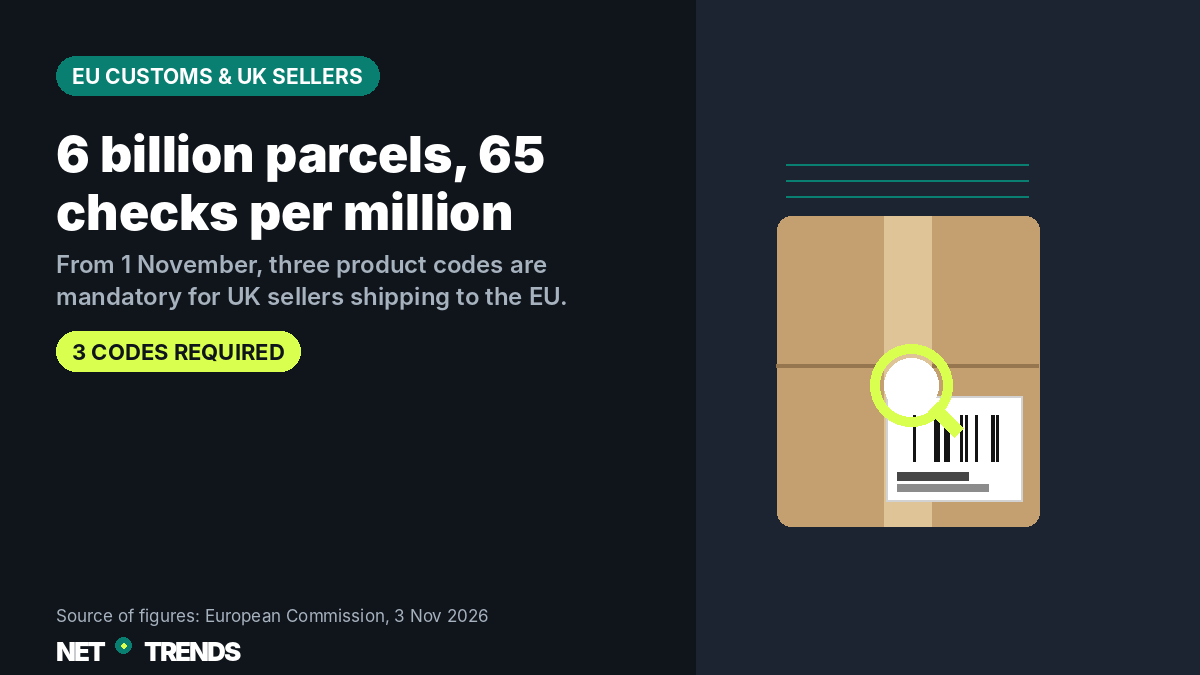
From 1 November 2026, UK-based online sellers shipping goods directly to customers in the EU must include three product identifiers in every EU customs declaration.
Key points
- Since 1 November 2026, the EU has required three product identifiers (PIDs) in customs declarations for e-commerce imports sold to EU-based buyers – and this applies to UK retailers shipping there, because the UK is outside the EU.
- The three identifiers are a merchant identifier (M-PID), a manufacturer/model identifier (NS-PID) and, where one exists, a standardised code such as an EAN or GTIN (S-PID).
- It is the customs declarant in the EU – an IOSS intermediary or customs representative, not the UK seller directly – who submits the data.
- For goods imported into the UK itself, this EU rule does not apply; UK imports are governed separately by HM Revenue & Customs (HMRC) using commodity codes.
UK-based online retailers that sell directly to customers in the EU now face a new compliance requirement: since 1 November 2026, every qualifying customs declaration must carry three product identifiers. The rule does not touch parcels coming into the UK, but it does apply to British sellers shipping out to EU buyers.
The European Commission describes the obligation as a binding requirement to state product identifiers for goods sold at a distance to buyers in the EU. A UK customs-data specialist that tracks the same EU regulation confirms the rule applies to “all retailers based outside of the European Union, including UK-based retailers” shipping business-to-consumer (B2C) parcels to any EU destination – unless that retailer already holds stock inside an EU member state, in which case different, EU-internal rules apply instead.
The three identifiers UK sellers now need
The M-PID identifies the specific listing in a shop, marketplace or platform – for example a seller’s own SKU, article number or Amazon ASIN – and is assigned by the seller or platform. The NS-PID links the product to its manufacturer and model, such as a manufacturer’s part or model number; there is no single mandatory international format. The S-PID is an internationally standardised code, typically a barcode such as an EAN, UPC or ISBN; where none exists, the customs declarant must enter a designated exemption code instead.
An SKU can serve as the M-PID, but it cannot substitute for the NS-PID: both are required on every qualifying declaration, while the S-PID is mandatory only where a standardised code already exists for the product. The requirement covers B2C distance sales; business-to-business (B2B) imports are generally excluded.
Who actually submits the data
According to the European Commission, the customs declarant handles the submission – typically the IOSS (Import One-Stop Shop) intermediary or a customs representative based in the EU, not the UK retailer’s own website and not the EU buyer. For UK sellers, the practical task is making sure product-level data (description, HS code, country of origin, M-PID, NS-PID and S-PID where available, plus quantity and value) is complete and can be passed on to whoever lodges the declaration, such as a courier, freight forwarder or marketplace.
For UK shoppers buying from outside the UK, this EU rule changes nothing at the checkout: there is no new field to fill in when ordering. The identifiers are data exchanged between sellers, platforms and declarants so that EU customs authorities can trace a specific product more easily during checks.
Checklist for UK sellers shipping to EU customers
- Confirm every product has a merchant identifier (M-PID) – an SKU, article number or marketplace ASIN.
- Record a manufacturer/model identifier (NS-PID) for every product.
- Where a GTIN, EAN, UPC or ISBN exists, store it as the S-PID; otherwise use the designated exemption code.
- Check that your e-commerce, warehouse and shipping systems can store and transmit these fields to whoever declares the shipment in the EU.
- Test the data flow before shipping, since customs may refuse to clear parcels with missing PID data – which can delay orders to EU customers.
The identifiers are neither a safety certificate nor an extra customs fee in themselves. According to the Commission, they are meant to improve traceability and risk-based selection for customs checks, against a background of sharply rising numbers of small e-commerce parcels entering the EU.
Frequently asked questions
Does this EU rule apply to parcels coming into the UK?
No. It applies to goods sold at a distance to buyers inside the EU. Imports into the UK are handled separately by HMRC using the UK’s own commodity code system.
Which UK businesses does it actually affect?
UK-based online sellers, marketplaces and platforms that ship business-to-consumer parcels directly to customers in any EU country, unless they already hold stock inside an EU member state.
What are the three identifiers again?
M-PID (seller/platform), NS-PID (manufacturer/model) and, where it exists, S-PID (a standardised code such as EAN, UPC or ISBN); without an S-PID, a designated exemption code is used instead.
Since when has this been mandatory?
It has been mandatory since 1 November 2026; voluntary submission was possible from 1 July 2026.
Sources and status
- European Commission, Taxation and Customs Union: Product identifiers mandatory for e-commerce imports from 1 November 2026, 3 November 2026.
- European Commission: E-commerce, product compliance and safety – EU customs data on shipment volumes and checks.
- Spring GDS: Product identifiers – the 1 November changes for non-EU retailers, including the UK.
Research and data as of 7 November 2026. The figures concern the EU’s e-commerce import rules as they apply to UK-based sellers shipping to EU buyers; customs handling of an individual shipment depends on the procedure used.
Transparency note: AI-assisted tools were used in researching, structuring and writing this article. The sources used are listed in the article. Publication takes place only after manual editorial approval. UK edition researched and adapted from an article on Net Trends.
Share this article