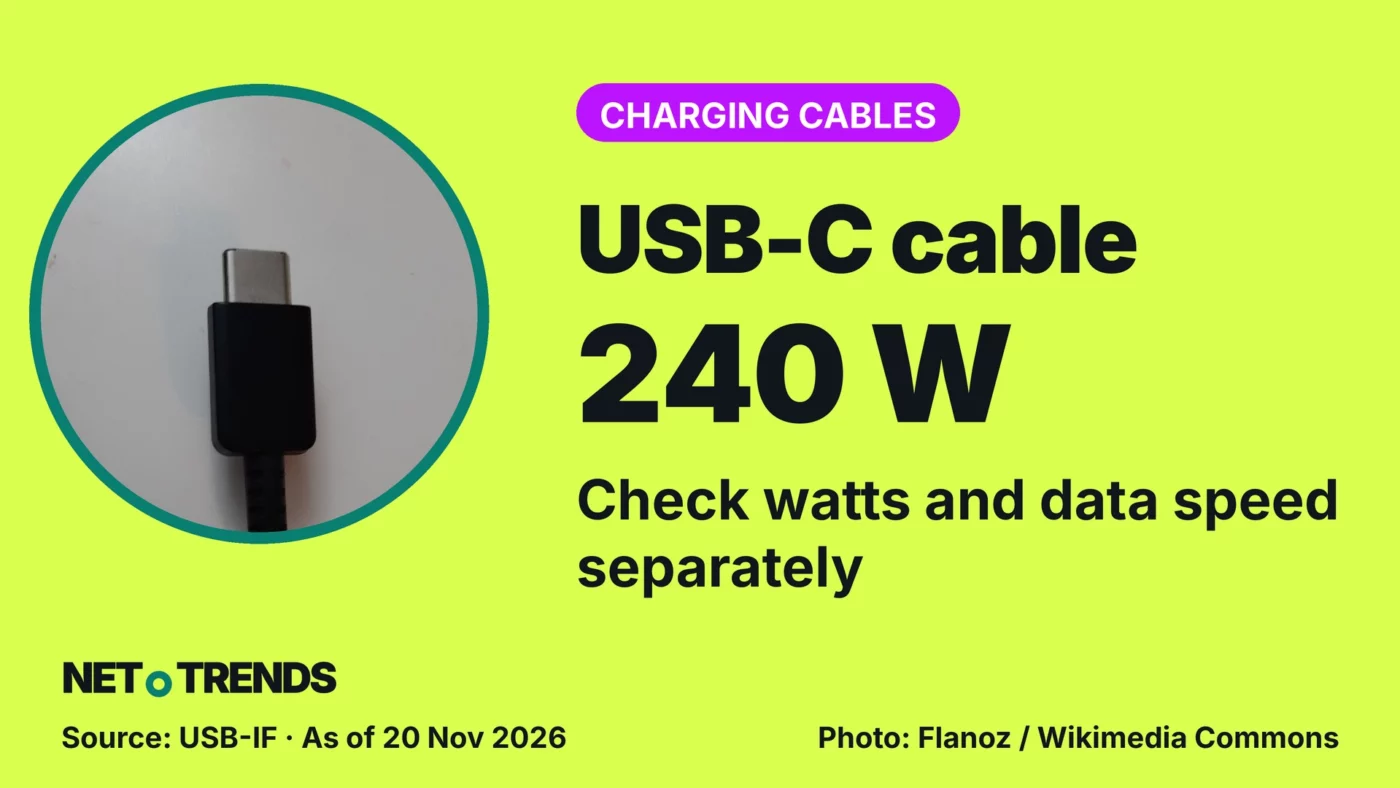
Anyone connecting a laptop or external drive should check a cable’s wattage and data speed separately – even when the plugs look identical.
USB-C cables look alike but can do very different things. A 60W or 240W marking says nothing about whether the cable also transfers data quickly.
The USB Implementers Forum (USB-IF), the body behind the standard, requires every certified USB-C to USB-C cable to carry a power marking of either 60W or 240W. The shape of the plug alone is no proof that a cable supports up to 240 watts. The rule applies to certification; it does not ban older cables from sale.
Black Friday is a popular time to stock up on cables and chargers. A discount label, however, does not answer a compatibility question.
Watts are a separate property
USB-IF’s certification logos distinguish between the 60W and 240W power classes. The figure describes what the cable can carry, not a promise that every device will charge that fast. If your main question is the charger, our guide on how many watts a USB-C charger really needs explains how device and plug interact.
The testing organisation UL Solutions describes the requirements for cables in the extended power range: they need an electronic identification chip known as an e-marker. The 240W design described there works at 48 volts and 5 amps. These are design limits, not measurements of your own laptop.
High wattage does not mean fast data
A charging cable can carry a lot of power and still move data only at USB 2.0 speed. The USB-IF cable logo guidelines put that at up to 480 megabits per second, and this data rate does not have to appear on the charging logo.
For other certified USB-C to USB-C data cables, USB-IF requires the supported data rate to be marked next to the power rating. Watts and gigabits per second answer different questions, so a high wattage alone is not enough for a fast external SSD.
No common charger rules in Great Britain
Unlike the EU, Great Britain has no legal requirement for USB-C ports or for charging labels on packaging. In its response to the common charger call for evidence, the government concluded that similar regulations are not necessary in GB and said it will keep EU developments under review. In Northern Ireland, the EU Common Charger Directive has applied since 28 December 2024. For shoppers in England, Scotland and Wales, the markings on the cable itself are therefore the most reliable guide.
Check what your device needs first, then compare the cable’s power and data rate separately. Do not rely on the plug shape if a marking is missing. A suitable cable you already own does not need replacing just because another product advertises a higher wattage.
Your view: Which cable detail was missing the last time you connected a device? Share your experience in the comments.
Sources and date
- USB-IF: Cables and Connectors (certification requirements, accessed 20.11.2026)
- USB-IF: Cable Logo Usage Guidelines (technical guideline, accessed 20.11.2026)
- UL Solutions: 240W USB-C Cable Performance Testing and Safety Considerations (technical explainer, accessed 20.11.2026)
- GOV.UK: Government response to the common charger call for evidence (government response, accessed 20.11.2026)
As of: 20.11.2026
Transparency note: AI-assisted tools were used in researching, structuring and writing this article. The sources used are listed in the article. Publication takes place only after manual editorial approval.
Share this article



Comment Tell us what you think →