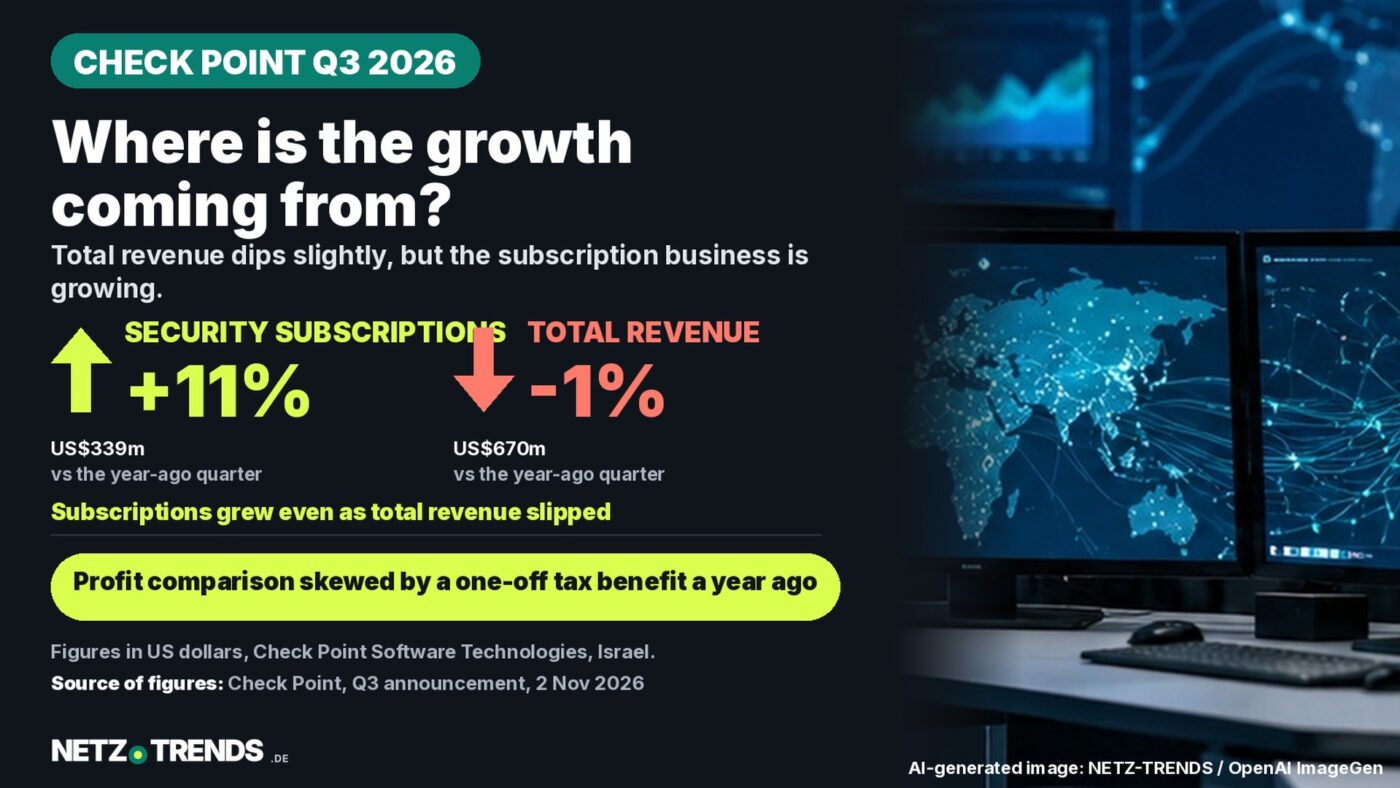
The security vendor posted $670 million in third-quarter revenue. Recurring security subscriptions grew, while the year-on-year profit comparison is distorted by a one-off tax effect.
Key points
- Check Point generated $670 million in revenue for the quarter ending 30 September 2026, down 1 percent on a year earlier.
- Security subscription revenue rose 11 percent to $339 million, the company says; remaining performance obligations stood at $2.5 billion.
- Reported earnings per share fell sharply. A one-off tax benefit of about $1.47 per share a year earlier, however, inflated that comparison.
Check Point Software posted lower revenue in the third quarter of 2026 than a year earlier, but double-digit growth in security subscriptions. Today’s figures show a mixed picture: the subscription business grew while total revenue slipped slightly and reported profit came in well below last year because of a strong prior-year comparison.
The Israeli cybersecurity vendor reports $670 million in revenue for the three months to 30 September, a 1 percent decline on the year-ago quarter. Security subscription revenue, by contrast, rose 11 percent to $339 million. Check Point published the results on 2 November 2026 in a statement with financial tables.
For businesses and IT decision-makers in the UK, the shift within the business model is the more interesting signal: recurring security subscriptions grew even though the overall revenue base did not. That says nothing, however, about product effectiveness or about demand or pricing specifically in the UK.
Subscriptions grow, revenue dips slightly
Security subscriptions brought in $338.6 million for the quarter, rounded to $339 million in the statement. That is around 50.6 percent of total revenue (338.6 divided by 669.8) — an approximation based on the published figures. The financial tables also show $105.5 million for products and licences and $225.7 million for software updates, maintenance and services.
A second metric points to future contracted revenue: Check Point reports remaining performance obligations (RPO) of $2.5 billion at quarter-end, up 5 percent on the year. The company describes RPO as the value of non-cancellable contracts for products and services not yet recognised as revenue. The figure is therefore neither revenue already earned nor a guarantee of when or how much will be booked.
GAAP operating income was $177 million; the company’s own adjusted non-GAAP measure was $251 million. The two are not interchangeable. Check Point sets out in its financial tables which items it excludes from its non-GAAP figures.
Why the profit comparison is misleading
Earnings per share (EPS) came to $1.82 on a GAAP basis and $2.49 on a non-GAAP basis in the third quarter. Against the year-ago figures of $3.28 and $3.94 respectively, that is a decline of 45 and 37 percent. Taken at face value, those percentages overlook a one-off effect in the comparison quarter.
According to Check Point, the third quarter of 2025 included a one-off tax benefit of about $1.47 per share. Stripping out that effect, using the company’s own published comparison, EPS rose by roughly 1 percent on both measures. That is the company’s own adjusted comparison, not a GAAP figure — it explains the base effect but does not change the fact that officially reported EPS was lower year-on-year.
Check Point also reported a $25 million reduction in research and development costs for the quarter, linked to a new Israeli incentive programme. That too belongs in any assessment of the results. The statement does not say how this effect will develop in future quarters.
What quarterly figures do not answer
The results do not say how many customers Check Point won or lost, which security incidents its products prevented, or how prices are developing in the UK. A rising subscription metric is a business signal, not independent proof of product quality or protective effect. Nor does the report break out revenue by country.
What UK businesses can take from the figures
The report suggests that recurring security revenue is growing faster at Check Point than group revenue overall. For buyers in the UK, that is a reason to look closely at contract term, renewal terms, included services and total cost of ownership when comparing offers. The quarterly figures themselves do not say whether a given product fits a particular organisation’s security needs; that requires independent testing, concrete requirements and contract detail.
Statements on demand and the expected course of business likewise come from the company. CEO Nadav Zafrir said subscription revenue had been supported by demand for email security, CTEM and AI security, among other things, and that Check Point expects a gradual improvement from the fourth quarter. These are management’s own assessments, not independently verified market forecasts.
The operational picture therefore remains mixed: the subscription segment and the order backlog developed positively, while total revenue came in just below the year-ago level. The profit comparison needs the extra explanation because of the one-off tax effect. For coming quarters, the key question is whether subscription growth continues and feeds through into total revenue.
Frequently asked questions
How much revenue did Check Point report for the third quarter of 2026?
The company reported $670 million in revenue for the three months to 30 September 2026, 1 percent less than in the year-ago quarter.
Which part of the business grew fastest?
Security subscription revenue rose 11 percent to $339 million, according to Check Point.
Why did earnings per share fall so sharply?
Reported GAAP EPS fell 45 percent and the non-GAAP figure 37 percent. The year-ago quarter, however, included a one-off tax benefit of about $1.47 per share. Stripping out that comparison effect, Check Point says both measures rose by roughly 1 percent.
What does the $2.5 billion RPO figure mean?
According to Check Point, it is the value of non-cancellable contractual commitments not yet recognised as revenue at the reporting date. RPO is not revenue already earned and not a guaranteed revenue forecast.
Reader question: Which metric matters most to you when assessing a cybersecurity vendor — recurring revenue, total revenue, or reported profit? Share your view in the comments.
Sources and status
- Check Point Software Technologies: Q3 2026 results and explanation of metrics, 2 November 2026.
- Check Point Software Technologies: Financial tables and GAAP/non-GAAP reconciliation, 2 November 2026 (PDF).
Research and data as of 2 November 2026. Dollar figures are US dollars. Growth and comparison figures are based on published company data; management statements are attributed accordingly.
Transparency note: AI-assisted tools were used in researching, structuring and writing this article. The sources used are listed in the article. Publication takes place only after manual editorial approval. Country edition based on an article by Net Trends, researched for the UK market.
Share this article