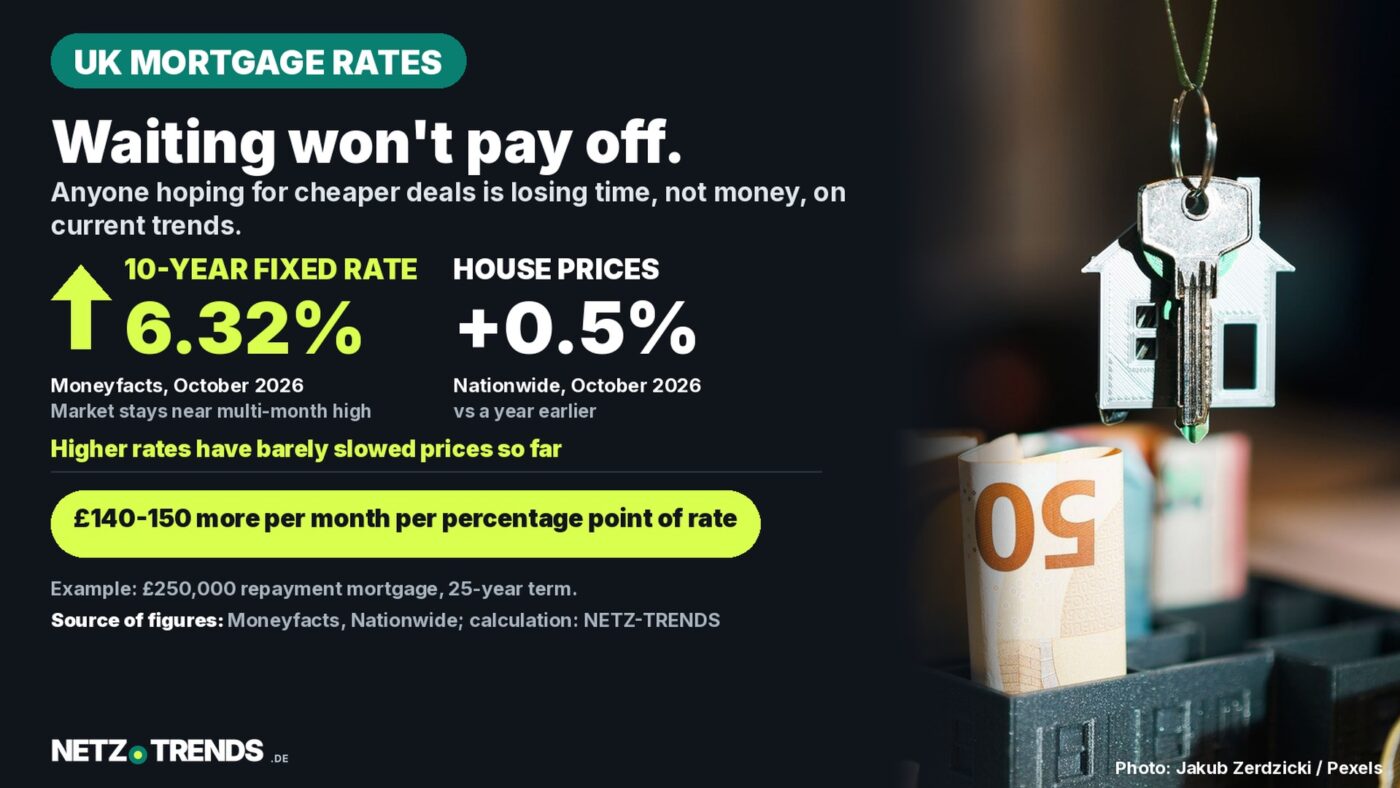
Moneyfacts puts the average 10-year fixed mortgage at 6.32 percent in October 2026, while Nationwide reports house prices still 0.5 percent higher than a year earlier
Key points
- Moneyfacts recorded an average new mortgage rate of 5.88 percent across all UK deals on 15 October 2026, with the average 10-year fixed rate at 6.32 percent and the average 2-year fixed rate at 5.96 percent.
- Nationwide’s House Price Index put annual UK house price growth at 0.5 percent in October 2026, the weakest reading since January 2024, with the average home at £273,566.
- On a £250,000 repayment mortgage over 25 years, a Net Trends model calculation shows that each extra percentage point of interest adds roughly £140 to £150 to the monthly payment, depending on the rate band.
UK mortgage rates are still high by recent standards: Moneyfacts put the average new deal at 5.88 percent in mid-October 2026. House prices, meanwhile, have barely moved.
Anyone buying a home or remortgaging in the UK right now is budgeting for monthly payments well above what they would have paid a few years ago. At the same time, official and industry data show that UK house prices have not fallen in response — they are still slightly higher than a year ago, even as borrowing costs stay elevated.
Where the 5.88 percent average comes from
According to data published by financial data provider Moneyfacts, the average rate across all new UK mortgage deals stood at 5.88 percent on 15 October 2026, unchanged from a week earlier but up from 5.68 percent a month before. Broken down by product: the average 2-year fixed rate was 5.96 percent, the average 5-year fixed rate was 5.99 percent, and the average 10-year fixed rate was 6.32 percent, up from 6.29 percent in September.
Two-year and five-year fixed-rate deals remain by far the most widely taken in the UK mortgage market, unlike in Germany where ten-year fixes are the norm — a difference worth keeping in mind when comparing rates across countries.
Nationwide Building Society’s House Price Index, released on 30 October 2026, showed prices essentially flat month-on-month after seasonal adjustment, following a 0.3 percent fall in September. The average UK home price was £273,566 on an unadjusted basis.
What one percentage point costs on a £250,000 mortgage
What a change of one percentage point means for a monthly payment can be shown with an example. This is a Net Trends model calculation, not a forecast or an offer from any lender.
Model calculation: £250,000 repayment mortgage, 25-year term
- At 5.88 percent (Moneyfacts UK average, October 2026): roughly £1,590 a month.
- At 4.88 percent (one percentage point less): roughly £1,450 a month, around £140 less.
- At 6.88 percent (one percentage point more): roughly £1,740 a month, around £150 more.
Method and limits: standard capital-and-interest repayment formula over 25 years. Excludes fees, overpayments or any rate change during the term. Real offers vary by lender, loan-to-value and credit profile — this only shows the rough scale of one percentage point.
Anyone coming off a fixed-rate deal taken out a few years ago at a much lower rate will feel this difference directly once that deal ends. Switching lender at the end of a fixed term is generally possible in the UK and can be worth comparing, even while overall rates stay high.
Why house prices are not falling
Higher borrowing costs usually cool demand because financing becomes more expensive. Even so, Nationwide’s October 2026 index put annual UK house price growth at 0.5 percent, down from 0.8 percent in September — the weakest annual reading since January 2024, but still a rise, not a fall.
Nationwide’s commentary points to continued constrained supply in many areas and steady demand from cash and lower-deposit buyers as factors cushioning prices, even as mortgage-dependent buyers face tighter budgets. The picture varies significantly by region and property type, in line with the wider pattern seen across much of Europe this year.
What to check before you commit
Practical checklist before fixing a mortgage rate
- Compare deals from several lenders and a whole-of-market broker, not just your current bank — rates vary noticeably by lender and loan-to-value band.
- Check the arrangement fee and any early repayment charges, not just the headline rate — a slightly higher rate with no fee can work out cheaper.
- Match the fixed-rate term to how much certainty you want: a longer fix protects against future rises but usually costs a premium today.
- If you are close to the end of a fixed deal, start comparing 3–6 months before it ends — many UK lenders let you lock in a new rate ahead of time.
- Ask whether overpayment is allowed without penalty, and up to what annual limit, before you sign.
None of this amounts to a blanket recommendation for or against buying now — how much borrowing makes sense depends on income, deposit and personal circumstances.
Frequently asked questions
Will UK mortgage rates come down soon?
That cannot be confirmed at this stage. Moneyfacts data shows the average rate was unchanged over the two weeks to 15 October 2026 after rising through September; longer-term forecasts from lenders and brokers vary.
Why are house prices still rising if mortgages are so expensive?
According to Nationwide, prices rose only slightly nationally and the picture differs by region; the building society does not point to a single official explanation for the pattern.
What does one percentage point of interest mean in practice?
On a £250,000 repayment mortgage over 25 years, the Net Trends model calculation in this article shows a difference of roughly £140 to £150 a month per percentage point.
Do I have to remortgage with my current lender?
No. Switching lender when a fixed deal ends is generally possible in the UK, and comparing several offers can be worthwhile, particularly while rates remain elevated.
How are you handling higher mortgage rates: waiting for them to fall, or pressing ahead anyway? Share your experience in the comments.
Sources and status
- Moneyfacts, cited via The Intermediary: “Average mortgage rate holds at 5.88%”, 16 October 2026
- Nationwide Building Society House Price Index, cited via WRE News: October 2026 release, 30 October 2026
Research and data as of: 1 November 2026.
Transparency note: AI-assisted tools were used in researching, structuring and writing this article. The sources used are listed in the article. Publication takes place only after manual editorial approval. Country-specific version based on an article from Net Trends, researched for the United Kingdom.
Share this article