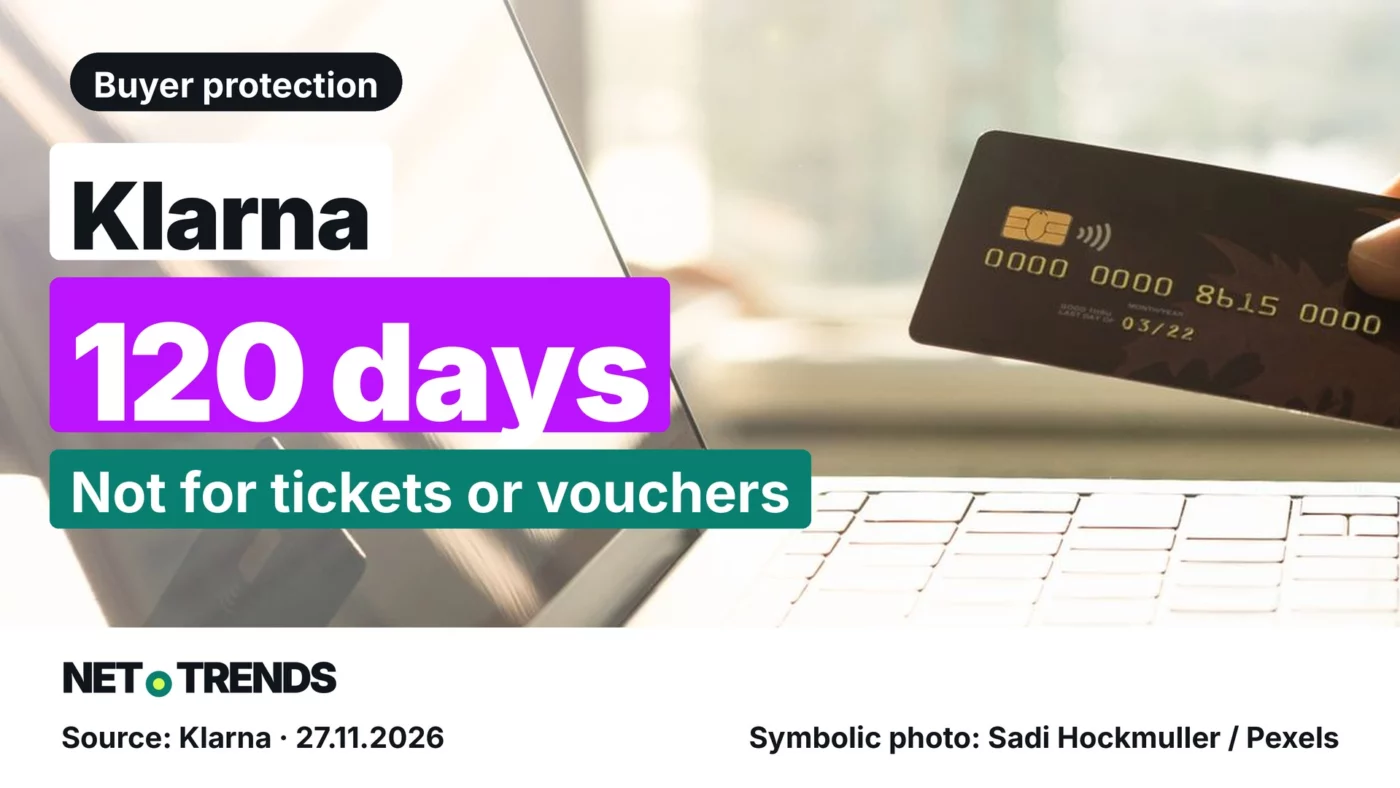
Klarna can refund goods that never arrive, but the 120-day window, a first complaint to the shop and a long exclusion list decide whether it helps.
Key points
- For “goods not received” and “significant deviation” Klarna gives 120 days; its page counts from purchase in one place and from the invoice date in another.
- You must contact the shop first and be able to prove it if asked.
- Concert and plane tickets, accommodation, vouchers and gift cards are excluded.
- For comparison, PayPal allows 180 days from payment; since 15 July 2026, Section 75 can also apply to new buy now, pay later agreements of £100 to £30,000, according to Which?.
If you pay with Klarna on Black Friday, 27 November, and your order never arrives or is not as described, you can ask for protection within 120 days. You must first have tried to sort it out with the shop.
Klarna says on its buyer protection page that the policy applies to eligible purchases made after 11 May 2023. The company said in May 2025 that it had passed 11 million UK customers, so many shoppers will meet these terms this weekend.
The policy is not a right to return goods and does not replace your legal rights against the retailer. The sections below set out what it covers, where it stops and how it compares with other ways of paying.
120 days: how long you have
Klarna names two cases: goods not received and a significant deviation from the description. For both it allows claims within 120 days. The page says “from purchase” in one place and counts from the invoice date in another, so the start of the window is not clear. Count from the earlier date and report a problem well before the deadline.
After you report a problem, Klarna pauses your payment until the issue is resolved. If you already paid and win, the money goes back to the original payment method. Klarna decides at its own discretion whether you are eligible. It does not state how long a review takes.
Contact the shop first
Klarna requires that you contacted the store first to resolve the issue directly, and that you can prove this if asked. Keep your order confirmation, dispatch emails, tracking numbers and every message to the shop. You may not raise more than two claims for the same order.
If you send an item back, the protection is not a returns right. If you report a return with valid tracking, Klarna pauses your payment for 21 days so the shop can process it.
Excluded: tickets, vouchers and more
Anyone booking travel or events this weekend should read the exclusions before paying. Klarna lists, among others:
- services and events, for example concert and plane tickets, accommodation and beauty treatments;
- cash equivalents such as gift cards, vouchers and donations, and financial products;
- property, utility bills and rent, and purchases from private individuals;
- in-store transactions and payments not made through your Klarna account;
- gambling, gaming and cryptocurrency payments;
- cases you have already raised with your card issuer, and cases where you agreed store credit or a replacement with the shop.
A defect that the shop described correctly is not covered either.
Klarna, PayPal and credit card compared
The routes differ in time limit and in what you must do first. The table compares Klarna with PayPal and a credit card.
Three ways to pay: how long can you claim?
| How you paid | Time limit | First step |
|---|---|---|
| Klarna buyer protection | 120 days, from purchase or invoice date | Contact the shop, then report in Klarna |
| PayPal Buyer Protection Longest window | 180 days from payment for item not received | Open a dispute, then escalate within 20 days |
| Credit card, Section 75 | Check with your card provider | Contact your card provider; single item over £100 and up to £30,000 |
On PayPal, the buyer protection page says a dispute must be opened within 180 days of the payment, then escalated to a claim within 20 days. PayPal reimburses the full price and original postage, according to its help page. Friends and family payments are excluded.
For credit cards, Section 75 of the Consumer Credit Act 1974 makes the card provider jointly liable with the supplier for a single item costing more than £100 and up to £30,000. If you pay by card through Klarna, you must choose a route: Klarna says it cancels its own dispute if you also dispute the charge with your card issuer and a chargeback or other reversal happens.
What you can do now
Check before paying whether your order falls under the exclusions. Keep your evidence from the first day and tell the shop about a problem in writing. Do not agree a voucher or replacement with the shop before you know whether you still need Klarna’s protection, because such an agreement is excluded.
New rules also apply since 15 July 2026. The government said that buy now, pay later products are now regulated by the Financial Conduct Authority and that providers must run affordability checks. Which? reports that you can take a complaint to the Financial Ombudsman Service and that Section 75 can apply to eligible purchases of £100 to £30,000. The rules only apply to agreements taken out from 15 July 2026.
Frequently asked questions
Do I have to keep paying if I report a problem?
Klarna says it pauses your payment until the issue is resolved.
Does Klarna protection replace my right to return goods?
No. It is not a returns right. If you report a return with valid tracking, Klarna pauses your payment for 21 days.
Does it cover concert tickets or flights?
No. Klarna lists concert and plane tickets, accommodation and beauty treatments among the exclusions.
Can I use Klarna and my card issuer at the same time?
For card purchases you can file with Klarna or dispute with your card issuer. If you do both and a chargeback happens, Klarna cancels your dispute.
Your view: Have you ever made a buyer protection claim with Klarna or another provider? Share your experience in the comments.
Sources and date
- Klarna: Buyer protection (company policy page, accessed 27 November 2026)
- Klarna: Klarna hits 11 million UK customers (company release, 2 May 2025)
- PayPal: Buyer Protection (company page, accessed 27 November 2026)
- legislation.gov.uk: Consumer Credit Act 1974, section 75 (statute)
- HM Treasury: Buy now, pay later rules come into force (government press release, 15 July 2026)
- Which?: 7 things you need to know about new buy now pay later rules (consumer guide, 2026)
As of: 27 November 2026
Transparency note: AI-assisted tools were used in researching, structuring and writing this article. The sources used are listed in the article. Publication takes place only after manual editorial approval.
Share this article
Read next
Your curiosity
Our next story
Bring your ideas for AI and digital media
Discover open positions Research
 ▶ Reel