Berlin, Germany / Vienna, Austria, 21 April 2024 – Combating rip-deal crime is of great importance, particularly in countries where this type of fraud is widespread. In this context, it is essential to obtain well-founded estimates of the scale of the damage caused by rip-deal fraud. Between May 2020 and November 2022, the Rip-Deal-Unit Vienna in Austria handled a total of 443 rip-deal cases. Of these, however, only 85 cases were solved and resulted in court convictions, corresponding to a clearance rate of 19.2%. This period provided valuable insights into the dynamics of these criminal activities and the considerable financial damage they can cause.
In Germany, a country with a much larger population and comparable, if not even poorer, clearance rates for crime, projecting the damage caused by rip deals is of particular interest. Despite the larger population and the potential scale of these criminal activities in Germany, no detailed projections exist at federal or state level.
That is why NETZ-TRENDS.de produced well-founded projections for its up to 450,000 readers per year, so that at least approximate figures are available for the public debate on rip deals. The NETZ-TRENDS calculations draw on the transparently published data of the Rip-Deal-Unit Vienna. These data, covering a two-and-a-half-year period from May 2020 to November 2022, make it possible to treat the situation in Austria as a model case and transfer it to Germany. The comparatively higher clearance rate in Austria provides an important reference point for estimating the potential cases and financial damage in Germany.
The figures from Austria show that the damage and the seized counterfeit money relate exclusively to those cases that were solved by the Rip-Deal-Unit Vienna and brought to court, which accounts for about 19.2% of all cases handled by the special unit of the Vienna criminal police (Kriminalpolizei). This underlines the urgency of carrying out well-founded projections for Germany in order to understand the scope of this criminal phenomenon and respond appropriately.
Austria and Germany share many socio-economic and cultural characteristics as well as similar legal and policing structures. These similarities make it easier to apply the data collected in Austria to Germany, as similar conditions and behaviour among criminals and victims can be assumed.
Using these data supports a scientifically rigorous approach to the problem of rip deals by providing a sound basis for forecasts and prevention strategies.
The perpetrators of the rip-deal mafia are frequently members of the Roma community. These individuals are often multilingual, agile and extremely adaptable and can therefore operate across national borders with ease. A typical rip deal involves various actors, including people who establish and maintain contact as well as those who carry out the crime and manage the stolen money or goods. These perpetrators skilfully exploit their linguistic versatility and the possibility of disappearing into Roma communities in Lombardy (Italy), Serbia, Croatia and Romania to hamper prosecution – and, unfortunately, in a good 80 per cent of cases to escape it completely.
Rip deals are preferably carried out near national borders, airports, motorway exits and international rail connections. These locations give the perpetrators the opportunity to escape quickly if their criminal schemes are discovered. The large sums of money involved in a rip deal – often several hundred thousand or even millions of euros – heighten the urgency of avoiding arrest.
Projection of rip deals in Austria as a basis for rip-deal gangs in Germany
In Austria, a country with around 9 million inhabitants, the Rip-Deal-Unit Vienna handled a total of 443 rip-deal cases within the evaluation period from May 2020 to November 2022 announced in a press release. However, only 85 cases were solved and resulted in court convictions, giving a clearance rate of 19.2% of all cases – a rather good figure compared with the dismal clearance rates in Germany, especially as investigations have to be conducted across borders and Italy and other countries have not always taken part in solving crimes.
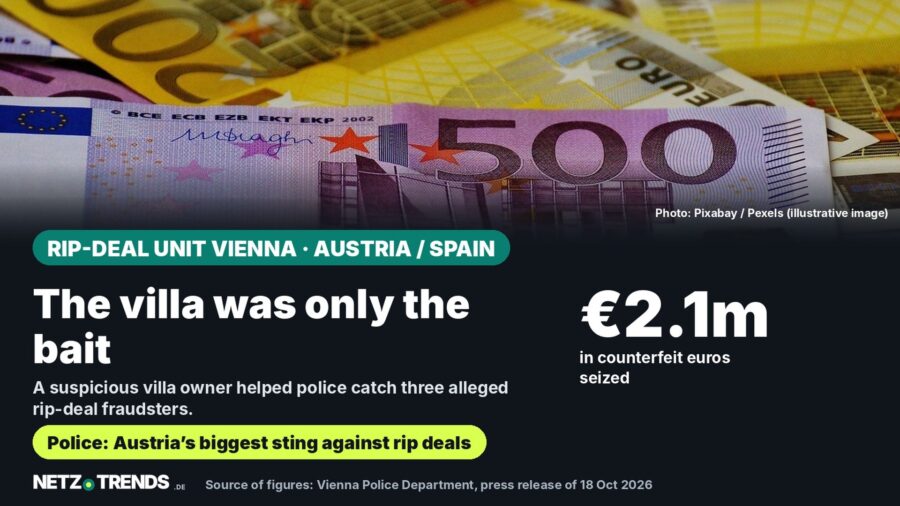
In the 19.2 per cent of rip-deal cases handled by the Rip Deal Unit Vienna that led to convictions in the two and a half years examined, considerable damage of more than 10 million euros was recorded; in addition, counterfeit money worth 3.2 million euros was uncovered during this period in the 19.2 per cent of cases that were solved and led to convictions.
With a population of around 83 million in Germany, a projection factor is applied that is based on the population ratio of Germany to Austria. This factor makes it possible to estimate the potential cases and financial damage for Germany. This is how NETZ-TRENDS.de calculates it:
Projection factor = population of Germany / population of Austria = 83 million / 9 million
Using this factor (9.22), the cases registered in Austria can be transferred to Germany. The projected number of cases is obtained by multiplying the number of cases in Austria by the projection factor. Likewise, the projected damage is calculated by multiplying the damage determined in Austria by the projection factor. The same method is used to project the counterfeit money registered in Austria and determine the estimated amount for Germany.
Rip deals have existed in Europe for 40 years – which is why this figure is included in the projection
Rip deals have existed mainly in Europe, but partly also in Canada, for around 40 years, writes Austria’s Federal Ministry of the Interior (Bundesministerium für Inneres) in Austria. NETZ-TRENDS.de therefore also uses this figure as a basis for projections, at least for Germany:
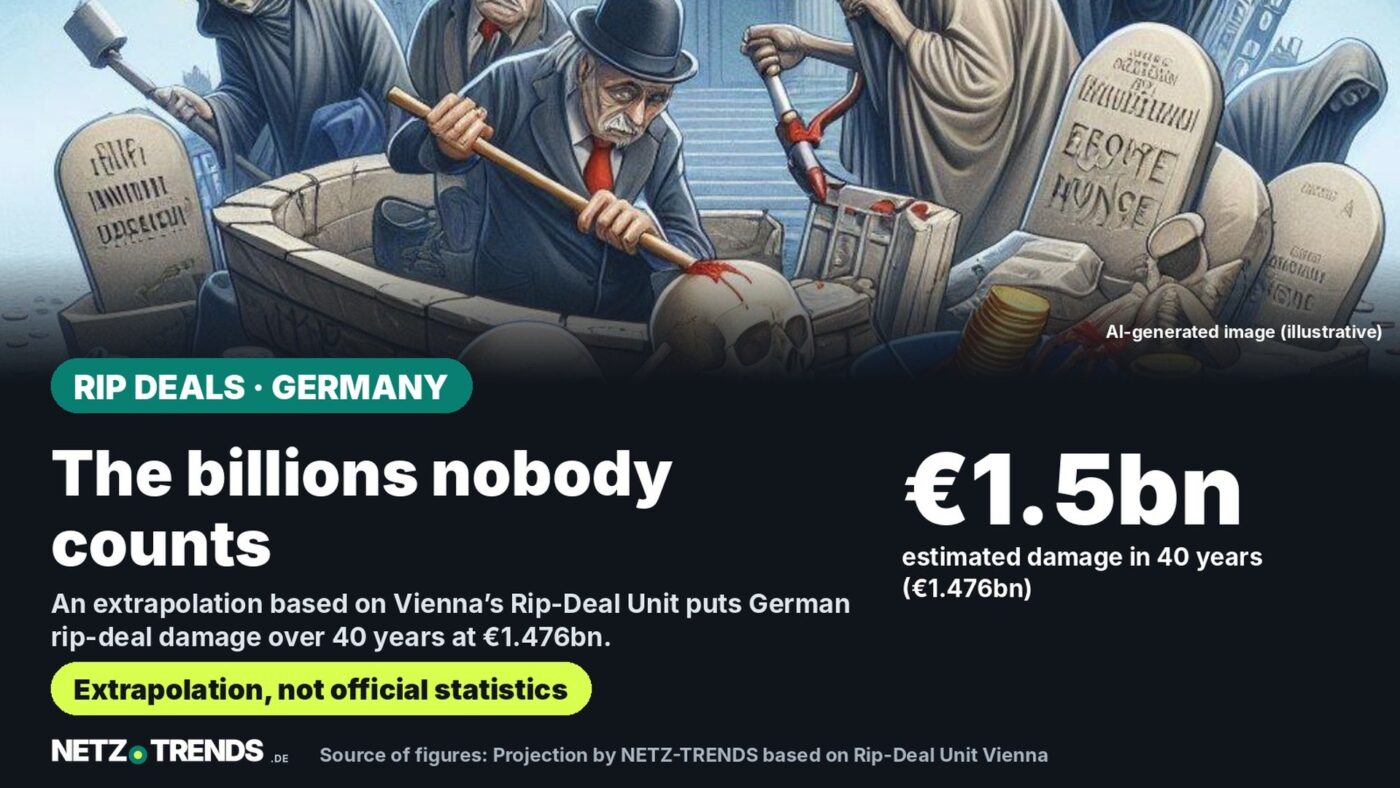
Over a period of 40 years, Germany could potentially have experienced around 65,250 rip-deal fraud and theft cases, based on the figures published by the Rip-Deal-Unit Vienna in Austria. Taking into account the 19.2 per cent of cases that actually led to a conviction, the estimated damage amounts to around 1.476 billion euros. In addition, the counterfeit money seized in these convicted cases, specifically facsimile play money, is estimated at around 472 million euros. But in each case these figures cover only the 19.2 per cent of cases that led to court convictions.
Total number of solved rip-deal cases in Germany, assuming the Austrian projection
The total number of solved cases for Germany, based on the published solved cases of the Rip-Deal-Unit Vienna, gives the following picture: in Austria, 85 rip-deal fraud and theft cases resulting in court convictions were recorded in two and a half years from May 2020 to November 2022 (the clearance rate of 19.2% of all cases mentioned above). The projection for Germany for the same period comes to around 783 rip-deal fraud and theft cases solved in court (19.2% of all cases). For a period of 10 years, there would be roughly 3,132 such cases (19.2% of all cases), and for 40 years around 12,528 solved rip-deal cases (19.2% of all cases), set against a dramatic total of around 65,000 cases.
Over 40 years: around 2.46 billion euros in counterfeit money in Germany through rip deals
The amount of counterfeit money seized in the solved cases also sheds light on the total volume of counterfeit money generated by rip deals in Germany: in Austria, 3.2 million euros in counterfeit money were seized in 85 rip-deal fraud and theft cases that led to court convictions, which corresponds to about 19.2% of all cases. Projected onto Germany, the counterfeit money in the assumed 19.2 per cent of rip-deal fraud and theft cases resulting in court convictions amounts to around 154 million euros. Over a period of 10 years, this would correspond to around 615 million euros, and over 40 years to around 2.46 billion euros in counterfeit money.
Estimated number of rip-deal perpetrators in Germany: 5,760 identified individuals in 40 years / total number of perpetrators around 30,000
The number of perpetrators identified in the solved cases allows an estimate of the total number of criminals involved in rip deals in Germany. Conclusions can be drawn from the data from Austria, where the Rip Deal Unit Vienna identified and arrested a total of 39 suspects over a period of two and a half years between May 2020 and November 2022. Of these suspects, 27 were of Serbian-Croatian descent, most of them members of the Roma community, and nine were of Austrian origin. The investigations of this specialised unit led to nine convictions, resulting in a total of 29.5 years of unconditional prison sentences.
Taking these data into account, the projection for the assumed 19.2 per cent of rip-deal perpetrators convicted in court in Germany is as follows: in two and a half years, around 360 convicted rip-deal perpetrators were identified. Over a period of 10 years this would be around 1,440, and over 40 years around 5,760 perpetrators.
To estimate the total number of rip-deal perpetrators representing the assumed 100 per cent, we use the available data: in two and a half years, 360 perpetrators were convicted, which corresponds to 19.2 per cent of the estimated total. To determine the actual number, we scale this figure up to 100 per cent. We apply the same calculation to the data for 10 years and 40 years, with 1,440 perpetrators convicted in 10 years and 5,760 in 40 years. These figures also each reflect 19.2 per cent of the estimated total, so a simple conversion gives the estimated totals for these periods.
Over a period of two and a half years, the 360 convicted rip-deal perpetrators represent a share of 19.2 per cent. Scaled up to 100 per cent, this gives an estimated total of 1,875 perpetrators. For a period of 10 years, the 1,440 convicted individuals result in an estimated total of 7,500 perpetrators. Over 40 years, this would accordingly amount to 30,000 perpetrators.
65,248 rip-deal fraud and theft cases in Germany in 40 years: projection based on data from the Rip-Deal-Unit Vienna
The 443 rip-deal cases handled by the Rip-Deal-Unit Vienna within a two-and-a-half-year period form a meaningful data set. These data offer valuable insight into the scale of rip-deal crime in Europe and the European Union (EU) and can serve well as a basis for estimates and projections in other countries such as Germany. In the case of NETZ-TRENDS.de, the situation in Germany was examined, using the population as the basis for the projection.
The number of projected and probable rip-deal fraud and theft cases in Germany adds up to an alarming 65,248 rip-deal cases in 40 years, carried out by around 30,000 perpetrators, many from the Middle East with links to Roma communities, as countless police stations confirmed to us. Italy, Serbia, Croatia and Romania are frequently the hubs. The damage runs into billions. Only around 19 per cent of the cases and perpetrators are solved or identified.
Why this extensive background on rip deals? Two prominent examples that remain unsolved to this day
NETZ-TRENDS.de has looked closely at the rip-deal scene in Germany and Austria and produced projections based on Austrian experience. Why did we do this? This investigation comes ahead of the eighth anniversary of the death of Thomas Wagner on 14 July 2024. Wagner, the founder of the Leipzig-based travel holding company UNISTER (Leipzig, Saxony, Germany), a company that at its peak had 2,100 employees, was an outstanding figure in the European internet scene, a start-up star and the most prominent victim of a rip deal in Europe, whose case remains unsolved to this day.
On 14 July 2016, Thomas Wagner and Levy Vass met in Venice, Italy. Vass is a well-known rip-deal gangster, presumably from Croatia or Lombardy, in particular from Milan. These regions are known centres of the highly organised European rip-deal scene. Wagner wanted short-term bridge financing of 15 million euros for a planned stock market listing of his successful internet travel brands. He had therefore entered into a loan agreement with Vass, which had been reviewed and accepted by Wagner’s Frankfurt-based management consultancy. The agreement promised him the loan at a high interest rate of 25 per cent. As Wagner needed the money for only a few months, he reluctantly agreed.
For the loan, Vass demanded a security deposit of 1.5 million euros. The money was supposedly to be deposited in cash with a notary in Venice as loan security with Lloyds Bank London. Wagner brought the sum in a backpack to the meeting at a hotel in Venice. From there, as originally agreed, they would travel together to the notary. Wagner, then only 38 years old, kept to the agreement and handed the money to Vass. But instead of turning up at the notary’s office, Vass disappeared in his Jaguar, never to be seen again. Before that, in order to lull the German internet star into a sense of security, Vass had probably shown Wagner one of his numerous forged passports, presumably an Italian or Israeli one.
Instead of the bridge loan promised by Levy Vass for the planned billion-euro stock market listing of the companies AB-IN-DEN-URLAUB.de and FLUEGE.de in autumn 2016 – an ambitious project driven forward for months by numerous management consultants and employees of the holding company UNISTER – Thomas Wagner and UNISTER co-shareholder Oliver Schilling, whose twin brother is still alive, tragically received counterfeit Swiss franc banknotes in a briefcase. Only a few hours later, a fateful accident occurred when the small private aircraft Piper32, in which Wagner wanted to return from Venice to Leipzig, crashed at an altitude of 1,000 metres a few minutes’ flight north of Ljubljana, the capital of Slovenia. He had his last conversation before the flight with Ralph Michaelsen, who today is once again part of the management of UNISTER’s successor INVIA. Despite the fraud he had reported to the police in Venice, Wagner was still busy with business matters and wanted to settle a corporate insurance policy with GENERALI that was to take effect in the event of travel cancellations. This showed once again Wagner’s tireless commitment and optimism.
Besides Wagner, the crash also killed Unister co-founder and school friend Oliver Schilling, a 73-year-old experienced pilot and a 64-year-old “loan broker” who, together with a Leipzig property developer, had been part of the chain from initiating the corporate loan through to Vass. The Leipzig property developer says he never knew that it was a fraud, that he merely established contacts and feels deceived himself, which observers consider quite possible. It is suspected that Wagner’s opponents deliberately set a rip-deal trap for him in Venice, a fate that can often befall successful entrepreneurs.
Years later, the Slovenian air accident investigation authorities announced their finding that the aircraft, which had no de-icing system, had iced up and therefore crashed – in summer. However, some observers consider a murder plot a more likely explanation of the tragic event, possibly originating from circles in Leipzig. At the crash site in Slovenia, Wagner’s friends have hung a heart for him – on a tree.
In 2018, the German public broadcaster ARD (Arbeitsgemeinschaft der öffentlich-rechtlichen Rundfunkanstalten der Bundesrepublik Deutschland) produced a detailed television documentary about this incident entitled „Wie Deutschlands erfolgreichstes Start-up unterging“ (How Germany’s most successful start-up went under). Business Insider took up the topic again and on 16 September 2022 published the podcast „Betrug, ein Flugzeugabsturz und ein Rip-Deal: Neue Folge ‚Macht & Millionen‘ über Aufstieg und Fall von Unister“ (Fraud, a plane crash and a rip deal: new episode of “Macht & Millionen” on the rise and fall of Unister).
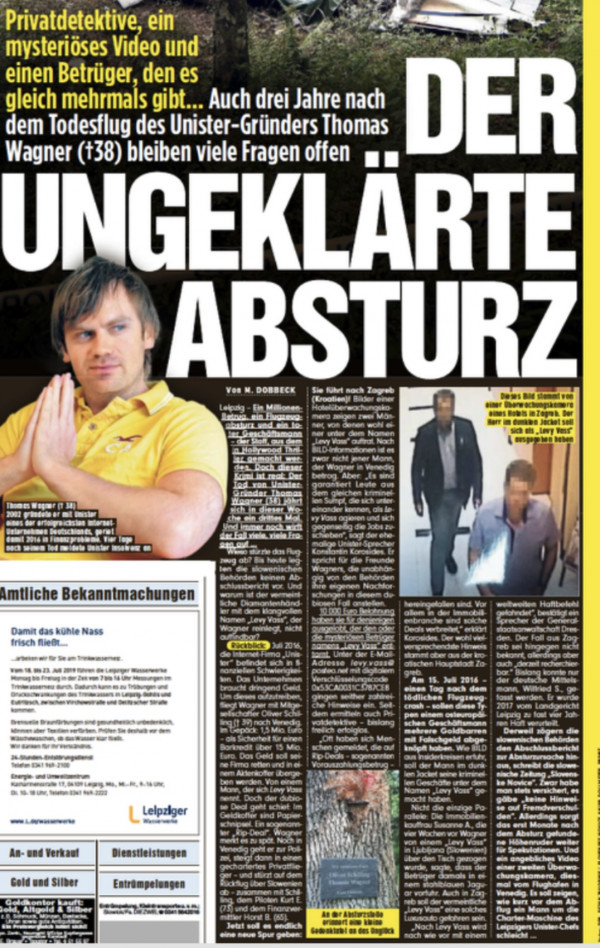
Two weeks before the tragic incident involving Thomas Wagner, other business people from Germany fell victim to a fraud by the same Levy Vass in Slovenia. Those affected included an architect and three Greeks who were defrauded at the Ahotel Ljubljana. The hotel’s location at a motorway exit leading directly to Croatia offered ideal conditions for such rip deals: the quick escape route to Croatia, a well-known refuge for rip-deal gangsters, makes it easy for perpetrators to evade prosecution.
The business people were relieved of hundreds of thousands of euros. Despite numerous witness statements and available evidence – including an offer by the architect to have a facial composite of Levy Vass made, as she has a good memory for faces, and recorded telephone conversations between her and Vass – the competent Public Prosecutor General’s Office (Generalstaatsanwaltschaft) in Dresden, Saxony, under the then public prosecutor Dr. Dirk Reuter did not, in the view of many, respond appropriately. This evidence was not published and no wanted picture was created, which baffled many and did not make the public search any easier.
The Saxony Public Prosecutor General’s Office (Generalstaatsanwaltschaft Sachsen) in Dresden and its special unit, the Integrated Investigation Unit Saxony (Integrierte Ermittlungseinheit Sachsen, INES), investigated the case. However, the frequent change of the public prosecutors in charge was certainly not helpful, and so they did not succeed in catching the rip-deal gang around Levy Vass. This illustrates how rip deals are handled in Germany and highlights the challenges of cross-border organised crime. The case is a striking example of the difficulties investigators face with this type of crime, but also of the difficulties victims face in obtaining justice under the rule of law, which often fails.
These examples illustrate the urgent need for political measures that do not just exist on paper but are actually implemented. It is essential that the police are better equipped and that supranational working groups are actively promoted and supported. Transparency is also crucial: only when problems are openly addressed can they be tackled effectively.
Note: All figures for Germany in this article are projections (estimates) by NETZ-TRENDS.de based on published data from the Rip-Deal-Unit Vienna, not official statistics. This English version was translated from the German original with the help of artificial intelligence (AI).