Spain’s police seized around €7.1 million in counterfeit money in 2023 – how the scam works and how to protect yourself
Key points
- Spain’s National Police arrested eight suspects in summer 2023. According to the police, they belong to a travelling gang of Italian-Croatian origin.
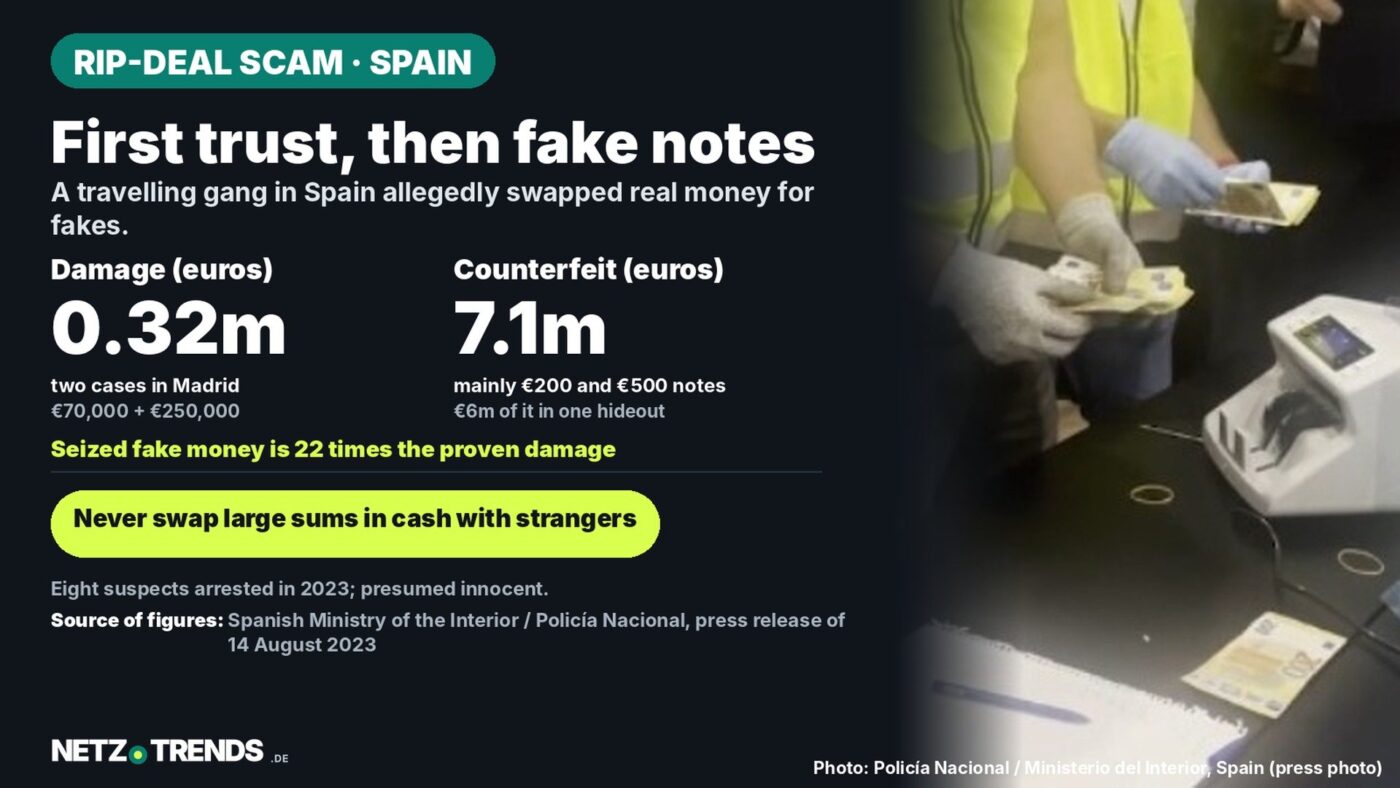
- Two losses in Madrid totalling €320,000 are documented. Around €7.1 million in counterfeit money was seized.
- The scam is called a rip deal: the perpetrators first build trust, then swap real money for fakes at the handover.
An Italian-Croatian gang allegedly used the rip-deal scam in Madrid in 2023 to cheat two victims out of a total of €320,000; around €7.1 million in counterfeit money was seized. According to a statement by the Spanish Ministry of the Interior of 14 August 2023, Spain’s National Police (Policía Nacional) broke up a travelling gang said to have used this method in Madrid and Valencia.
The case dates back three years. It is still instructive for readers across Europe: it shows step by step how rip-deal fraudsters operate. Similar cases are also known to German investigators. The Croatian daily Novi list also reported on the case in August 2023.
Eight arrests, three brothers at the top
According to the police, seven suspects were caught red-handed in Valencia. An eighth person was arrested at the end of July 2023 in the Catalan resort of Lloret de Mar (province of Girona). The group was allegedly led by three brothers who, according to the police, have already come to police attention many times in Spain and other European countries. The police describe the group as a travelling gang “of Italian-Croatian origin”. No names were published. All suspects are presumed innocent.
According to the statement, the following was seized:
- counterfeit money with a face value of €7,121,400, of which around €6 million in €200 and €500 notes was found in a storage unit in Madrid
- €23,645 in genuine cash
- three money-counting machines and several mobile phones
On 14 August 2023, Spain’s National Police also published a post with footage of the operation on the platform X:
🚩Desarticulado un grupo criminal itinerante en #Madrid, #Valencia y #LloretdeMar, especializado en estafas “Rip Deal”
🚔8 detenidos
👉Intervenidos 7.121.400💶 en billetes con la inscripción “FACSIMIL” y 23.645💶 de curso legal🔹Llegaron a adquirir con este método licencias… pic.twitter.com/IeojMqMUH7
— Policía Nacional (@policia) August 14, 2023
Three cases, one pattern
The police attribute three incidents to the group. The €320,000 is the documented loss from two cases. The €7.1 million, by contrast, is seized counterfeit money, not loot.
| Location | Pretext | Loss |
|---|---|---|
| Madrid | Purchase of licences for chauffeur-driven ride services (VTC licences) | €70,000 |
| Madrid | Investment in a property | €250,000 |
| Valencia | Planned purchase of a crypto wallet worth 800,000 US dollars; the arrest took place at the handover | – |
How a rip deal works
The term comes from the English “to rip off”, meaning to cheat someone. The Spanish police describe three phases:
- Contact: The perpetrators specifically target people who want to sell a property or other valuables. They pose as wealthy buyers, sometimes with a false profession and a false identity.
- Trust: Over several meetings and phone calls they check how much money the victim has and build trust.
- Handover: At the agreed location they first show genuine notes. Then the money is swapped unnoticed, or the fakes are hidden between genuine notes. In return, the victim hands over cash, cryptocurrency or the goods.
A popular variant is the supposed currency exchange: the buyer asks to swap large notes for smaller ones, for example so that the amount can be paid into a bank. The victim hands over real money and receives fake €200 or €500 notes.
Also known in Germany
The Saxony State Criminal Police Office (Landeskriminalamt, LKA) warned about rip deals as early as 2013 in a media release. In those cases, the perpetrators lured victims with exchange deals worth several hundred thousand euros and a profit margin of around 20 per cent. The victims were asked to travel to other European countries, where they were relieved of the cash they had brought.
How to spot the scam
The accounts of both authorities point to clear warning signs:
- A stranger explicitly wants to settle a large deal in cash, even though a bank transfer would be possible.
- Money is to be “exchanged” or “broken down” before the purchase, especially into €200 or €500 notes.
- An unusually high return or a particularly cheap loan is promised.
- The handover is to take place at an unfamiliar location, such as a rented flat or abroad.
- The other party pushes for speed and leaves no time to check the money calmly.
Practical tip: checking banknotes
Germany’s central bank, the Deutsche Bundesbank, recommends the three-step check “Feel – Look – Tilt”:
- Feel: Genuine banknote paper feels crisp and firm, and parts of the print are raised to the touch.
- Look: Held against the light, the watermark appears; from the €20 note upwards, a transparent window in the hologram stripe shows a portrait of the mythological figure Europa.
- Tilt: The hologram shimmers in rainbow colours, and the emerald number (the shiny value numeral at the bottom left) changes colour.
According to the Bundesbank, counterfeit money is not reimbursed. Anyone with a suspicion can contact their bank or a branch of the central bank. Obvious counterfeits should be handed to the police.
The most effective protection remains simple: large sums go through a bank account, not a bag full of notes. Anyone selling a car, a watch or a flat who wants to accept cash should arrange the handover at a bank branch, where the money can be checked and paid in on the spot.
What remains open
In 2023, the police announced further investigations and did not rule out further arrests. By 12 October 2026, NETZ-TRENDS had found no follow-up statement on the outcome of the proceedings. Whether charges were brought or verdicts handed down is therefore not publicly documented.
Have you ever received a suspicious cash offer, for example when selling a car? Feel free to share your view in the comments.
Sources
- Spanish Ministry of the Interior / Policía Nacional: “La Policía Nacional desarticula un grupo criminal itinerante especializado en estafas Rip Deal”, press release of 14 August 2023
- Saxony State Criminal Police Office: “RIP-Deals und der Traum vom schnellen Geld”, media release of 31 July 2013
- Novi list (Rijeka, Croatia): report of 15 August 2023
- Policía Nacional (Spain): post on X of 14 August 2023
- Deutsche Bundesbank: press note on counterfeit statistics with the checking tips “Feel – Look – Tilt”
Transparency note: AI-assisted tools were used in researching, structuring and producing this article, including the translation from the German original. The sources used are listed in the article. Publication takes place only after manual editorial approval.