Gerald Goldnagl, Valentin Szaga-Doktor and Mario Kaintz [Source] show how it is done. The man who calls himself “Levy Vass” swindled internet entrepreneur star Thomas Wagner in Venice in a multi-million fraud – 1.5 million euros in cash. Wagner died on the return flight. Why the fraudster must finally be arrested in Croatia or wherever he may be.
Key points at a glance
- The Rip Deal Unit Vienna of the State Criminal Police Office of Vienna (Landeskriminalamt Wien) in Austria specialises in rip deal fraud.
- In May 2026 it set a trap for fraudsters using 25 real gold bars – leading to an arrest in a Viennese beer garden.
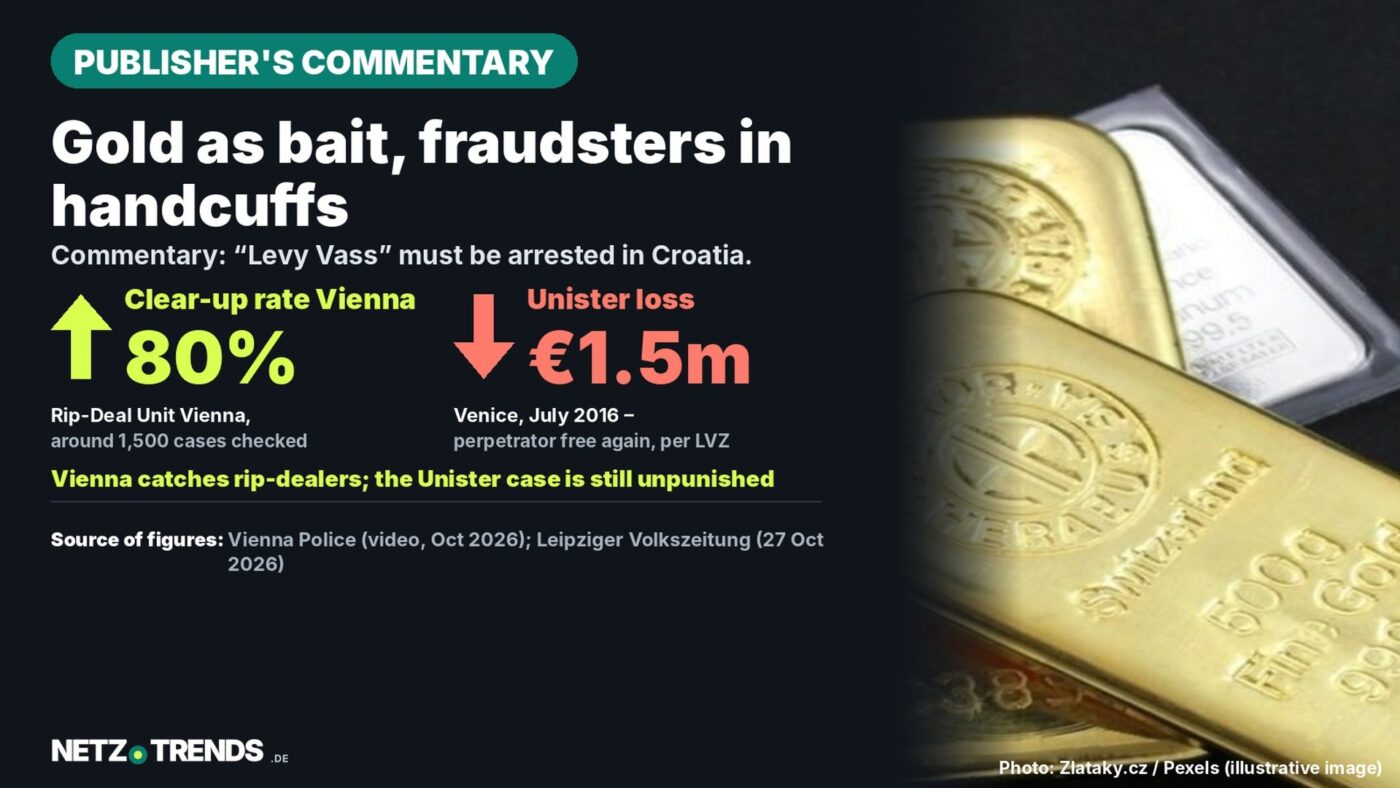
- The man who cheated UNISTER founder Thomas Wagner out of 1.5 million euros in Venice in 2016 was released again in Croatia, according to the Leipziger Volkszeitung.
- By its own admission, the Dresden Public Prosecutor General’s Office (Generalstaatsanwaltschaft Dresden) in Saxony, Germany, kept silent for six years about the man’s arrest in 2020.
- We, the bereaved and close friends of Thomas Wagner, call on the Croatian authorities to clarify the case and on the European Public Prosecutor’s Office (EPPO) to examine it.
Gerald Goldnagl, a criminal investigator through and through, heads the Rip Deal Unit Vienna, quite evidently Europe’s best rip deal investigation unit (reference: YouTube video by the Austrian police). District Inspector Valentin Szaga-Doktor and Mario Kaintz are also among its top investigators. Nobody easily fools these three Viennese detectives. Together, they recently set a trap once again for a highly criminal gang of fraudsters and robbers: with real gold and with a victim who played along.
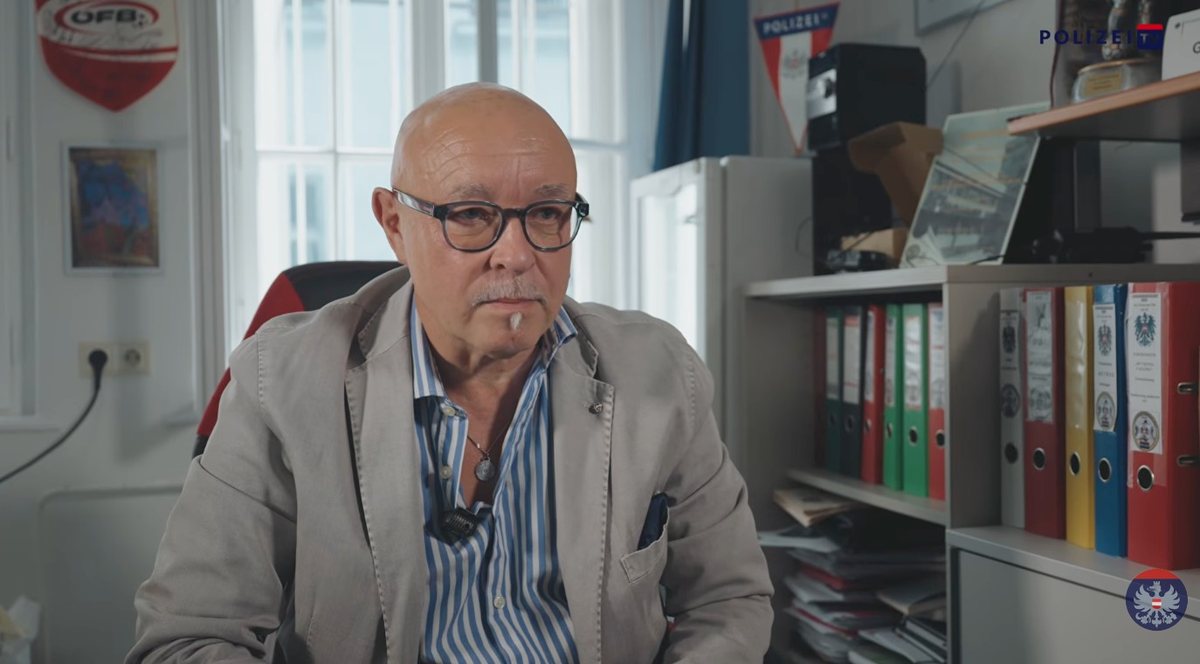
According to Goldnagl, speaking in a widely noticed YouTube video by the Austrian police, the unit has already reviewed around 1,500 cases in the few years of its existence. In Austria, this led to 130 criminal complaints against 186 identified suspects, with total damages of 47 million euros. Counterfeit money worth 15 million euros was seized. In cases from abroad, the unit identified 225 suspects and damages of 56 million euros. The clearance rate is 80 percent.
The comparison with Germany is remarkable – though not across the board. Across all offences, the police in Austria actually clear up slightly fewer cases: 53.6 percent of 538,656 reported offences (Police Crime Reporting Statistics Austria 2025 (Kriminalpolizeiliche Anzeigenstatistik Österreich 2025)), compared with 57.9 percent of around 5.5 million offences in Germany (Police Crime Statistics (Polizeiliche Kriminalstatistik, PKS) 2025 of the German Federal Criminal Police Office (Bundeskriminalamt, BKA)). In violent crime, however, Austria, at 85.7 percent, is clearly ahead of Germany, at 77.3 percent. The two statistics do not count in exactly the same way, but the pattern is clear: where Austria sets targeted priorities, the results are better. Its dedicated rip deal unit shows this most clearly. To my knowledge, there is no comparable special unit in Germany.
What this means is shown by the UNISTER case. The man who calls himself “Levy Vass” and whose Israeli passport bore the name “Wiaiss” is still at large today. The Croatian national has shown victims and police countless forged passports – sometimes Israeli, then Italian, Greek, Romanian or German. He speaks only broken German.
The pattern is always the same: he presents himself as respectable – as a wealthy investor, as an Israeli diamond dealer – yet from head to toe he is, in my view, a villain and a serious criminal. That is also how it went with UNISTER founder Thomas Wagner in Venice, before his fatal return flight on 14 July 2016. According to Handelsblatt, Wagner had 1.5 million euros “in his backpack” and expected in return a bridging loan of 15 million euros for a few months. To my knowledge, the money was meant to support a planned stock market flotation of UNISTER – an IPO (initial public offering) that Wagner, under great pressure, wanted to push through somewhat hastily. It was precisely this haste that made him the ideal victim. Handelsblatt describes the result as follows: “Instead, he got a suitcase full of counterfeit money.”
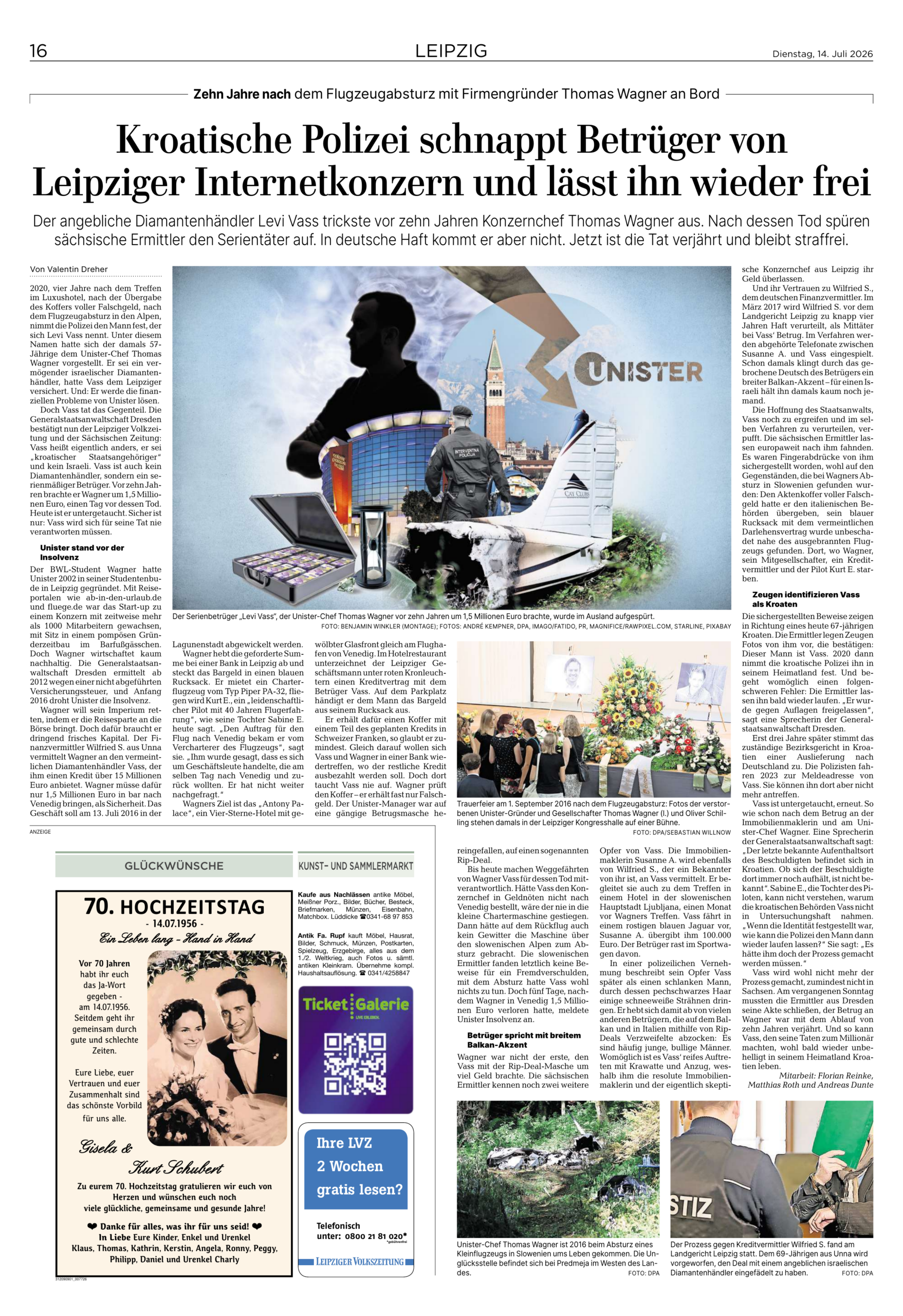
To my own knowledge, in the summer of 2016 alone, within only about two weeks, the serial criminal took around 2 million euros in Slovenia and Italy. At the end of June 2016 he struck at the AHotel in Ljubljana, Slovenia, near the southern motorway ring road – according to witness testimony, around two weeks before the crash. There, the architect Susanne A. lost, by her own account, 100,000 euros, and a Greek group a further 345,000 euros or so. A few days later, on 14 July 2016, he took 1.5 million euros from UNISTER founder Thomas Wagner in Venice. Together, that comes to around 1.95 million euros. Slovenia lies between Italy, Austria and Croatia; from Ljubljana, all three borders can be reached quickly by car – a circumstance that is likely to have favoured a rapid escape abroad and hampered the investigations for years.
How quickly the getaway car was actually ready is described by the architect Susanne A. in her witness interview on 19 September 2016 at the Saxony State Criminal Police Office (Landeskriminalamt Sachsen) in Dresden, Germany (file number 395 Js 100/16, Dresden Public Prosecutor General’s Office): after the money was handed over, “Levy Vass” immediately disappeared in a blue Jaguar with a driver.
She described the slim, gaunt man with salt-and-pepper (black-and-grey) hair, dark brown eyes, a tanned complexion and a strikingly shaped, neatly trimmed beard. At the time, “Levy Vass” was estimated to be around 60 years old – so today he is likely to be around 70. His shoulder bag, she said, was a “polished shoulder bag that didn’t have a single scratch”; he had placed it “very neatly on the table”. She estimated the driver at 1.78 to 1.82 metres, with a jet-black full beard and precisely cut hair, paler than his companion. Asked by public prosecutor Dr. Dirk Reuter “How old?”, the witness replied: “I’d put him at 30 at the very most.” She was questioned by Dr. Reuter and detective inspector Keiser – so names, file number and transcript exist, to which foreign investigating authorities could also turn.
The interview lasted from 11:30 a.m. to 3:16 p.m. – almost four hours, with several breaks, a photo line-up and a technical analysis of her phone. This is how meticulously, down to the last detail – beard hairs, posture of the shoulders, measurements in centimetres – the investigation was conducted here. The crucial question remains whether this information was cross-checked with Slovenia, Italy and Croatia.
What matters is what taxpayers are putting billions into the states’ judicial systems for: results must be delivered.
To understand the scandal, you need to know what happened afterwards in Croatia. In 2020, the man who calls himself “Levy Vass” was caught there – and released again, “subject to conditions”. After that, to my knowledge, he remained unmolested for three years. When the Croatian authorities “wanted” to arrest him in 2023, he could no longer be found at his place of residence. He is said to live today near Zagreb or near Split.
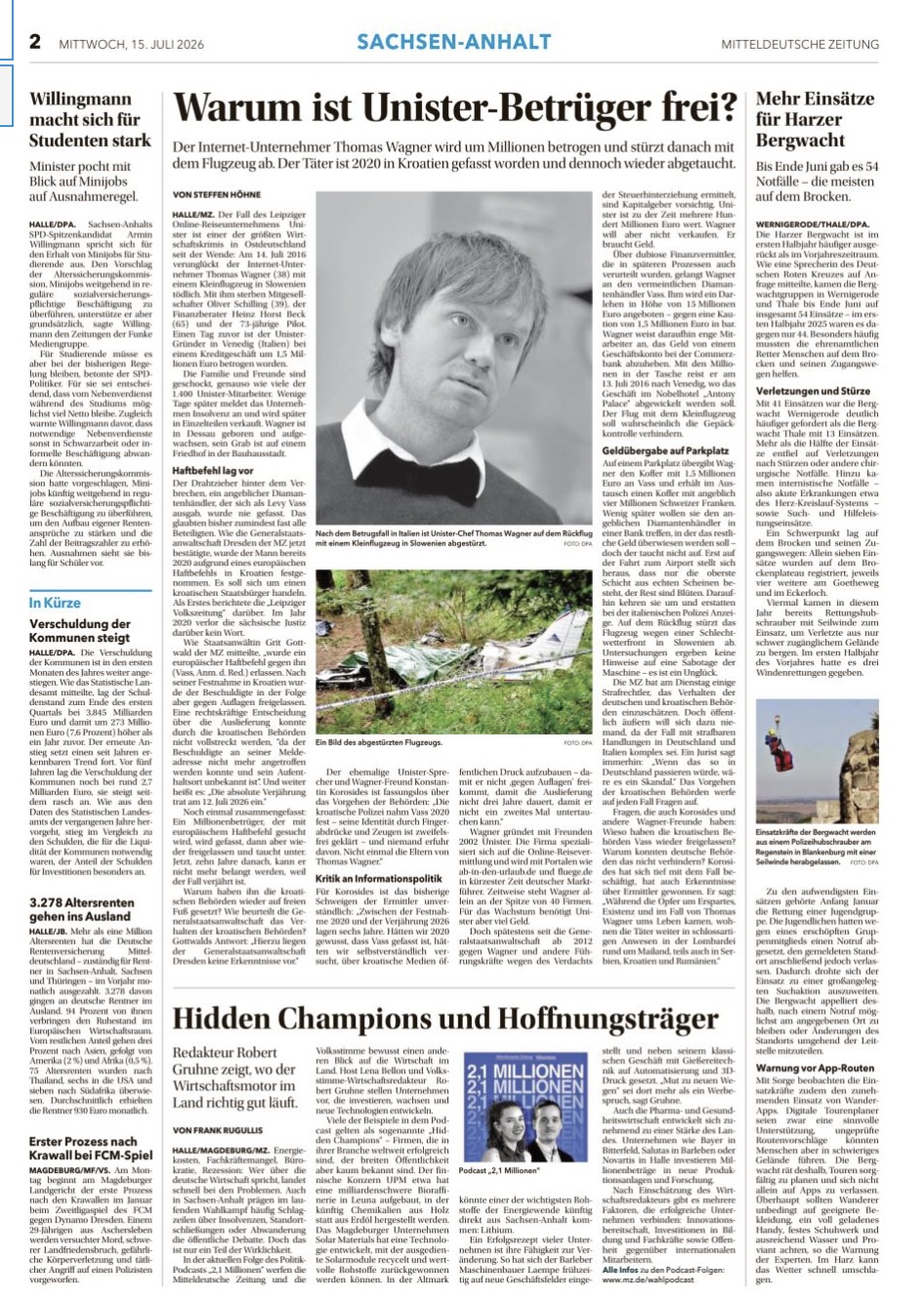
Nobody knew about this: not Thomas Wagner‘s parents, not Susanne A., not Wagner’s friends – and not me either. How the Dresden Public Prosecutor General’s Office dealt with this is the second judicial scandal in this case (more on this below).
Taken together, this amounts to a judicial scandal of the first order – in Croatia as well as in Saxony. The conduct of the Croatian investigating authorities raises questions that must be clarified independently.
But the victims and the bereaved do not forget. Ten years after the death of Thomas Wagner, they are still waiting for answers – and for someone to be held accountable.
What a rip deal is
In a rip deal (English slang for roughly a “rip-off deal”), fraudsters pose as wealthy buyers or intermediaries. In other languages the scam is called “escroquerie au rip deal” in French, “estafa rip deal” in Spanish, “truffa rip deal” in Italian, “rip deal prijevara” in Croatian and “înșelătorie rip deal” in Romanian.
Almost anything of high value serves as bait: houses and flats, luxury and sports cars, yachts and boats, horses up to racehorses, gold, watches and jewellery, works of art, antiques or company shareholdings; crypto assets are popular too. Anything that whets the appetite for more. Just as often, the perpetrators – according to information from Vienna, frequently Roma (as also in the case of Levy Vass) – promise loans or investments worth millions, supposedly from a wealthy backer abroad – exactly as in the UNISTER case.
This is shown by the warning of the Bavarian State Criminal Police Office (Bayerisches Landeskriminalamt), a crime prevention warning brochure and cases handled by the Rip Deal Unit Vienna. During the handover, the perpetrators swap real money or gold for counterfeit money or worthless material.
“The rip deal is the supreme discipline of fraud.”
Gerald Goldnagl, head of the Rip Deal Unit Vienna, State Criminal Police Office of Vienna (Landeskriminalamt Wien, LKA Wien), in the video by the Vienna police
According to Goldnagl, this is not only about fraud. The range extends from counterfeit money and organised crime to armed robberies, “all the way to murder”.
The gold trap of 7 May 2026
A case from May 2026 shows how the investigators work. A German man wanted to sell a property in Burgenland, a state in eastern Austria, for around 2.6 million euros and became suspicious. He turned to the police and helped lure the perpetrators into a trap.
District Inspector Valentin Szaga-Doktor praises him in the video: the victim “really played his part perfectly”, “almost like an actor at the Burgtheater” (Vienna’s famous national theatre). The police “spared no expense or effort” and obtained 25 real gold bars of 100 grams each.
On 7 May 2026, a young woman with a doctored leather bag appeared in a beer garden in Vienna’s 15th district. She was arrested. In a secret compartment secured with magnets lay a package of worthless metal brackets – it was supposed to be swapped for the gold.
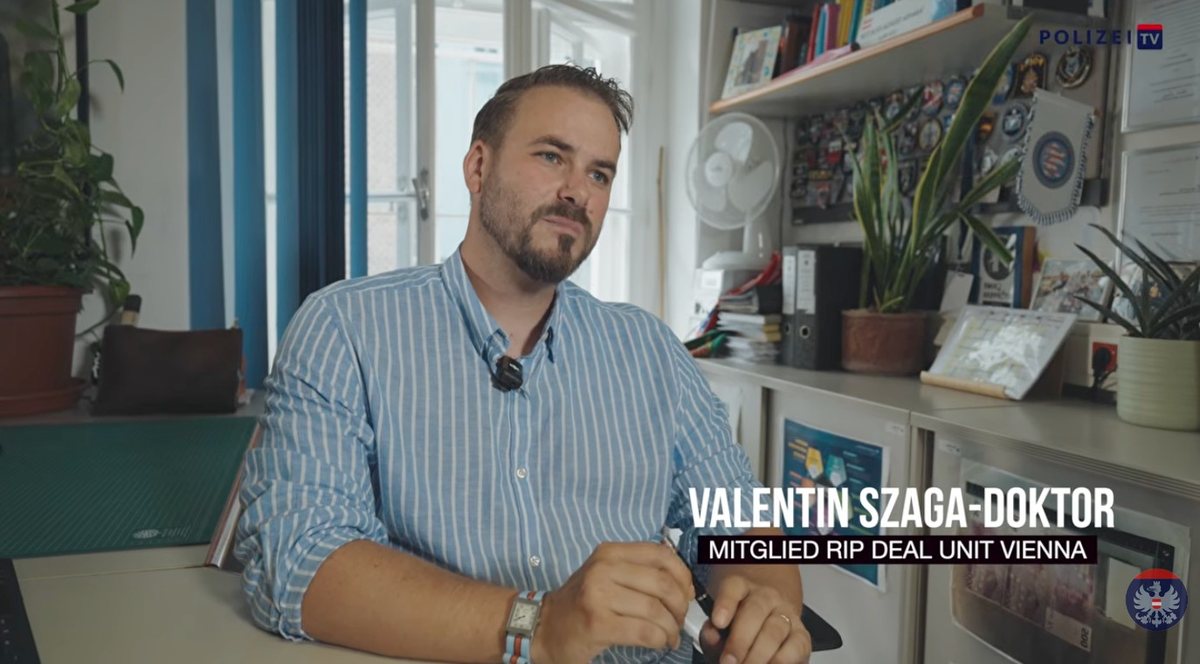
The case shows why this work matters beyond Austria. According to Szaga-Doktor, the unit evaluates every piece of information and passes it on via Europol (the law enforcement agency of the European Union) and Interpol. The investigators came across this gang because, since the beginning of 2024, the same aliases, telephone numbers and company details had been turning up in several countries, including Germany.
Who is responsible in Austria
The Vienna State Criminal Police Office is part of the Vienna Provincial Police Directorate (Landespolizeidirektion Wien), headed by Provincial Police President Gerhard Pürstl. Political responsibility for the Austrian police lies with Interior Minister Gerhard Karner (ÖVP, Austrian People’s Party) at the Federal Ministry of the Interior (Bundesministerium für Inneres, BMI) in Vienna.
According to Goldnagl, the ministry expressly approved the creation of the special unit. Justice Minister Anna Sporrer (nominated by the SPÖ, Social Democratic Party of Austria) is responsible for the public prosecutors’ offices.
Fighting fraud succeeds when an authority dedicates its own specialised unit to a field of crime – here rip deal fraud, property fraud, gold fraud and counterfeit money.
UNISTER: perpetrator caught and released again
For six years I was Chief Communication Officer of UNISTER and a personal friend of Thomas Wagner. From that time I know the background of the case first-hand – which is why I have not let go of it for ten years.
Under Wagner, UNISTER grew into an internet group with travel and price comparison portals which at times invested up to 150 million euros a year in advertising with Google alone – and up to 75 million euros a year with the RTL Group, and in earlier years with ProSiebenSat.1. Celebrities such as Reiner Calmund (fluege.de) and Michael Ballack (ab-in-den-urlaub.de) advertised UNISTER brands. A peculiar contradiction emerged: on the one hand, Bloomberg valued UNISTER in the billions. On the other hand, publicly staged investigations were at the same time setting the company on fire from below, with maximum publicity.
The fraud in Venice has been dealt with in court: an intermediary from Germany was sentenced to almost four years in prison by the Leipzig Regional Court (Landgericht Leipzig). The supposed backer called himself “Levi Vass” (in some reports also “Levy Vass”).
According to the Leipziger Volkszeitung, he is a serial fraudster who was tracked down abroad years later.
The Leipziger Volkszeitung was the first to report on this, on 14 July 2026, the tenth anniversary of Thomas Wagner‘s death. According to its report, his crime will go unpunished.
The Mitteldeutsche Zeitung followed up on 15 July 2026 – under the headline “UNISTER-Betrüger gefasst und wieder frei” (“UNISTER fraudster caught and free again”) – and asked why the public prosecutor’s office had not provided information about it.
Ten years after the UNISTER insolvency, it is clear that little remains of the former Leipzig internet empire – but individual brands such as ab-in-den-urlaub.de, fluege.de or auto.de continue under new, partly foreign owners. Only in 2025 was part of the travel brands sold on for just under 250 million euros to WP Holding in Warsaw (Poland).
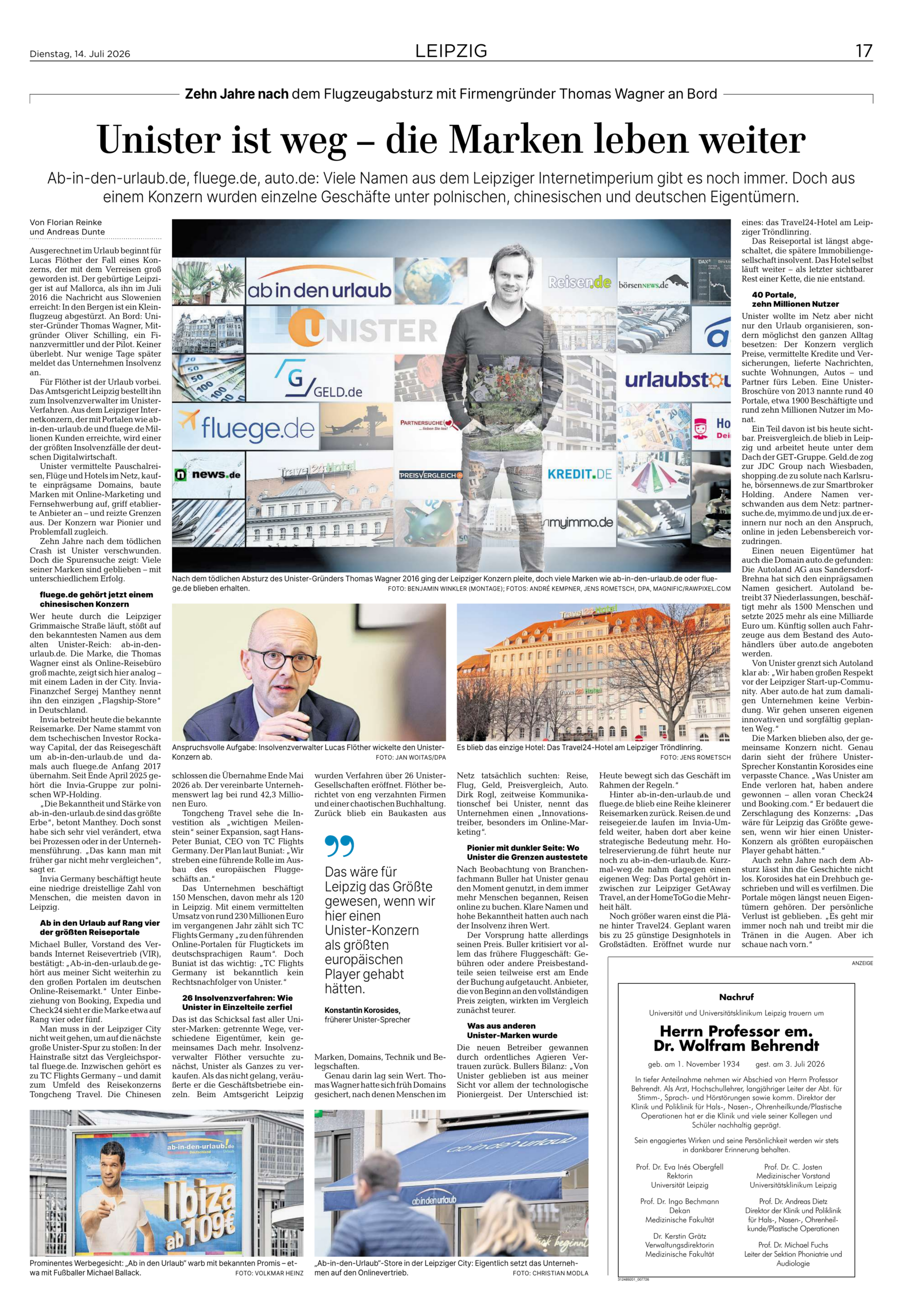
The second judicial scandal: Saxony’s six years of silence
The Dresden Public Prosecutor General’s Office said not a word for years about the man’s arrest in Croatia. Only in July 2026 – after a press enquiry around the tenth anniversary of his death and only one day before the ten-year limitation period expired on 14 July 2026 – did it come to light that the man had been caught in Croatia and let go again. By that point, according to this account, the judiciary in Zagreb and in the Croatian provinces could no longer do anything anyway. The Dresden Public Prosecutor General’s Office is headed by Prosecutor General Wolfgang Schwürzer (in office since 1 July 2026); supervision lies with the Saxon State Ministry of Justice (Sächsisches Staatsministerium der Justiz) under Justice Minister Constanze Geiert (CDU, Christian Democratic Union); ultimate responsibility rests with the Saxon State Government under Minister-President Michael Kretschmer (CDU).
My demands on Croatia and the EU
We, the bereaved and close friends of Thomas Wagner, expect the Croatian authorities to pursue this case vigorously and to arrest those responsible. In Croatia, USKOK is responsible for organised crime and corruption – the Office for the Suppression of Corruption and Organised Crime (Ured za suzbijanje korupcije i organiziranog kriminaliteta) at the State Attorney’s Office of the Republic of Croatia.
We address this demand explicitly to USKOK. It applies equally to the Croatian Interior Minister Davor Božinović and Justice Minister Damir Habijan (both HDZ, Croatian Democratic Union).
Why a suspect in a multi-million fraud was able to go free again is incomprehensible to me. I have no evidence of corruption, and I make no accusation against any particular person or authority.
That is precisely why the question must be clarified – independently, thoroughly and in a publicly transparent manner. USKOK exists for exactly such examinations.
At the same time, I ask the European Public Prosecutor’s Office (EPPO) to examine whether it has jurisdiction here. That would be the case if the financial interests of the European Union are affected, for example through money laundering or corruption. Croatia participates in the EPPO; the authority has already investigated there several times and has publicly pointed to conflicts with national bodies.
That is why my explicit thanks go to Gerald Goldnagl, Valentin Szaga-Doktor, Mario Kaintz and the entire team of the Rip Deal Unit Vienna for their enormous work. Other countries, including Germany and Croatia, should follow their example.
Venice, 14 July 2016: a case that will not rest
Thomas Wagner flew to Venice in a chartered small aircraft of the Piper PA-32 type. Instead of the promised loan, he received counterfeit money: only the top notes of the bundles are said to have been genuine.
Just three years after his death, the German tabloid BILD also publicly asked about open questions in the case: about private detectives, a mysterious video and a fraudster who exists “several times over”.
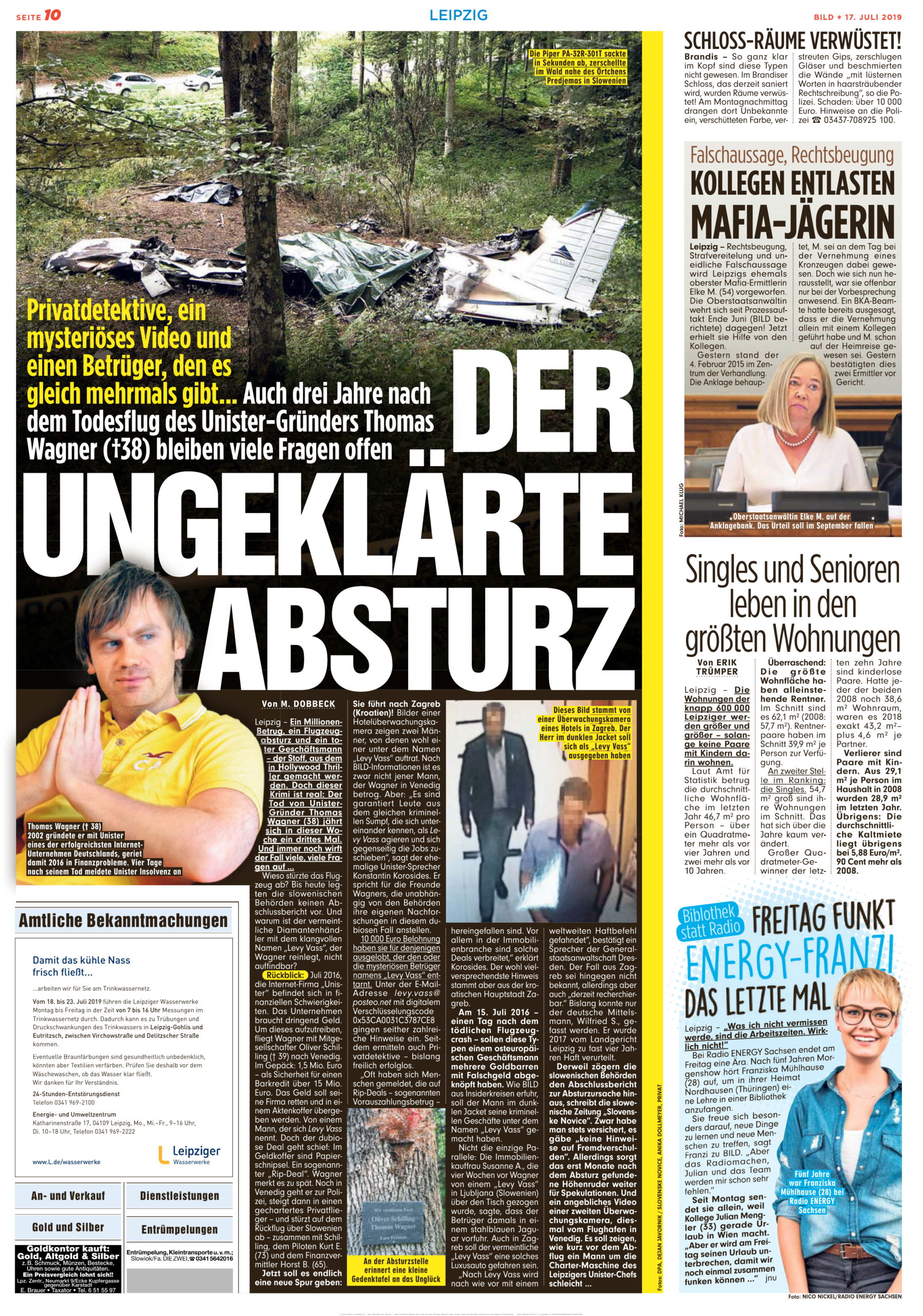
On the morning of 14 July 2016, the aircraft took off in Venice for the return flight to Leipzig in Saxony, Germany. At 10:34 a.m. it disappeared from radar and crashed into a forest near Predmeja, close to Ajdovščina in western Slovenia, as Slovenian public broadcaster RTV Slovenija reported. All four people on board died: Thomas Wagner; his business partner and UNISTER co-shareholder Oliver Schilling – a school friend from Wagner’s home town of Dessau in the German state of Saxony-Anhalt, where he is buried today in the municipal cemetery –; an investment adviser; and the 73-year-old pilot.
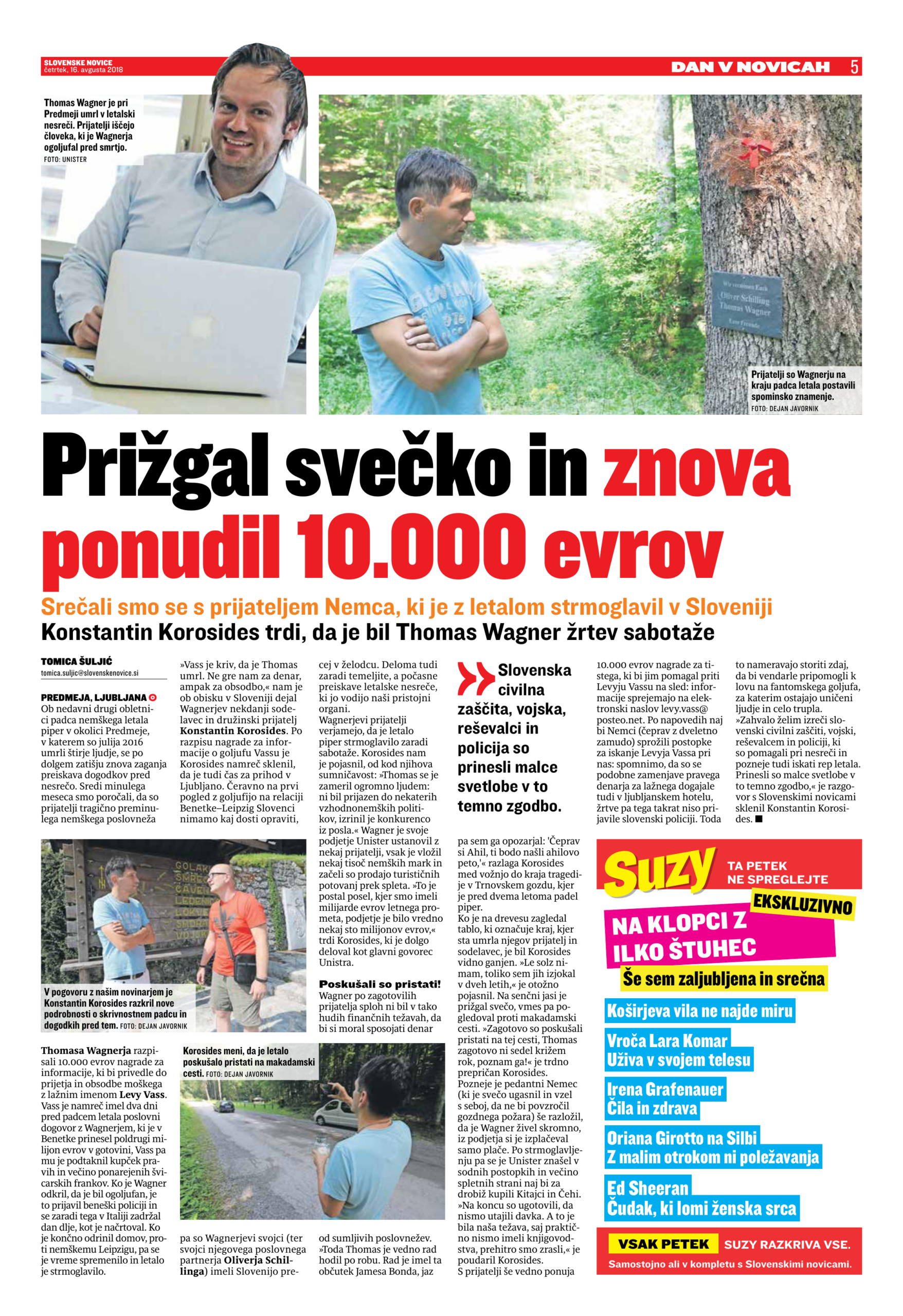
Two years after the crash, I visited the crash site in Slovenia myself, lit a candle there and once again offered a reward of 10,000 euros for information – the Slovenian newspaper Slovenske Novice reported on it.
According to its final report, the Slovenian investigating authority concluded that the pilot deviated from the planned route because of a bad-weather front, flew into thunderstorms with icing, and the horizontal stabiliser broke off. He was left on his own by the control tower in Slovenia for minutes. The aircraft was not certified for flights in icing conditions. A few weeks later, UNISTER filed for insolvency.
Nevertheless, like many others who have followed the case for years, I still assume to this day that it may also have been murder, perfidiously carried out on behalf of third parties whose identity has not been established to this day. This is expressly a supposition, not a statement of fact.
The case made headlines around the world. Media in Germany, in Slovenia and as far away as Argentina reported on the death of the internet entrepreneur, on the fraud in Venice and on the question of who is behind “Levy Vass”.
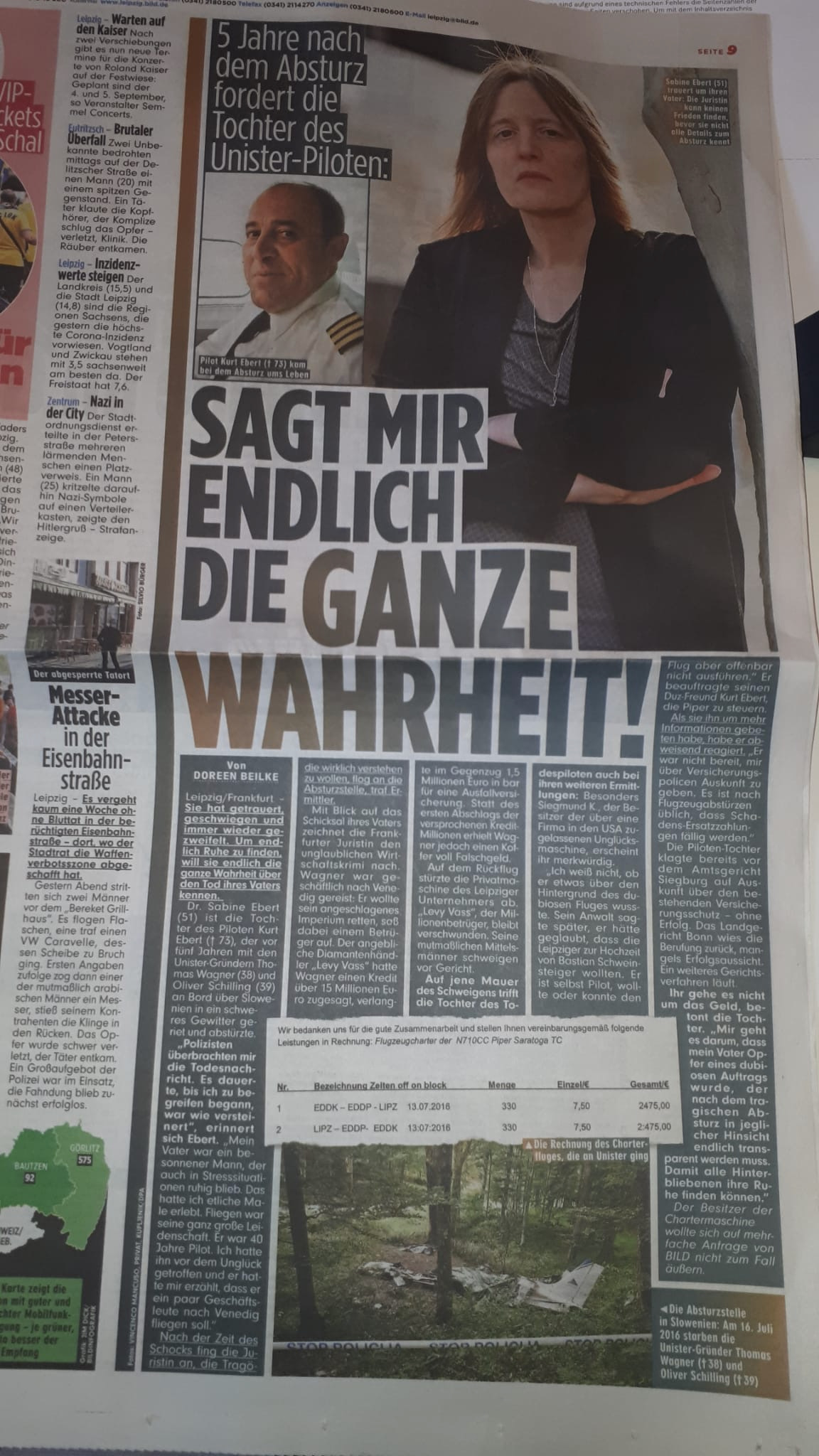
The same applies to the relatives of the other victims. Five years after the crash, the pilot’s daughter, Dr. Sabine Ebert, who works at Deutsche Bank in the bank tower in Frankfurt am Main, publicly demanded in BILD a full investigation into the accident in which her father Kurt Ebert lost his life.
Why “Levy Vass” must be arrested
Whether the crime in Venice is time-barred is not decided by the calendar alone. In Germany, commercial gang fraud is a felony and, under Section 263 (5) of the German Criminal Code (Strafgesetzbuch, StGB), is punishable by up to ten years in prison. The limitation period is therefore ten years (Section 78 (3) no. 3 StGB).
However, it is interrupted and begins anew as soon as, for example, an arrest warrant is issued or investigative measures are taken against the accused (Section 78c StGB, interruption of the limitation period). Such an offence becomes finally time-barred only after 20 years. Whether the limitation period was interrupted in the UNISTER case must be disclosed by the competent public prosecutor’s office; Italy, where the crime took place, also has its own rules.
Even if the crime in Venice could no longer be prosecuted, the case would not be closed. If there are further victims and further offences that are not time-barred – in Germany, Italy, Croatia or elsewhere – then the man belongs in court.
That is what the European Arrest Warrant is for: every member state of the European Union must arrest wanted persons and surrender them to the state prosecuting them. I call on the authorities in Germany, Italy and Croatia to examine all of the man’s offences and to arrest him by this route – in accordance with the rule of law, but with all due vigour.
And even where criminal law no longer applies, the bereaved have a right to know who defrauded Thomas Wagner in Venice. That is exactly why we demand a full investigation.
Dr. K. Korosides, publisher of NETZ-TRENDS.DE
Frequently asked questions
What is the Rip Deal Unit Vienna?
A special investigation unit of the State Criminal Police Office of Vienna in Austria, headed by Gerald Goldnagl. It specialises in rip deal fraud and works with sting operations.
How do rip deal fraudsters lure their victims?
With the purchase or sale of high-value goods such as property, luxury cars, yachts, horses, gold, jewellery, art or antiques – or with loans and investments from a supposed foreign backer.
What happened to UNISTER founder Thomas Wagner?
He was defrauded of 1.5 million euros in Venice in July 2016 and died on 14 July 2016 when his small aircraft crashed in Slovenia. According to the Leipziger Volkszeitung, the Croatian police found the fraudster and let him go again.
Is the crime in Venice time-barred?
Whether the crime is time-barred also depends on whether international arrest warrants or investigative measures in Italy and Croatia interrupted the limitation period. In addition, further possible offences by the serial fraudster are at issue.
Sources and status
- Vienna Police: “Ein Blick in die Rip Deal Unit Vienna” (“A look inside the Rip Deal Unit Vienna”), YouTube, October 2026
- Roman Taudes, LinkedIn post “Krypto-Abzocke in Wien – Täterfotos veröffentlicht” (“Crypto rip-off in Vienna – photos of perpetrators published”; names Mario Kaintz as the third investigator of the Rip Deal Unit Vienna)
- Report by the Mitteldeutsche Zeitung, 14 July 2026
- Report by the Leipziger Volkszeitung, 27 October 2026
- Leipziger Volkszeitung: verdict in the UNISTER fraud trial
- Bavarian State Criminal Police Office: rip deal, as of 24 July 2026
- Warning brochure “Vorsicht vor Rip-Deals!” (“Beware of rip deals!”)
- 5min.at: rip deals with luxury goods as bait, 18 February 2024
- German Criminal Code (StGB), Sections 78, 78c, 263
- European Arrest Warrant (EU e-Justice Portal)
- EPPO: statement on conflicts of competence in Croatia
- State Attorney’s Office of the Republic of Croatia (DORH, Državno odvjetništvo Republike Hrvatske) / USKOK
- RTV Slovenija, 15 July 2016
- AERO International: final report on the crash
- Mercado (Argentina), 16 August 2016
- Police Crime Reporting Statistics Austria 2025 (Austrian Federal Criminal Police Office, Bundeskriminalamt Österreich)
- Police Crime Statistics (PKS) 2025 of the German Federal Criminal Police Office
- Volksstimme: Prosecutor General Wolfgang Schwürzer takes office, Saxony, July 2026
Research and data as of: 29 October 2026.
This commentary reflects the personal opinion of the author. The presumption of innocence applies to all persons named until they have been convicted by a final judgment.
Transparency notice: AI-assisted tools were used in researching, structuring and producing this article. The sources used are listed in the article. Publication takes place only after manual editorial approval. This translation from the German original was also produced with AI assistance.