Britain is also fighting data centres: Thames Water says one site can use up to 19 million litres a day, Ofgem tracks 140 grid requests
Key points
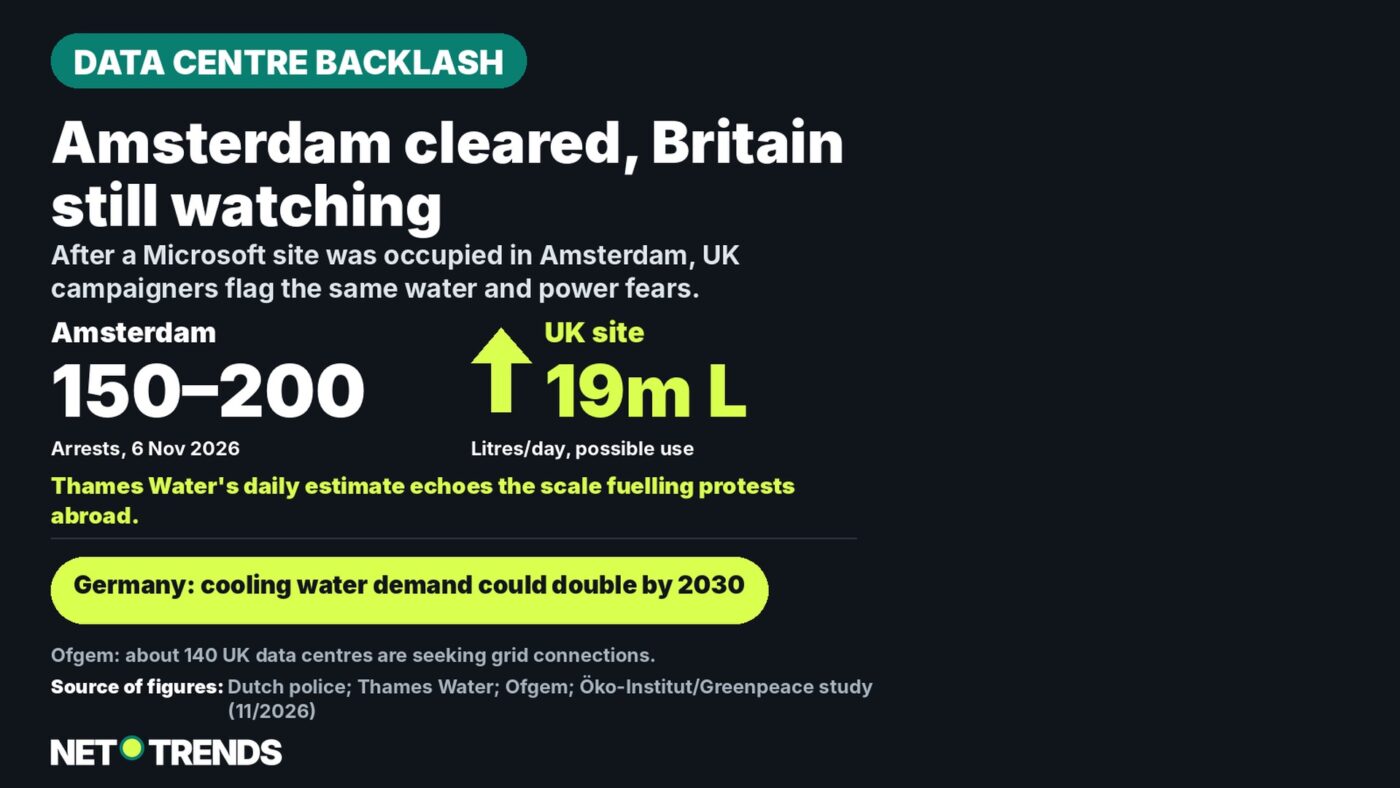
- Dutch police report 150 to 200 arrests after protesters occupied the construction site of a planned Microsoft data centre in Amsterdam on 6 November 2026.
- Campaigners from the “Stop Dirty Data Centres” coalition held linked protests in at least 15 countries, and Global Action Plan UK coordinated two days of action across Britain in February 2026.
- Thames Water has said a single large data centre can use up to 19 million litres of water a day, while Ofgem says about 140 data centres are seeking grid connections needing 50 GW at peak.
Hundreds of activists occupied a Microsoft construction site in Amsterdam on Friday, and Dutch police reported 150 to 200 arrests. British campaigners have raised similar concerns about water and power use at data centres planned across the UK.
Dutch police said those detained were suspected of trespassing. Microsoft said it was aware of the demonstration, respected the right to peaceful protest, but would not tolerate unlawful acts or actions that endanger people.
Organisers described the Amsterdam protest as the opening of a two-day, Europe-wide action against the rapid build-out of data centres for cloud and AI services, with rallies also reported in London. For British readers this is not a distant story: campaigners here have spent much of 2026 pushing back against hyperscale data centres over their water and electricity demands.
An occupied site, a crane, flares
In Amsterdam’s Sloterdijk district, several hundred protesters broke into the construction site of a planned Microsoft data centre on Friday afternoon. Some climbed a construction crane and lit flares, and there were clashes with police. Officers cleared the site by late afternoon.
The action was organised by the Dutch group “Geef Tegengas” (“Push Back”). The umbrella campaign “Stop Dirty Data Centres” says around 100 organisations in 15 countries took part in coordinated weekend actions, including in London and Vienna.
Ofgem: 140 data centres seeking grid power, Thames Water warns on water
Britain’s own data-centre debate has been building for months. On 27 February 2026, Global Action Plan UK coordinated two days of action with local campaigners and NGOs across the country. Oliver Hayes, head of campaigns at Global Action Plan, said “Big Tech’s unchecked construction of hyperscale AI data centres is putting the UK’s climate targets at risk.” Leigh Tugwood, co-chair of the Iver Heath Residents Association, said the group is “not Hi-Tech NIMBYs,” and is calling for a moratorium on new hyperscale sites pending a public inquiry.
The scale of the UK build-out is reflected in regulator figures: Ofgem says around 140 data centres are seeking grid connections that would need 50 GW of capacity at peak — more than Britain’s peak winter demand of 45 GW on a recent cold day. Thames Water has separately said a single large data centre can use up to 19 million litres of water a day. More than 100 data centres are planned across the UK, and campaigners say the largest proposed site would use more electricity than all households in Wales combined.
“Construction would mean eight to ten years of noise and disruption for residents.”
Ian Pirie, coordinator, Friends of the Earth Havering, on a proposed Green Belt site
The UK government has separately admitted a “serious logical error” in approving a large Buckinghamshire data centre without sufficient environmental checks. A Savanta poll commissioned by Beyond Fossil Fuels found a majority of people in Britain want government and Big Tech to act on data-centre impacts, with more than three-quarters saying new sites should only be built if powered by additional renewable energy.
Germany: 13 billion litres today, up to 27 billion by 2030
Germany, where Friday’s parallel protest also reached Berlin, now has its own figures. According to a short study published on 2 November 2026 by the Öko-Institut for Greenpeace (in German), German data centres used around 13 billion litres of water for cooling in 2025 — comparable, the study says, to the drinking-water needs of about 275,000 people. By 2030, that figure could roughly double to up to 27 billion litres a year, driven by rising electricity demand from new AI facilities.
The German digital industry body Bitkom pushes back on the framing: it says the amount of water used per kilowatt-hour of connected capacity has fallen from 0.55 in 2023 to 0.4 in 2025, according to an EU register, and that 65% of German data centres already have “very low direct water use.”
What residents can check when a data centre is proposed nearby
- What cooling technology is planned — and has an environmental impact assessment, including water use, been published?
- What connection capacity in megawatts is planned, and which water source would supply cooling?
- Is there a public consultation, and when does the objection period close?
- What does the local water company or grid operator say about capacity and drought risk in the area?
Let us know in the comments what role water and power use should play when a data centre is proposed near you.
Frequently asked questions
Why did activists protest against the Microsoft data centre in Amsterdam?
Protesters are opposed to the rapid expansion of data centres for cloud and AI services, especially their electricity and water use and the lack of public oversight. Dutch police reported 150 to 200 arrests for trespassing.
Is there similar opposition to data centres in the UK?
Yes. Global Action Plan UK coordinated nationwide protests in February 2026, and regulators including Ofgem and Thames Water have flagged the scale of power and water demand from planned sites.
How much water can a UK data centre use?
Thames Water has said a single large data centre can use up to 19 million litres of water a day.
How much water do German data centres use?
A short study for Greenpeace put 2025 use at around 13 billion litres, potentially rising to 27 billion litres by 2030.
Sources and status
- Öko-Institut for Greenpeace: short study on water use by German data centres, as of 11/2026 (in German)
- Bitkom press release, 3 November 2026 (in German)
- Dutch police and Microsoft: statements of 6 November 2026 on the occupation of the Amsterdam-Sloterdijk site
- The Ecologist: Hyperscale data centre protests, 27 February 2026
Research and data as of 7 November 2026.
Transparency note: AI-assisted tools were used in researching, structuring and writing this article. The sources used are listed in the article. Publication takes place only after manual editorial approval. Country edition based on an article from Net Trends, researched for the UK.
Share this article