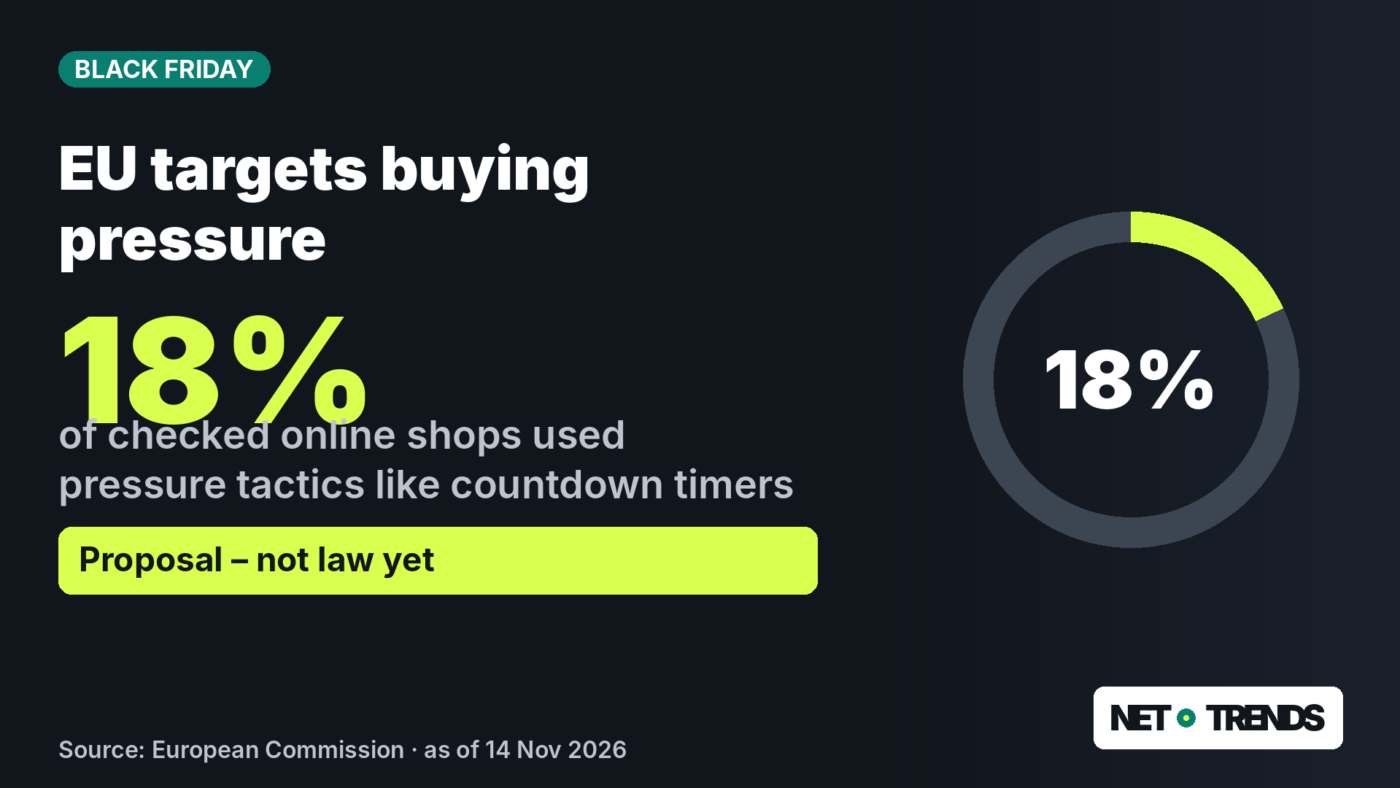
The European Commission wants to curb manipulative online sales tactics. The proposal isn’t adopted yet and wouldn’t bind the UK directly anyway – but fake urgency can already break UK consumer law, and the UK now has its own, broader toolkit.
Key points
- On 11 November 2026 the Commission presented a proposal for a Digital Fairness Act.
- It is EU law in the making, not EU law in force, and it wouldn’t bind the UK after Brexit even once adopted.
- It targets fake scarcity, manipulative interfaces and hard-to-cancel subscriptions.
- The UK already has its own rules: the Consumer Protection from Unfair Trading Regulations 2008 and the newer Digital Markets, Competition and Consumers Act 2024.
A countdown drops to a few minutes next to “only 2 left”: the European Commission wants to rein in exactly this kind of tactic. For UK shoppers the proposal itself changes nothing directly – but the UK’s own rules on fake urgency are already in force and getting sharper teeth.
The Commission adopted its Digital Fairness Act proposal on 11 November 2026, aiming to update EU consumer law for digital practices: countdown timers, addictive design, personalised offers aimed at vulnerable users, influencer advertising and the cancellation of auto-renewing contracts. The text still has to go through the EU legislative process, and as a non-EU country the UK would not be bound by it even once adopted. For UK readers the EU debate is mainly useful as context for the country’s own, separate consumer-protection framework.
Contents
What the European Commission wants to change
The EU proposal targets practices that push consumers toward a decision through a misleading interface. A claim such as “only 2 left” would be particularly relevant if it doesn’t reflect real stock levels; genuinely low stock isn’t banned just because it’s mentioned. The Commission adopted the text on 11 November and sent it to the European Parliament and the Council of the EU; no date for new obligations has been set, and as an EU instrument it will not automatically apply in the UK.
What already applies in the UK
The UK does not need to wait for Brussels on this. The Consumer Protection from Unfair Trading Regulations 2008 already ban misleading claims, including false statements about limited availability or time-limited offers, enforced by Trading Standards and the Competition and Markets Authority (CMA). Since April 2025 the Digital Markets, Competition and Consumers Act 2024 (DMCCA) has given the CMA new powers to fine traders directly, without going to court, for banned practices listed in Schedule 20 – including fake countdown timers and drip pricing – and it sets new rules for subscription contracts, such as reminder notices before auto-renewal and an easier cancellation route. The CMA has already used its existing powers against retailers such as Wowcher and Simba Sleep over misleading urgency claims.
What shoppers should check for Black Friday
Practical checklist
- Check the product and price: model number, variant, delivery cost and total price.
- Put time pressure in perspective: a timer is a reason to pause, not proof of a fake. Save the product page and price with a timestamp.
- Check the seller: identity, returns address and cancellation rights.
- Read free-trial terms closely: free period length, price afterwards, renewal and how to cancel.
Frequently asked questions
Does the Digital Fairness Act already apply for Black Friday 2026?
No. As of 14 November 2026 it is only a European Commission proposal. The European Parliament and the Council still need to consider it, and as an EU instrument it would not bind the UK even once adopted.
Are countdown timers now banned in UK online shops?
Not as a blanket rule. A demonstrably false scarcity claim can already breach the Consumer Protection from Unfair Trading Regulations 2008. A genuine countdown or a note about limited stock isn’t automatically unlawful.
Do I need to wait for new EU rules to cancel a subscription?
No. The Digital Markets, Competition and Consumers Act 2024 already strengthens subscription-contract rules in the UK, including reminder notices and easier cancellation, independent of anything happening in Brussels.
Sources and last checked
- European Commission: Digital Fairness Act – proposal and legislative status, accessed 14 November 2026.
- European Commission: results of the review of online sales practices (26 March 2026), accessed 14 November 2026.
- legislation.gov.uk: Consumer Protection from Unfair Trading Regulations 2008, accessed 14 November 2026.
- legislation.gov.uk: Digital Markets, Competition and Consumers Act 2024, Part 4, accessed 14 November 2026.
Research and data as of: 14 November 2026.
Transparency: this article was researched and drafted with the support of artificial intelligence and is intended for human editorial review. Source checking and final editorial review were carried out against the linked original sources. Country edition based on a Net Trends article, researched for the UK.
Share this article


Kommentieren Sag uns deine Meinung →