Battery health, warranty and range checks before you sign anything
Key points
- Before buying a used electric car, ask for a traceable battery health report, not just the dashboard percentage.
- The range shown on screen is not an independent battery test.
- Remaining manufacturer warranty, mileage, service history and written battery statements should all be checked together.
- Buying from a dealer gives you different legal protection than buying privately — a manufacturer warranty does not replace your statutory rights.
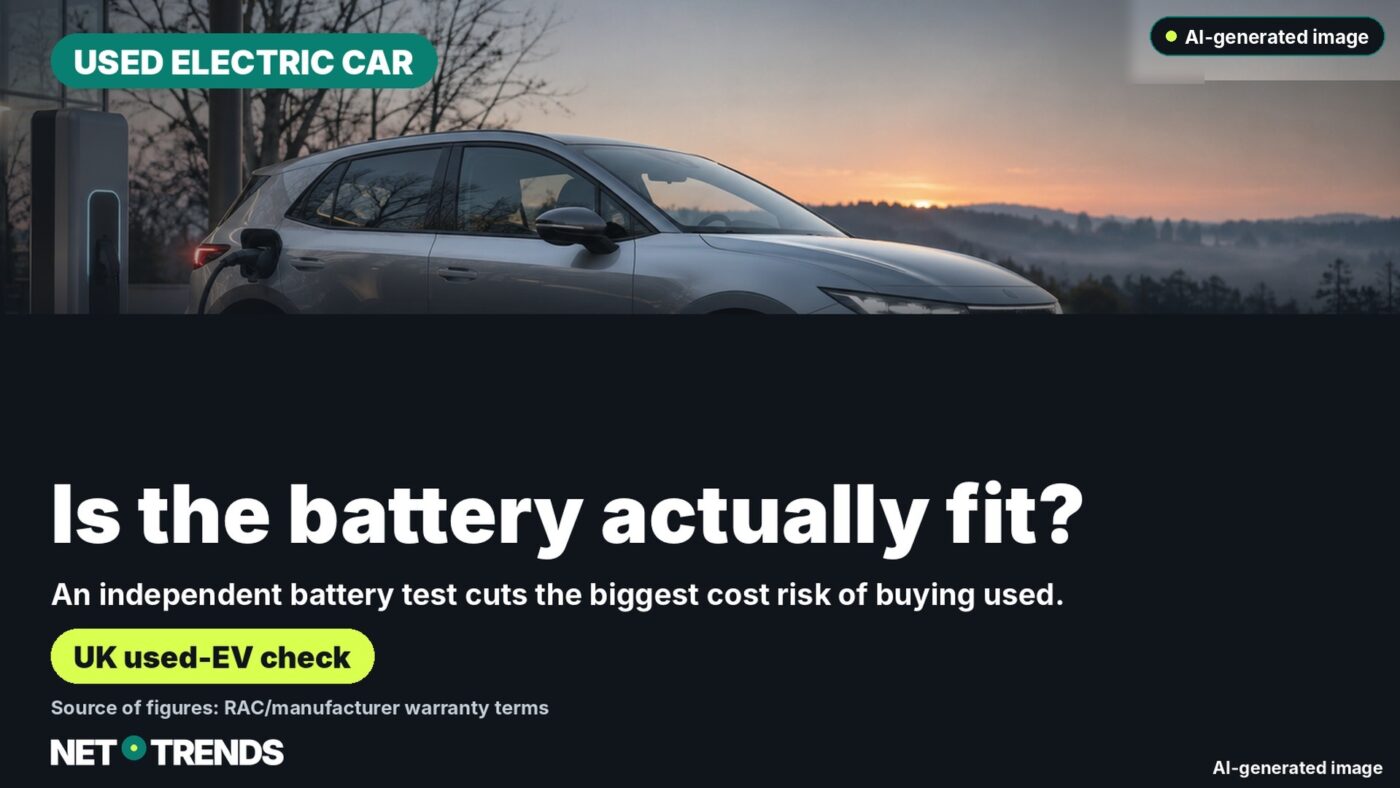
The battery is the most expensive and most range-critical part of an electric car, so a used-car buyer should trust neither the odometer alone nor a percentage on a screen. What matters is a traceable battery test, the terms of any remaining warranty, and a test drive that matches your own routine.
How SoH compares internationally
The UK’s RAC and motoring bodies such as the AA publish general guidance on buying a used EV, but a single, universally quoted percentage threshold for battery State of Health (SoH) is not commonly published by a UK body the way the German motoring club ADAC does. As an international reference point only, not a UK standard, this article uses ADAC’s own orientation figures: at least 92% SoH at 50,000 km, 88% at 100,000 km, 84% at 150,000 km and 80% at 200,000 km. State of Charge (SoC, how full the battery is now) and State of Health (SoH, remaining capacity versus new) are different things; the dashboard range estimate reflects neither independently, since it is calculated from recent driving, temperature and speed.
Paperwork that matters
Ask for every available battery and workshop record: test certificates, invoices, and any record of modules or the whole pack being replaced, including whether a new or transferred warranty applies. Compare the VIN on the paperwork, the car and the service history, and get the first registration date and mileage confirmed in writing.
Warranty vs. your legal rights
Volkswagen’s UK warranty terms, published at volkswagen.co.uk, set out the manufacturer’s high-voltage battery cover for eligible BEV and PHEV models in the UK market; the exact duration and mileage limit depend on model and date of first registration, so always check the document for the specific vehicle rather than assuming the German terms (8 years / 160,000 km) apply unchanged. A manufacturer warranty is a separate, voluntary promise with its own exclusions and required maintenance — it is not the same as your statutory rights below.
Your statutory consumer rights
Buying a used car from a trader in the UK is covered by the Consumer Rights Act 2015: goods must be of satisfactory quality and as described (section 9), and under section 19 you generally have the short-term right to reject within 30 days, then a right to repair or replacement, and under section 23 the first repair or replacement attempt must happen without significant inconvenience. A fault within the first six months is treated as present at delivery unless the trader proves otherwise. Buying privately gives you far weaker protection — mainly that the car must match its description — so a written, vehicle-specific battery statement matters even more.
Test drive and total cost
Plan a test drive on roads that resemble your real routine — town, dual carriageway or motorway — and note the state of charge at the start so you can judge real-world consumption rather than the on-screen estimate alone. Check charging at a public AC point and, if possible, a rapid DC charger, watching for error messages. Compare total running costs, not just the purchase price: insurance, road tax (Vehicle Excise Duty), servicing, tyres, finance and expected depreciation; charging costs depend heavily on whether you can charge at home overnight or rely mostly on public rapid chargers, which are usually markedly more expensive per kWh.
Tick these off before you sign
- VIN on the paperwork, the car and the service history all match.
- A dated battery health report with a stated test method exists, or an independent test is booked before you commit.
- Workshop, battery and any accident history are documented as fully as possible.
- Remaining manufacturer warranty, mileage limit and transferability are confirmed in writing for this specific car.
- Test drive, charging sockets, charging speed and safety systems have been checked.
- The sales contract records known faults, promised features, battery documents and included accessories.
- Total cost — purchase, finance, insurance, charging and likely repairs — has been compared with your own usage.
Frequently asked questions
What SoH should a used electric car have?
There is no single SoH figure that applies to every model and use case, and no UK-specific benchmark was found for this article. As an international reference only, ADAC in Germany estimates at least 92% at 50,000 km, 88% at 100,000 km, 84% at 150,000 km and 80% at 200,000 km — treat these as orientation, not a guarantee, and ask for a dated, vehicle-specific test.
Can I rely on the range shown on the dashboard?
No. The figure is calculated from recent driving, temperature and speed, and does not independently describe battery health. Ask for a proper test report and take a test drive that matches your own routine.
How long does the battery warranty last on a used EV?
It depends on the manufacturer, model, first registration date, mileage and the specific warranty document. Some manufacturers quote 8 years or a mileage limit for the UK market, but this is not automatically the same for every model — get the remaining cover confirmed in writing for the VIN.
Am I better protected buying from a dealer than privately?
Buying from a trader in the UK gives you rights under the Consumer Rights Act 2015, including a short-term right to reject and repair or replacement rights. A private sale gives much weaker protection, mainly that the car must match its description. Check the actual contract and promises before signing either way.
Sources and status
- RAC: advice on buying a used electric car
- Volkswagen UK: new vehicle warranty terms
- Consumer Rights Act 2015, section 19 (short-term right to reject, repair and replacement)
- Consumer Rights Act 2015, section 23 (right to repair or replacement)
- ADAC (Germany): battery check for electric cars — used here only as an international reference point (in German)
Research and data status: 14 November 2026.
Transparency note: AI-assisted tools were used in researching, structuring and writing this article. The sources used are listed in the article. Publication takes place only after manual editorial approval. Translation and adaptation of a Net Trends original for the UK market, researched separately.
Share this article