NETZ-TRENDS.de, an independent German-language news portal serving Germany, Austria and Switzerland, is asking Anthropic to explain how $90 in additional Claude usage credit could be exhausted within only a few hours. According to our assessment, our intensive editorial usage pattern had not materially changed compared with the preceding seven days. Task logs also indicate parallel AI processes.
NETZ-TRENDS.de has been listed in Google News in Germany, Austria and Switzerland since 2011 and reaches up to 450,000 readers per year. The news portal covers technology, IT, business, digital markets, mobility, energy, media and consumer affairs for the German-speaking DACH market.
€214.20 per month – then another $107.10 invoice
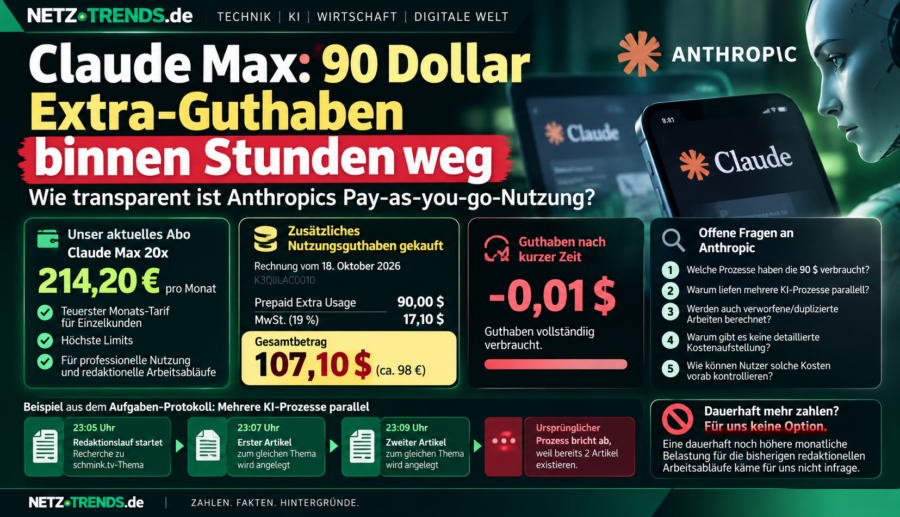
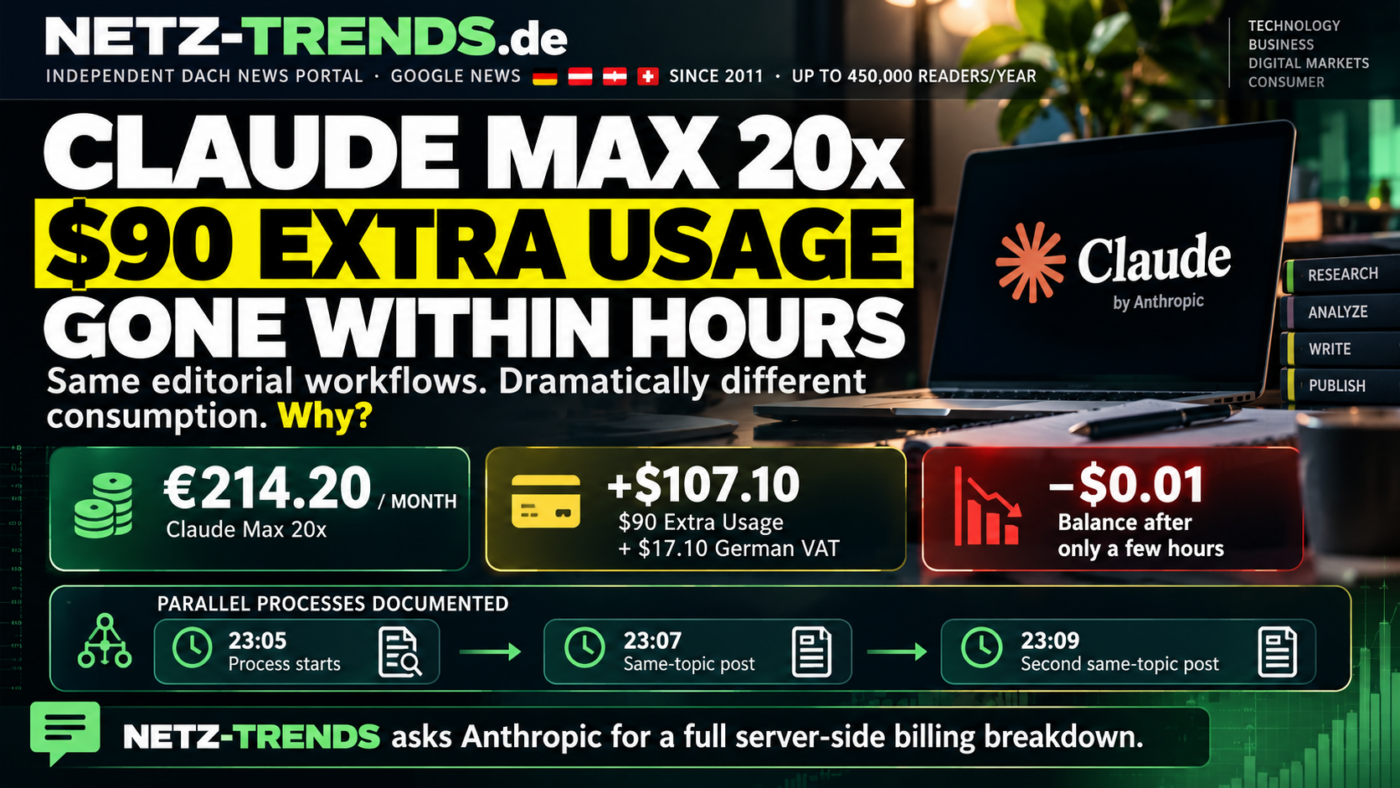
The case concerns NETZ-TRENDS‘ own editorial use of Claude. Our newsroom pays €214.20 per month for Claude Max 20x and uses the AI system intensively for research, editorial production and automated workflows.
After the included weekly usage limit was reached, NETZ-TRENDS purchased $90.00 in prepaid Extra Usage on October 18, 2026. German VAT added another $17.10, bringing the additional invoice to $107.10.
Within only a few hours, the additional $90 balance was exhausted. The account subsequently displayed a balance of approximately -$0.01.
The key question: why did comparable workflows suddenly consume $90 so quickly?
According to our assessment, our usage behaviour during the hours following the purchase did not materially differ from the intensive editorial workflows we had been running during the preceding seven days. That discrepancy is the central issue.
Anthropic states that once the included limits of paid Claude plans are exhausted, usage credits allow customers to continue at consumption-based pricing. According to Anthropic, subsequent usage is billed at standard API rates. Usage can vary depending on the model, conversation length and complexity, selected effort level, tools and other features.
That means $90 in Extra Usage cannot simply be treated as a proportional extension of a Max subscription. But it does not answer the question raised by this case: which specific billable activities consumed the entire $90 within such a short period?
Task logs show parallel processes
The issue is particularly relevant because task logs from one of our automated editorial workflows show apparently overlapping processes.
At approximately 23:05, an automated editorial process started working on a story. It checked the WordPress environment, evaluated potential topics and researched primary sources. While that process was still active, two posts concerning the same topic appeared at approximately 23:07 and 23:09. The original process subsequently abandoned creation of a third article after detecting that the subject had already been handled.
From the customer-facing information available to us, we cannot determine whether all of those processes consumed Extra Usage separately, how much each process cost, whether additional autonomous or sub-agent activity was involved, or whether research and tool calls were charged even when the resulting work was ultimately discarded.
A transparency issue, not merely a $90 issue
Anthropic’s current documentation explains that usage credits are charged separately from a paid Claude subscription and that usage continues until a spending limit is reached or the credit balance runs out. The company also provides controls for spending limits, auto-reload and usage alerts.
For professional users, however, the decisive question is whether the resulting costs can be reconstructed at task level. In an agentic workflow, a human may issue one instruction while software performs research, invokes tools, delegates subtasks or executes work in parallel. Human working time and billable machine activity can therefore diverge substantially.
From an editorial and consumer-protection perspective, NETZ-TRENDS considers the discrepancy extremely serious. If Anthropic cannot transparently reconcile the rapid consumption of the $90 with the actual billable usage, the circumstances would, in our view, come close to what a customer could reasonably perceive as deceptive billing.
This is not a finding that Anthropic committed fraud. Such a conclusion would require evidence that is not currently available to us. It is precisely why NETZ-TRENDS is requesting the underlying server-side usage and billing records before reaching any further conclusion.
NETZ-TRENDS asks Anthropic for a server-side billing breakdown
NETZ-TRENDS has prepared a press inquiry asking Anthropic to explain the incident. Among other points, we are asking the company to identify what exactly consumed the $90 and at what times; provide the server-side usage and billing record from the $90 starting balance to approximately -$0.01; state whether multiple autonomous, scheduled or sub-agent processes were running in parallel; explain whether duplicated or subsequently discarded agent work is charged; and explain the dramatic difference in consumption when, according to our assessment, our usage pattern had not materially changed compared with the preceding days.
We are also asking why the customer-facing interface does not provide a sufficiently detailed task-by-task cost breakdown, and whether Anthropic will refund or restore the affected credit if unintended parallel, redundant or erroneous processes materially contributed to its consumption.
Why the answer matters beyond NETZ-TRENDS
Claude Max is positioned for users who work with Claude frequently and need higher usage capacity. Anthropic describes Max 20x as offering twenty times the Pro plan’s usage allowance. For professional customers building recurring workflows around that capacity, predictability becomes particularly important once the included allowance ends and consumption-based billing begins.
NETZ-TRENDS already pays €214.20 per month for its Max 20x subscription. A permanently and substantially higher expenditure for the same established editorial workflows would not be economically viable for us. Had the potential speed of additional usage costs under otherwise comparable workflows been apparent beforehand, that information would have been material to our purchasing and workflow decisions.
If Anthropic’s server-side records demonstrate that the $90 was fully and correctly attributable to substantially more resource-intensive activity, we will report that finding. If parallel, duplicated or unintended autonomous processes materially contributed to the consumption, we expect Anthropic to explain that as well.
Editorial note: Anthropic is being asked for comment. Any substantive response will be documented transparently in this article.
Sources
- Anthropic Help Center: Manage usage credits for paid Claude plans
- Anthropic Help Center: How do usage and length limits work?
- Anthropic Help Center: What is the Max plan?
- Anthropic invoice dated October 18, 2026, and usage/task logs of the affected Claude account, reviewed by NETZ-TRENDS.