As Germany tightens its own debt-counseling law, the US relies on a different system: an FTC fee ban, state licensing, and a shrinking CFPB.
Key points
- Germany’s new Schuldnerberatungsdienstegesetz takes effect November 20, 2026, setting federal rules for debt counseling access and fees there.
- The US has no equivalent federal licensing law. Instead, a federal trade rule bars most for-profit debt relief firms from charging fees before they deliver results, and states license debt management providers separately.
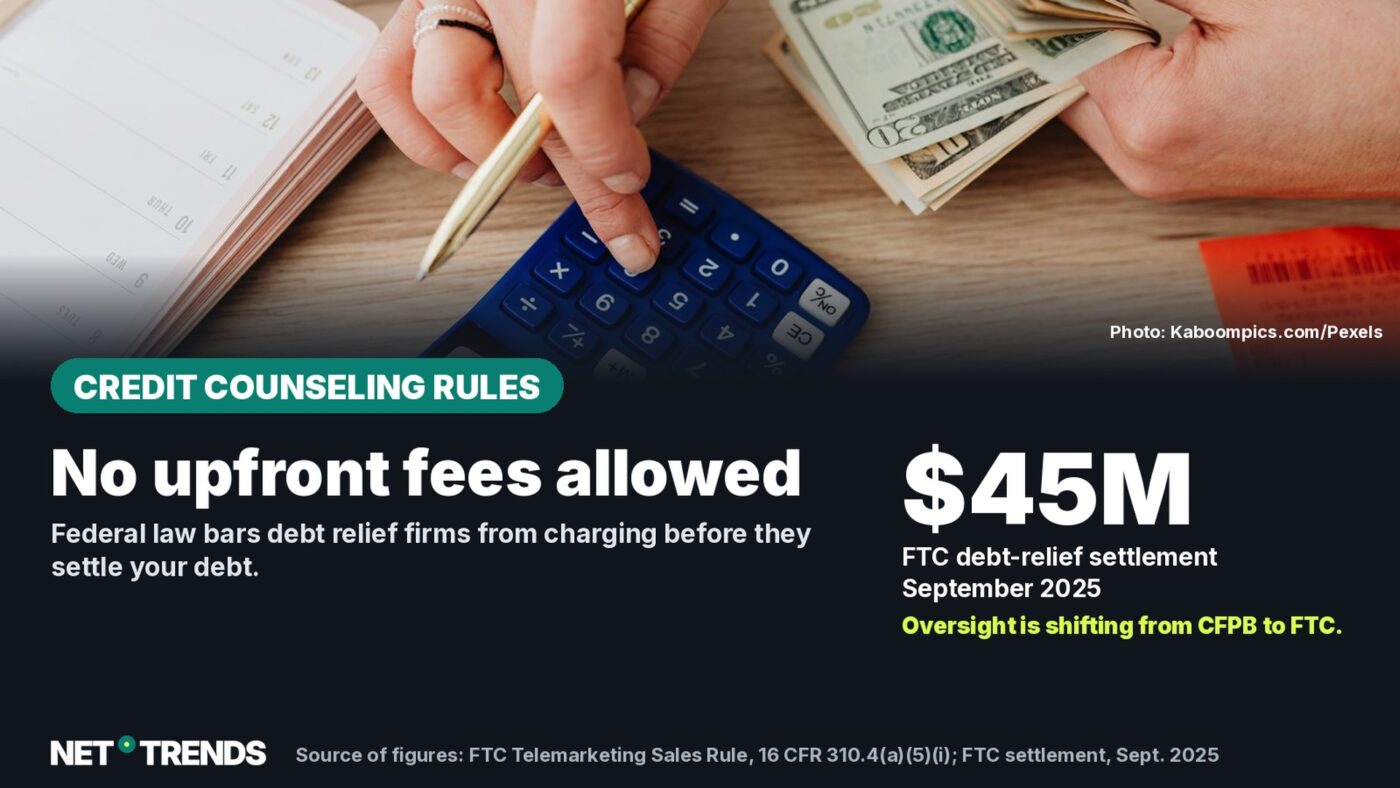
- The Federal Trade Commission’s Telemarketing Sales Rule (16 CFR § 310.4(a)(5)(i)) requires a result and at least one customer payment under the new terms before a debt relief company can collect a fee.
- The Consumer Financial Protection Bureau has scaled back debt-collection enforcement, while the FTC has stepped up debt-relief cases — including a $45 million settlement in September 2025.
Germany’s new Schuldnerberatungsdienstegesetz takes effect November 20, 2026, giving German consumers a federal framework for debt counseling access and fees. The United States has no comparable federal law — but it does have its own patchwork of rules that determine who can charge for debt help, and how. For US consumers behind on credit card bills, medical debt or other unsecured debt, those rules come mainly from the Federal Trade Commission, individual states, and a shrinking federal consumer bureau.
Understanding that patchwork matters because debt relief in the US spans two very different kinds of providers: nonprofit credit counseling agencies that build budgets and debt management plans, and for-profit debt settlement companies that negotiate lump-sum payoffs. The rules — and the risks — differ sharply between the two.
Germany’s new rules, briefly
Germany’s Schuldnerberatungsdienstegesetz (Debt Counseling Services Act) was signed on October 12, 2026, and most of it — the provisions on access, definitions and fees — takes effect November 20, 2026. It implements the EU Consumer Credit Directive 2023/2225 and lets German debt counseling centers charge fees only if they are not unreasonably burdensome and not profit-driven, with advance notice of any cost. The law applies to German federal law and has no direct bearing on US consumers; it is a useful contrast, not a US rule.
How credit counseling and debt relief work in the US
US consumers struggling with unsecured debt typically encounter two kinds of help. The first is nonprofit credit counseling: agencies that offer a free or low-cost budget review and, where appropriate, set up a debt management plan (DMP) that consolidates credit card payments into one monthly payment at a reduced interest rate negotiated with creditors. Many of the best-known agencies are accredited members of the National Foundation for Credit Counseling (NFCC), which requires member agencies to hold Council on Accreditation or ISO 9001 certification, operate as tax-exempt 501(c)(3) nonprofits, and follow its own member quality standards. NFCC-affiliated counselors serve all 50 states and US territories.
The second kind is for-profit debt settlement: companies that negotiate with creditors to pay a reduced lump sum to close an account, typically after the consumer stops paying creditors directly and instead deposits money into a dedicated account. This approach can damage credit scores and trigger collection calls or lawsuits while negotiations are underway, which is why federal rules focus heavily on disclosure and fee timing for this type of provider.
The federal rule: no fees before a result
The main US safeguard is not a licensing law but a fee rule: the Federal Trade Commission’s Telemarketing Sales Rule, specifically its debt relief amendments at 16 CFR § 310.4(a)(5)(i). Under that rule, a for-profit debt relief company cannot collect any fee until it has renegotiated, settled or otherwise altered at least one of the consumer’s debts under an agreement the consumer accepted, and the consumer has made at least one payment under that new agreement. Fees for multiple debts must be charged proportionally or as a uniform percentage of savings — not as a flat upfront charge. Before enrollment, the rule also requires companies to disclose the total fee, how long results are expected to take, and the consequences of stopping payments to creditors, including possible lawsuits and credit damage.
Bona fide nonprofit credit counseling agencies are not covered by the rule’s advance-fee ban, but the FTC has made clear in its own guidance that an organization falsely claiming nonprofit status remains covered. Mortgage-related debt relief is handled separately under the FTC’s Mortgage Assistance Relief Services (MARS) rule, not the telemarketing rule.
The FTC enforces this rule directly. In September 2025, the agency announced settlements with the operators of a student-loan debt-relief company, Superior Servicing, that allegedly claimed a false affiliation with the US Department of Education and collected advance fees for payments it kept for itself; the defendants agreed to pay more than $45 million and to permanently leave the debt-relief industry. In May 2025, the FTC separately obtained a final order worth more than $9.6 million against a debt collector accused of pursuing debts consumers did not owe.
State licensing: the Pennsylvania example
Unlike federal rules, which apply nationwide, licensing of debt management and credit counseling providers happens state by state — and requirements vary widely. Pennsylvania’s Debt Management Services Act (Act 2008-117) is a detailed example: anyone who wants to advertise or provide debt management services to a Pennsylvania consumer needs a license from the state’s Department of Banking and Securities. Applicants must submit audited financial statements, maintain fidelity insurance against employee fraud, post a bond covering the consumer funds they hold, and show that their counselors are certified and accredited. Nonprofits are not automatically exempt from licensing, though Pennsylvania charges them reduced fees. The law also caps specific charges — for example, an initial consultation fee of up to $50 and a monthly maintenance fee capped at $10 per included account, up to $50 total — and the state can impose civil penalties of up to $10,000 per violation.
Other states run comparable licensing regimes under their own debt management or credit counseling statutes, so a company licensed in one state is not automatically licensed to serve consumers in another. Separately, California’s Department of Financial Protection and Innovation finalized new reporting rules in 2025 under the state’s Debt Collection Licensing Act, expanding what debt collectors operating in California must disclose about accounts they pursue.
A federal regulator in retreat
For years, the Consumer Financial Protection Bureau supplemented FTC enforcement in this space, particularly against larger debt collectors and debt relief operations. That has changed: in 2025, the CFPB brought far fewer debt-collection enforcement actions than the year before, and in August 2025 it proposed raising the asset threshold that determines which debt collectors fall under direct federal supervision — a change that, at its highest proposed level, would remove roughly 95% of covered entities from that supervision, according to law firm tracking of the proposal. As of this article’s research date, no final rule had been issued. In practice, that has shifted the enforcement load toward the FTC and toward individual states — New York’s Department of Financial Services, for instance, has added staff with federal enforcement experience to examine large debt buyers.
For consumers, the practical takeaway is that federal oversight of debt relief and credit counseling in the US is real but uneven, and does not guarantee a quick response to a specific complaint. Checking a provider’s accreditation and state license before signing anything remains the most reliable safeguard.
Checklist before signing up with a debt relief or credit counseling company
- Confirm the agency is a 501(c)(3) nonprofit and, ideally, accredited by the NFCC or a similarly recognized body — not just a company that calls itself “nonprofit.”
- Ask whether the provider is licensed in your state for debt management or debt settlement services; a provider licensed elsewhere is not automatically licensed for you.
- If a for-profit company asks for payment before it has settled any debt and you’ve made a payment under the new terms, that is very likely a violation of the FTC’s rule.
- Get the total fee, expected time to results, and the consequences of missing creditor payments in writing before enrolling.
- Remember that stopping payments to creditors during debt settlement can trigger collection calls, lawsuits and credit score damage — ask the provider to explain this risk directly.
None of this replaces individual legal or financial advice. A consumer with urgent collection threats or a pending lawsuit should also consider contacting a legal aid organization or consumer law attorney in their state.
Frequently asked questions
Is credit counseling the same as debt settlement in the US?
No. Nonprofit credit counseling typically means a budget review and, if appropriate, a debt management plan that consolidates payments at a negotiated lower interest rate while debts are paid in full over time. Debt settlement is usually a for-profit service that negotiates a reduced lump-sum payoff, often after the consumer has stopped paying creditors directly — which can hurt credit scores in the meantime.
Can a US debt relief company charge me before it does anything?
For most for-profit debt relief companies, no. Under the FTC’s Telemarketing Sales Rule (16 CFR § 310.4(a)(5)(i)), a fee can only be collected after the company has reached a settlement or similar result for at least one debt and the consumer has made at least one payment under the new agreement.
Does a federal agency check whether a debt relief company is licensed?
Licensing itself is handled at the state level, not federally. The CFPB has reduced its direct supervision of debt collectors in 2025 and 2026, while the FTC continues to bring enforcement cases under its telemarketing and debt-relief rules. Checking a state’s own licensing database for debt management or debt settlement providers remains a separate, additional step.
Is Germany’s new law relevant to US consumers?
Not directly. The Schuldnerberatungsdienstegesetz is German federal law implementing an EU directive, and it governs access to debt counseling in Germany. It has no legal effect in the United States. It is included here as a point of comparison for how differently two countries can regulate the same consumer problem.
Sources and status
- Federal Trade Commission: 16 CFR Part 310, Telemarketing Sales Rule (debt relief services, § 310.4(a)(5)), eCFR, accessed November 8, 2026.
- Federal Trade Commission: “Debt Relief Services & the Telemarketing Sales Rule: A Guide for Business”, FTC staff guidance.
- Federal Trade Commission: Goodwin Procter year-in-review, “Debt Collection and Debt Settlement”, March 31, 2026, summarizing the FTC’s September 2025 Superior Servicing settlement and the CFPB’s 2025 proposed supervision-threshold rule.
- Pennsylvania General Assembly: Debt Management Services Act, Act 2008-117.
- National Foundation for Credit Counseling: NFCC member agency standards, accessed November 8, 2026.
- Schuldnerberatungsdienstegesetz: text of the German law (in German), for comparison only.
Research and legal status as of: November 8, 2026. US statements reflect federal law and the Pennsylvania example cited; other states’ rules differ and are not all covered here.
Transparency note: AI-assisted tools were used in researching, structuring and writing this article. The sources used are listed in the article. Publication takes place only after manual editorial approval. Country edition based on an article from Net Trends, researched for the US.
Share this article