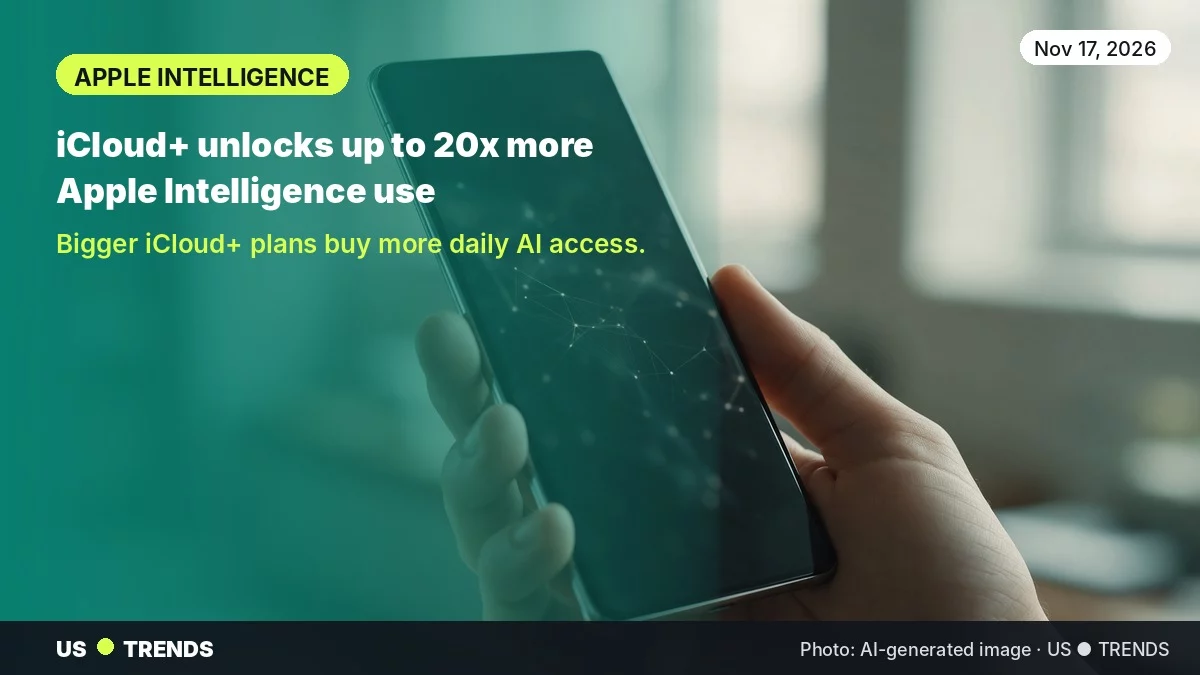
Apple is capping daily use of its cloud-based AI features. A bigger iCloud+ plan can raise that cap by up to 20 times in the US – a deal Apple does not offer in the EU, the UK or several other markets.
Das Wichtigste in Kürze / Key points
- Apple is introducing daily usage limits for AI features that run on its servers, including photo clean-up, Image Playground and Siri AI.
- Starting with iOS 27.3, larger iCloud+ plans in the US raise that limit: from double (200 GB) up to 20 times (12 TB) the standard daily amount.
- Apple’s support document explicitly ties the extra allowance to US-available iCloud+ tiers and excludes China, Brazil, the EU, the UK and South Korea.
- Apple does not publish how many requests the standard daily limit actually covers, so there is no way to know in advance who would ever hit it.
Apple is capping how often its AI features can be used per day. In the US, paying for a bigger iCloud+ plan is the one way to raise that cap – something Apple is not offering everywhere.
Apple published the usage-limits support document on its US support site on 16 November 2026. It states the higher tiers start with software release 27.3. The current release is iOS 27.2.1, which shipped 9 November 2026 according to Apple’s software update overview; no date has been given yet for 27.3.
Which features get a daily limit
The limit covers features that run on Apple’s servers rather than entirely on-device: Siri AI; the “Clean Up”, “Expand” and spatial-reframing photo tools; Image Playground; Shortcuts actions that use the AFM Cloud and Cloud Pro models; and third-party apps that call Apple’s models through the Private Cloud Compute infrastructure.
The cap applies per device and per feature area. Once a user hits it, Apple shows a notification; basic Siri requests, like setting a timer, keep working regardless. The allowance resets daily, generally around local midnight, and any unused allowance is lost, not carried over.
Apple first flagged usage limits for these features back in September 2026. What’s new now is the detail on how iCloud+ tiers change that limit in the US – and the list of regions where that upgrade path does not exist at all.
iCloud+ in the US: up to 20x more
Per Apple’s document, from release 27.3 US iCloud+ subscribers get: 50 GB at the standard limit; 200 GB up to double; 2 TB up to five times; 6 TB up to ten times; and 12 TB up to 20 times the standard per-device limit. The extra allowance is shared across every device on the Apple Account and with Family Sharing members.
The same document specifies where this does not apply: expanded access to select Apple Intelligence features via iCloud+ “is not available in China, Brazil, the EU, UK, or South Korea.” For Siri AI specifically, Apple names Brazil, the EU, the UK and South Korea. No reason is given for any of these exclusions.
| iCloud+ plan (US price, excl. sales tax) | Daily Apple Intelligence limit |
|---|---|
| 50 GB – $0.99/month | Standard device limit |
| 200 GB – $2.99/month | Up to 2x standard |
| 2 TB – $9.99/month | Up to 5x standard |
| 6 TB – $29.99/month | Up to 10x standard |
| 12 TB – $59.99/month | Up to 20x standard |
| Bottom line | In the US, the 12 TB plan is the only way to reach 20x the daily AI allowance. |
What the top tier costs over a year
- 200 GB: $2.99 × 12 = $35.88/year for up to 2x
- 2 TB: $9.99 × 12 = $119.88/year for up to 5x
- 6 TB: $29.99 × 12 = $359.88/year for up to 10x
- 12 TB: $59.99 × 12 = $719.88/year for up to 20x
Calculation: Apple’s listed US monthly price times twelve, before sales tax, which varies by state and is added separately at checkout.
Why this is a US story
The expanded-access offer is, for now, specifically a US iCloud+ feature: Apple’s document frames the whole upgrade path around US-available plans and explicitly rules out the EU, UK, China, Brazil and South Korea. Apple has not published a matching document for other English-language markets with the same detail; the UK and EU versions of the general usage-limits page still show the older, September 2026 wording with no mention of the iCloud+ tiers at all.
For US users, that means the practical choice is real: anyone who regularly hits the daily cap on photo clean-up, Image Playground or an AFM Cloud Pro shortcut can decide whether a bigger iCloud+ plan is worth it for more headroom, in addition to the extra storage.
What Apple does not say
Apple never discloses the actual size of the “standard” daily limit, for any plan. The document only says it “may change over time.” Without that baseline number, it’s not possible to say in advance how often a typical user would actually run into the cap, or how much a 2x or 20x multiplier really buys in practice.
It also remains open whether Apple will later offer the same iCloud+ upgrade path to users in the EU, UK or other excluded markets, and Apple gives no timeline for the final release of iOS 27.3.
Frequently asked questions
Which Apple Intelligence features get a daily limit?
Features that use Apple’s servers: Siri AI; the “Clean Up”, “Expand” and spatial-reframing photo tools; Image Playground; Shortcuts using the AFM Cloud and Cloud Pro models; and third-party apps built on Private Cloud Compute.
How do I get a higher daily limit in the US?
By subscribing to a larger iCloud+ plan once release 27.3 ships: 200 GB and up raise the limit, up to 20x on the 12 TB plan, per Apple’s 16 November 2026 document.
Does this work the same way outside the US?
No. Apple’s document says the expanded access is not available in China, Brazil, the EU, the UK or South Korea.
How big is the standard daily limit?
Apple does not say. The document refers only to a “standard amount” per device and notes that it may change over time.
Quellen und Stand / Sources and status
- Apple: About Apple Intelligence usage limits (support document, 16 Nov 2026)
- Apple: iCloud+ plans and pricing (accessed 17 Nov 2026)
- Apple: Apple security releases (software update overview, accessed 17 Nov 2026)
Stand / As of: 17 November 2026.
Transparency note: AI-assisted tools were used in researching, structuring and writing this article. The sources used are listed in the article. Publication takes place only after manual editorial approval.
Share this article

Comment Tell us what you think →