The EU’s new 2-euro handling fee for online imports does not apply in the US or the UK. But American shoppers already lost a bigger exemption in 2025, and UK parcels from outside the EU carry their own charges too.
Key points
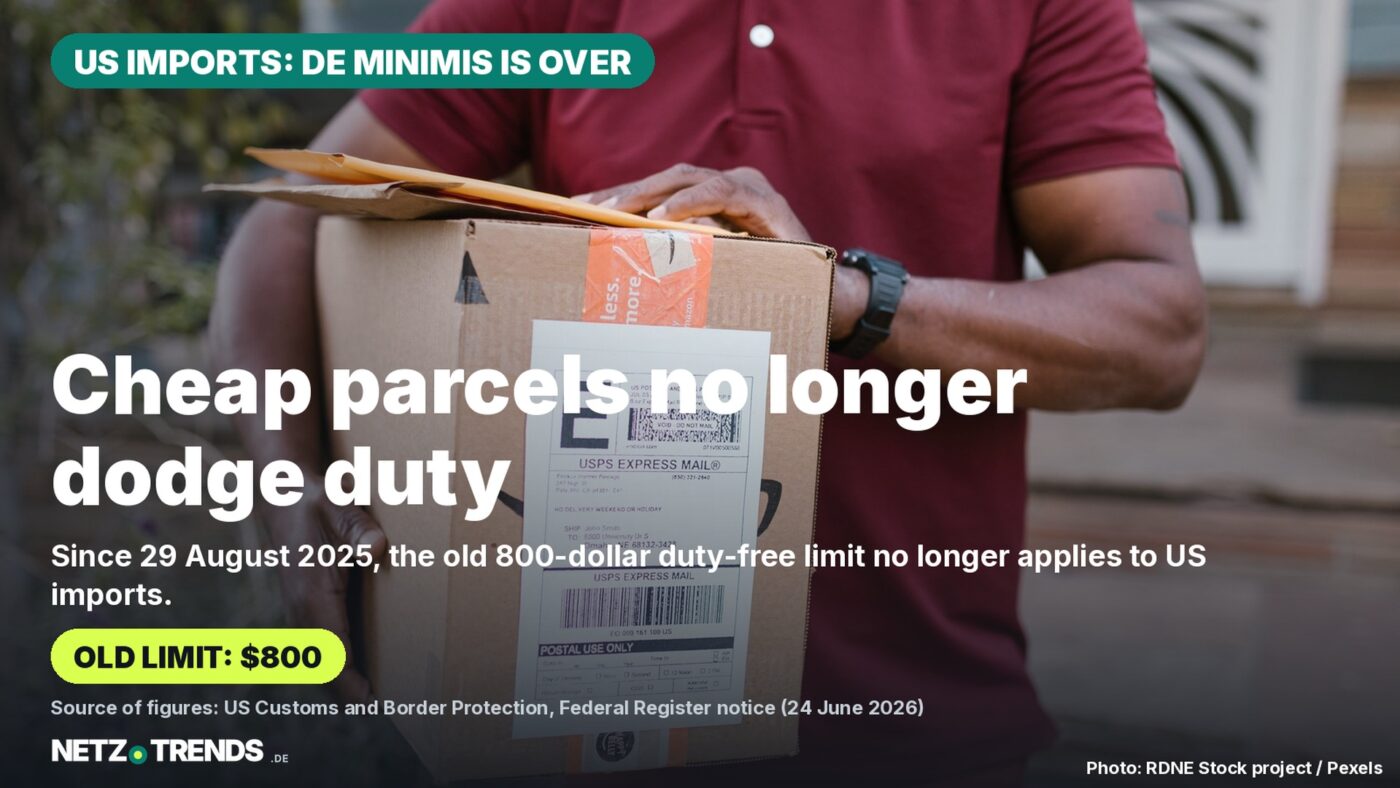
- Since 29 August 2025, the United States no longer exempts low-value imports worth 800 dollars or less from duty – the “de minimis” exemption was suspended by executive order.
- A further US Customs rule, effective 24 June 2026, ends simplified “release from manifest” entry for most low-value parcels arriving by courier, so more shipments need a formal or informal customs entry.
- The European Union, by contrast, introduced a separate 2-euro handling fee per customs item from 1 November 2026 for its own member states – it does not apply to parcels shipped to the UK or the US.
Anyone ordering a low-cost item from an overseas online shop into the United States is now dealing with customs duty that used to be waived entirely. Since August 2025, the exemption that let packages worth up to 800 dollars enter free of duty and tax has been suspended – and a newer rule tightens how those shipments are processed.
The change goes back to an executive order under the Trump administration that suspended the duty-free “de minimis” treatment under 19 U.S.C. 1321(a)(2)(C), first for shipments from China and Hong Kong in May 2025, then for imports from every country from 29 August 2025. The 800-dollar threshold itself dated back to a 2016 law that had raised it from 200 dollars.
On 24 June 2026, US Customs and Border Protection (CBP) went a step further for parcels arriving by courier and other non-postal modes: an interim final rule indefinitely suspended the “release from manifest” shortcut that let many low-value shipments clear customs with minimal paperwork. The simplified “Entry Type 86” option has been suspended, and importers must now generally use formal or informal entry procedures with more data submitted to CBP.
What applies to US imports now
Before August 2025, a package worth 800 dollars or less, imported by one person on one day, could generally enter the United States free of duty and tax. That exemption is now suspended indefinitely for commercial shipments arriving by any mode, following the executive order and CBP’s implementing rules. The separate bona fide gift exemption (100 dollars, or 200 dollars from certain island possessions) and the personal/household goods exemption (200 dollars) still exist and are not affected.
CBP’s June 2026 rule does not itself set a specific new duty rate or ad valorem percentage in the text of the notice – it directs officers to continue collecting “applicable duties, taxes, fees, and charges” as the underlying executive order requires, which in practice can include the general tariff on the product category plus any country-specific tariffs that apply. Statutory termination of the old exemption is scheduled for 1 July 2027 under separate legislation, which would make the suspension permanent in law rather than only by executive order.
Who ends up paying
The CBP notice does not say in so many words whether the consumer, the carrier or the retailer must cover the new duty – it refers only to “a party qualified to make such entry.” In practice, many overseas retailers and marketplaces have started charging duty at checkout or adding it to the shipping cost, while some courier services bill the recipient separately before delivery. Shoppers buying from non-US sellers should expect either a higher price at checkout or a separate customs bill, depending on how the seller or carrier handles it.
Practical checklist for US shoppers
- Check at checkout whether duty is already included in the price, or ask the seller how it is billed.
- Expect a separate invoice from the courier (UPS, FedEx, DHL or the postal service) if duty was not collected in advance.
- Gifts sent by individuals may still qualify for the 100-dollar gift exemption – check the sender’s declaration.
- For regularly ordered goods from the same overseas seller, ask whether formal entry paperwork could slow delivery compared with before August 2025.
What this means in the UK
The EU’s new fee and the US rule changes do not apply to parcels sent to the United Kingdom, which left the EU customs union. UK shoppers ordering from outside the UK already face their own long-standing rules: import VAT generally applies above a 135-pound threshold for most goods, and parcel operators such as Royal Mail or couriers can charge their own handling fee on top of any duty or VAT collected on behalf of HM Revenue & Customs. Those charges are separate from both the EU’s new 2-euro fee and the US de minimis suspension, and they have not changed as part of either move.
How this compares with the EU’s new fee
The European Union took a different route for its own 27 member states: instead of removing a value-based exemption, the European Commission introduced a flat 2-euro “Union handling fee” per customs item from 1 November 2026, on top of a temporary 3-euro duty already in place since July 2026 for certain parcels up to 150 euros. That EU fee applies only to goods entering the EU’s customs territory – it has no effect on shipments into the US or the UK, just as the US rule change has no effect on parcels entering the EU.
Frequently asked questions
Does every package into the US now get charged duty?
Low-value commercial shipments that used to qualify for the 800-dollar de minimis exemption generally no longer do, since the exemption was suspended from 29 August 2025. Genuine gifts up to 100 dollars and personal/household goods up to 200 dollars remain exempt.
Does the EU’s new 2-euro fee apply to US or UK shoppers?
No. It only applies to goods entering the European Union’s 27 member states from 1 November 2026. US imports are governed by separate CBP rules, and UK imports by separate HMRC and courier rules.
Is the US change permanent?
It currently rests on an executive order and CBP’s implementing rules, which can in principle change again. Separate legislation schedules a statutory end to the old exemption from 1 July 2027, which would lock the suspension into law.
Have the new US customs rules changed what you pay for packages from abroad? Share your experience in the comments.
Sources and status
- US Customs and Border Protection: interim final rule indefinitely suspending de minimis release-from-manifest procedures, Federal Register, 24 June 2026
- Federal Register: notice implementing the August 2025 suspension of the de minimis exemption
- European Commission: customs guidance on the temporary 3-euro duty and the Union handling fee, version of 5 October 2026 (in German original article; same Commission guidance applies EU-wide)
Research and data status: 2 November 2026.
Transparency note: AI-assisted tools were used in researching, structuring and writing this article. The sources used are listed in the article. Publication takes place only after manual editorial approval. Country edition based on an article from Net Trends, researched for the United States and the United Kingdom.
Share this article