Which? compares UK investment platforms: fees range from nothing to £150 a year on a £5,000 portfolio
Key points
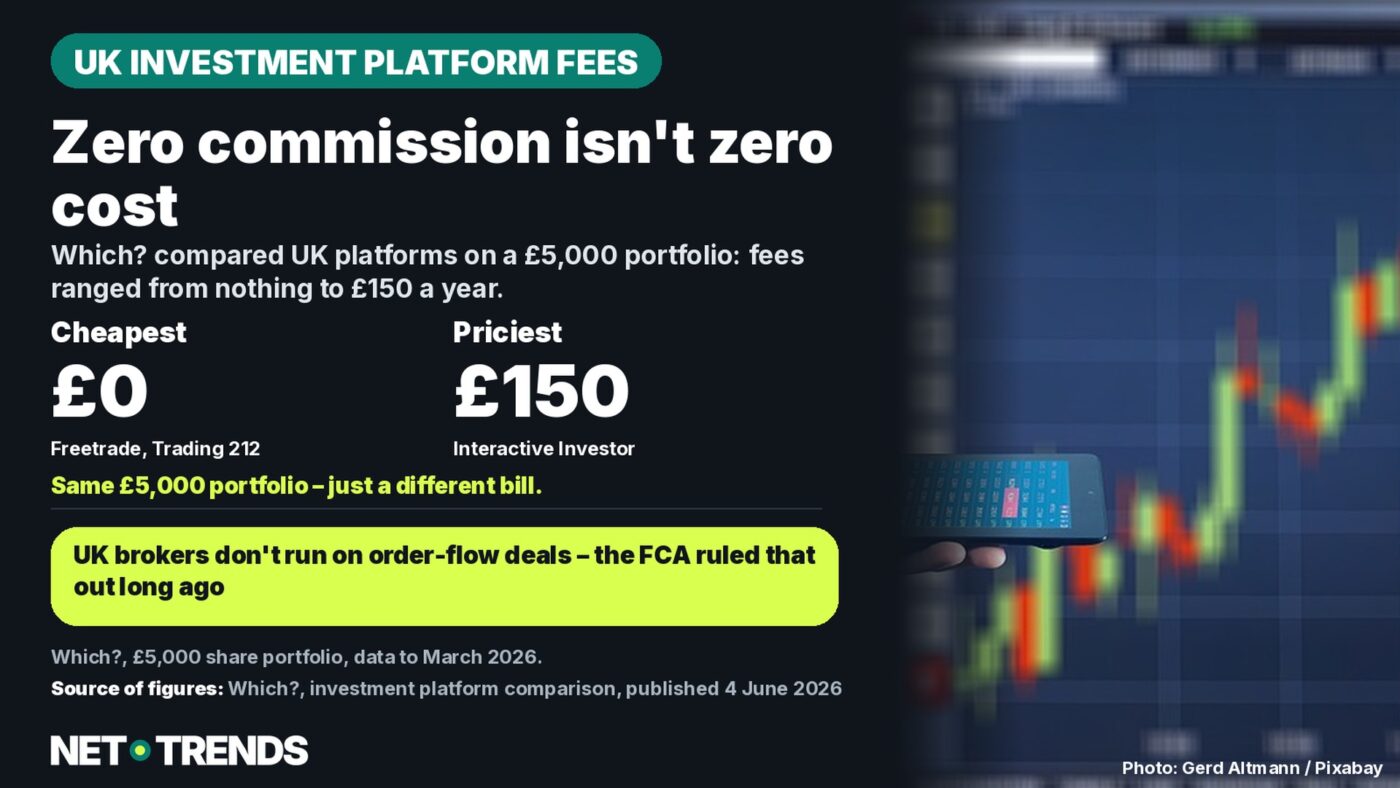
- Consumer group Which? compared UK investment platforms using data to 1 March 2026 and found annual fees on a £5,000 share portfolio ranging from £0 to £150 – and up to £2,262 a year on a £500,000 portfolio.
- Payment for order flow (PFOF) – rebates that trading venues pay brokers for routing client orders their way – has been banned across the EU since 1 July 2026 under Regulation (EU) 2024/791. The UK never adopted that EU rule.
- That does not mean PFOF is common in Britain: the Financial Conduct Authority (FCA), and before it the Financial Services Authority, has treated most PFOF arrangements as incompatible with its inducement and best-execution rules since 2012 guidance FG12/13 – more than a decade before the EU’s ban.
- Hargreaves Lansdown cut its standard share-dealing charge from £11.95 to £6.95 per trade in early 2026, while Freetrade and Trading 212 continue to charge no commission at all on share and ETF trades.
Which? compared UK investment platforms and found a £150-a-year gap on a £5,000 share portfolio, rising to £2,262 at £500,000. Unlike Germany, where an EU-wide ban on broker rebates is reshaping prices, UK regulation already kept that practice out of the mainstream.
For British savers choosing where to hold shares, funds or an ISA, the UK market looks different from the one Net Trends recently described in Germany. There, the Stiftung Warentest found that a new EU-wide ban on “payment for order flow” was forcing neobrokers to rework their pricing (in German). In the UK, the bigger cost difference between providers comes from platform and dealing fees that have little to do with PFOF – because PFOF has barely featured in British retail investing for years.
That does not make the UK story less relevant to savers. Which?’s comparison, using fee schedules current to 1 March 2026, shows that the platform someone picks can matter as much to their return as the investments they choose.
Which? finds a £150-to-£2,262 gap
Which?, the UK’s best-known consumer organisation, publishes an annually updated comparison of investment platform fees on which.co.uk, with figures stated as correct to 1 March 2026. Unlike the Stiftung Warentest study that prompted Net Trends’ German article, Which? publishes its fee tables openly rather than behind a paywall, comparing named platforms directly.
On a £5,000 portfolio held in shares, investment trusts or ETFs, Which? found annual platform costs ranging from £0 at Freetrade, Trading 212 and InvestEngine up to £150 at Fidelity, with Interactive Investor’s flat fee working out at £103.80 a year for that portfolio size. On a £500,000 portfolio, the gap between the cheapest and most expensive provider reaches £2,262 a year across funds, shares and ETFs alike.
“Choosing the right investment platform could save you hundreds of pounds a year.”
Which?, investment platform fee comparison, which.co.uk
Why the gap is so wide
Three things drive the difference between UK platforms: whether they charge a percentage-based custody fee or a flat monthly subscription, whether dealing is free or commission-based, and how foreign-exchange fees are applied to US and European shares. Percentage-based platforms tend to suit smaller portfolios, since a flat monthly fee can outweigh the saving once the amount invested is small. Flat-fee platforms such as Interactive Investor tend to become cheaper as a portfolio grows, because the monthly charge stays the same regardless of portfolio size.
Free-trading apps such as Freetrade and Trading 212 remove dealing commission entirely but still charge for currency conversion when buying US or European shares, and Freetrade’s higher-tier subscriptions (£4.99 or £9.99 a month) lower that FX fee in exchange for a monthly cost. None of this has anything to do with payment for order flow – it is simply a different business model to the fee structures the Stiftung Warentest tested in Germany.
Model calculation: annual cost on a £5,000 share portfolio
- Assumption: £5,000 held in UK-listed shares or ETFs, Which?’s standard comparison basis.
- Cheapest providers (Freetrade, Trading 212): £0 a year in platform fees, though FX fees apply to non-GBP trades.
- Most expensive provider in this size band (Fidelity): £150 a year in platform fees alone, before any dealing charges.
Calculation: Which?’s published figures for a £5,000 shares/ETF portfolio, correct to 1 March 2026. Dealing commission, where it applies, is calculated separately in the broker comparison below.
PFOF: an EU rule the UK never needed
Payment for order flow describes payments that trading venues or market makers make to a broker in return for routing client orders to them rather than to a rival venue. Since 1 July 2026, Regulation (EU) 2024/791 has prohibited the practice across the European Union, including for Germany’s neobrokers – the subject of Net Trends’ earlier German-language report on the Stiftung Warentest’s depot comparison.
The United Kingdom left the EU’s single market for financial services after Brexit and was never bound by the 2024 regulation. That might suggest PFOF could be thriving in Britain. In practice, the opposite is closer to the truth: the Financial Services Authority, the FCA’s predecessor, set out in finalised guidance FG12/13 in May 2012 that payments from market makers to brokers are “unlikely to be compatible” with the regulator’s inducements rule (COBS 2.3) unless a firm can show the payment improves client service and does not compromise best execution – a bar the guidance itself says is hard to clear for PFOF. The FCA has maintained that position since taking over from the FSA, more than a decade before the EU acted.
That history explains why UK commentators have reacted differently to the EU’s 2026 ban than their German counterparts. One industry commentator argued in CityAM in April 2026 that the UK’s rules, in place for “more than a decade,” already achieve what the EU ban is trying to do, while the FCA itself flagged payment for order flow as a point of interest for continued supervision in its wholesale markets regulatory priorities report, published in March 2026. No UK ban equivalent to the EU’s Article is being proposed – supervisors here rely on the existing conduct rules rather than a blanket prohibition.
What UK brokers charge today
The table below shows the core online share-dealing charge and account/custody fee at five platforms widely used by UK retail investors, based on each provider’s own pricing pages. None of the changes shown here were driven by PFOF rules – they reflect ordinary competition and, in Hargreaves Lansdown’s case, a broader fee overhaul announced in January 2026.
| Broker | Online share trade | Account/custody fee |
|---|---|---|
| Hargreaves Lansdown | £6.95 | 0.35%/year on shares & ETFs, capped at £150; 0.35% on funds up to £250,000 (cut from £11.95/0.45% in Jan 2026) |
| AJ Bell | £5.00* | 0.25%/year on shares, capped at £3.50/month; 0.25% on funds up to £250,000; funds dealing £1.50 |
| interactive investor | from £5.99/month** | Flat monthly subscription (£5.99–£39.99) instead of a percentage fee; higher plans include free trades |
| Freetrade | £0 | No commission on shares/ETFs; £0–£9.99/month plan fee; FX fee 0.99% (Basic) to 0.39% (Plus) on non-GBP trades |
| Trading 212 | £0 | No commission, no account fee; FX fee of up to 0.15% on non-GBP trades |
* £3.50 if ten or more share deals were made in the previous calendar month. ** interactive investor charges a flat monthly fee rather than per-trade commission; its Premium plan (£39.99/month) includes two free UK/US trades a month, with further UK/US trades at £2.99 each. Source: each provider’s own pricing page, checked 3 November 2026. Figures can change; always confirm current charges with the provider.
Two things stand out. First, free-trading apps (Freetrade, Trading 212) remove dealing commission entirely but recoup some margin through FX fees on non-GBP trades – a transparent charge, disclosed upfront, rather than a rebate hidden inside the order-routing process. Second, the percentage-based platforms (Hargreaves Lansdown, AJ Bell) now compete heavily on custody fees rather than per-trade pricing, which is why Hargreaves Lansdown’s January 2026 fee cut made headlines: it lowered both its dealing charge and its percentage fee at the same time.
Checklist before choosing a platform
- Compare the account/custody fee for your actual portfolio size, not just the headline dealing charge – Which?’s figures show the ranking changes between £5,000 and £500,000 portfolios.
- Check whether a provider charges a percentage fee, a flat monthly subscription, or both – flat fees tend to suit larger portfolios, percentage fees tend to suit smaller ones.
- If you expect to hold US or European shares, check the FX conversion fee separately – it can outweigh any saving from “free” dealing.
- Ignore PFOF-related price swings reported from Germany or the rest of the EU: UK brokers are not affected by the 1 July 2026 EU ban and were not relying on that revenue in the first place.
- If you trade often, compare the number of included trades per month on flat-fee platforms, not only the headline monthly price.
For investors who rarely trade and mainly pay into a stocks and shares ISA or a pension through regular contributions, the account/custody fee matters far more than the dealing charge. Those who buy and sell shares frequently will feel the per-trade commission – or the FX fee on free-trading apps – more directly over a year.
Frequently asked questions
How big is the gap between the cheapest and most expensive UK investment platform?
According to Which?’s comparison, correct to 1 March 2026, a £5,000 share or ETF portfolio costs between £0 and £150 a year in platform fees depending on the provider. On a £500,000 portfolio, the gap widens to £2,262 a year.
What is payment for order flow, and is it banned in the UK?
Payment for order flow (PFOF) is a payment a trading venue or market maker makes to a broker for routing client orders its way. The EU has banned it outright since 1 July 2026 under Regulation (EU) 2024/791. The UK has no equivalent statutory ban, but FCA guidance (FG12/13, May 2012) treats most PFOF arrangements as incompatible with its existing inducement and best-execution rules, which has kept the practice largely out of the UK retail market for more than a decade.
Why doesn’t the EU’s 2026 PFOF ban change much for UK investors?
Because UK brokers were not relying on payment for order flow in the way some EU neobrokers were before the ban. The price changes reported in Germany – new charges for trading away from a broker’s preferred venue, and new bonus schemes the BaFin is scrutinising – stem from brokers replacing lost PFOF income. UK platforms’ fee structures, including Hargreaves Lansdown’s January 2026 cut and the free-trading model at Freetrade and Trading 212, were not built around that revenue source.
Is a free-trading app automatically the cheapest option?
Not necessarily. Freetrade and Trading 212 charge no dealing commission, which makes them the cheapest option in Which?’s comparison for UK shares and ETFs. But both charge a foreign-exchange fee on non-GBP trades, and Freetrade’s higher-tier plans combine a monthly subscription with a lower FX fee, so the cheapest plan on paper is not always cheapest in practice once US or European shares are involved.
Have you compared your own platform’s fees against a rival recently – and did the difference surprise you? Let us know in the comments.
Sources and status
- Which?: investment platform fee comparison, data correct to 1 March 2026 (which.co.uk).
- Financial Conduct Authority / Financial Services Authority: Finalised Guidance FG12/13 on payment for order flow and the inducements rule, May 2012 (fca.org.uk).
- Financial Conduct Authority: Wholesale Markets regulatory priorities report, March 2026 (fca.org.uk).
- European Union: Regulation (EU) 2024/791 amending Regulation (EU) No 600/2014 (MiFIR), prohibiting payment for order flow from 1 July 2026 (eur-lex.europa.eu).
- Which?: “Hargreaves Lansdown cuts fees – but price rises lurk in the small print,” 30 January 2026 (which.co.uk).
- AJ Bell: dealing account charges, pricing page checked 3 November 2026 (ajbell.co.uk).
- interactive investor: new price plans from 1 February 2026 (ii.co.uk).
- Freetrade: plan pricing and FX fees, pricing page checked 3 November 2026 (freetrade.io).
- Trading 212: fee schedule and FX fee, reviewed via brokerchooser.com, checked 3 November 2026.
- CityAM: “Banning payment for order flow is an EU blunder the UK shouldn’t repeat,” 29 April 2026 (cityam.com) – opinion piece, cited for the UK regulatory contrast it describes, not as a factual primary source.
- Stiftung Warentest: press release on German depot fees that prompted Net Trends’ original German-language report, 12 October 2026 (test.de) (in German).
Research and data as of: 3 November 2026.
Transparency note: AI-assisted tools were used in researching, structuring and writing this article. The sources used are listed in the article. Publication takes place only after manual editorial approval. Country edition based on an article from Net Trends, researched for the United Kingdom.
Share this article