Destatis reports 1.3 percent growth year-on-year – investment falls, exports weaken, ECB leaves key rate unchanged
Key points
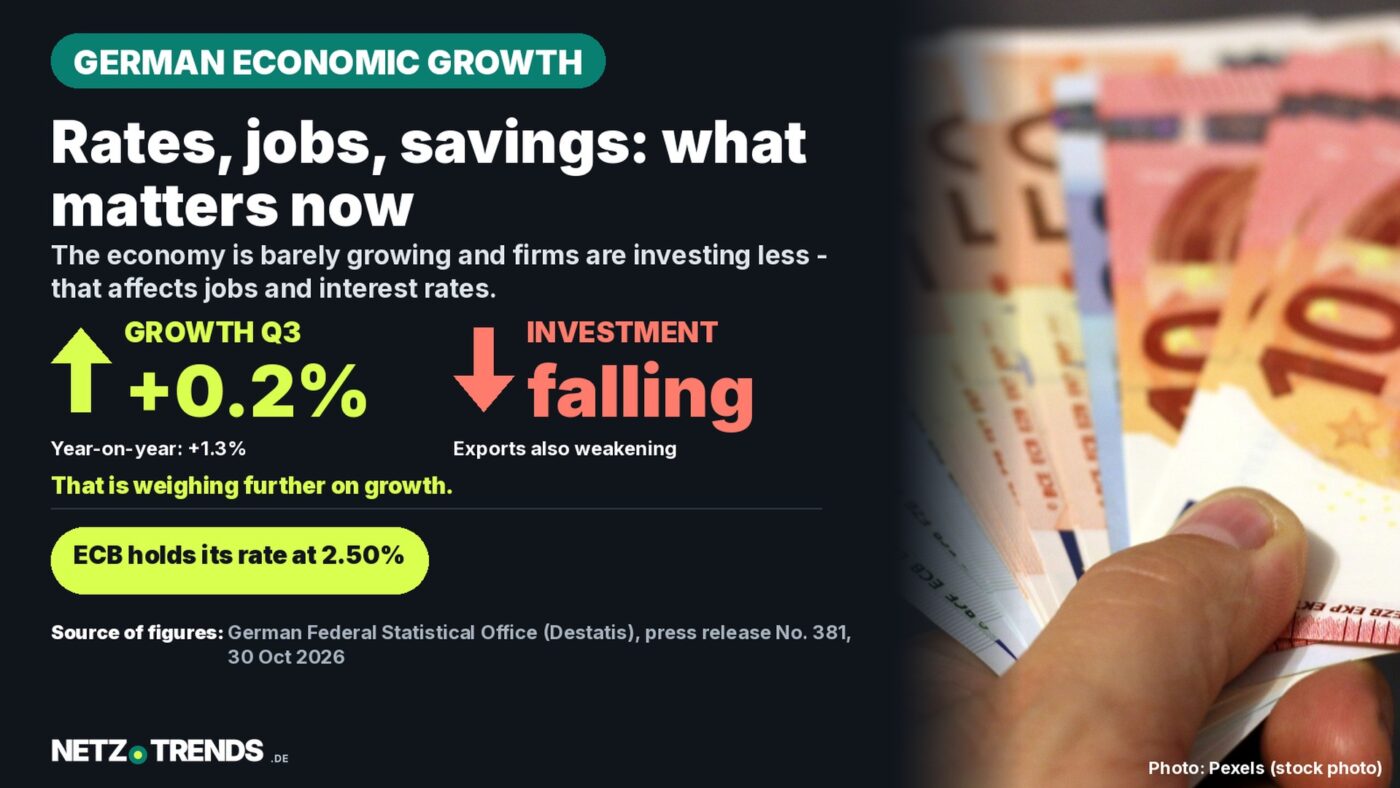
- Gross domestic product (GDP) rose 0.2 percent quarter-on-quarter and 1.3 percent year-on-year in the third quarter of 2026, according to Destatis (price-adjusted).
- Corporate investment declined according to preliminary findings, and exports, which had been very dynamic, also weakened noticeably in the third quarter.
- The European Central Bank nevertheless kept its key interest rate for the eurozone at 2.50 percent; Destatis will publish the detailed GDP results on 25 November 2026.
The German economy grew by just 0.2 percent in the third quarter of 2026. At the same time, corporate investment declined, according to a first estimate by the Federal Statistical Office (Destatis).
For employees, savers and anyone currently planning a loan or a mortgage, this is more than an abstract economic figure: weak growth combined with falling investment is generally seen as an early indicator of how secure jobs are and how likely noticeably lower interest rates are in the coming months.
The figures at a glance
According to figures from the Federal Statistical Office (Destatis, Germany’s national statistics agency) dated 30 October 2026, price-, seasonally- and calendar-adjusted GDP was 0.2 percent higher than in the previous quarter. Compared with the same quarter of the previous year, price-adjusted growth was 1.3 percent, or 1.2 percent calendar-adjusted. At current prices, i.e. without adjusting for price increases, economic output reached 1,188.63 billion euros – a nominal increase of 4.6 percent year-on-year.
| Indicator | Q3 2026 |
|---|---|
| GDP vs. previous quarter (price-, seasonally-, calendar-adjusted) | +0.2% |
| GDP vs. same quarter last year (price-adjusted) | +1.3% |
| GDP vs. same quarter last year (price- & calendar-adjusted) | +1.2% |
| GDP, nominal (current prices) | €1,188.63bn |
| GDP, nominal, vs. same quarter last year | +4.6% |
Germany, change versus the respective comparison period stated. Source: Federal Statistical Office (Destatis), press release No. 381 of 30 October 2026, first calculation.
Destatis explicitly notes that this is a first calculation. The previous quarters were also revised as part of this release, though no changes resulted for price-adjusted quarterly GDP for the first and second quarters of 2026.
Why investment and exports are slowing
Among the expenditure components named by Destatis in the first estimate, one development stands out in particular: corporate investment declined, according to preliminary findings. Private household consumer spending, by contrast, had a slightly positive effect on growth.
Foreign trade also acted as a drag: exports, which had grown very dynamically in the first half of 2026, weakened noticeably in the third quarter, according to the Federal Statistical Office. Destatis gives no figures for government spending or the exact net contribution of foreign trade in the first estimate – these details are due to follow with the detailed results on 25 November 2026.
A decline in corporate investment is generally regarded in economics as a signal of subdued expectations for the future: companies investing in machinery, plants or buildings are typically committing for years – a decline suggests that companies expect weaker demand or currently consider financing expensive.
Model calculation: how much of the increase is just price inflation?
- Nominal growth: +4.6% year-on-year (at current prices, €1,188.63bn)
- Real (price-adjusted) growth: +1.3% year-on-year
- Arithmetic difference: about 3.3 percentage points
Model calculation: Net Trends, simple difference between the two annual rates reported by Destatis. The difference approximates the so-called GDP deflator, i.e. the price trend of total economic output – it is not identical to consumer price inflation, which Destatis reports separately and which most recently stood at 2.8 percent. Not a forecast.
The fact that a substantial part of the nominal increase is due to price rises rather than actually higher output of goods and services also explains why the real growth of 1.3 percent barely feels like a noticeable upswing for many households. For comparison: general inflation in Germany stood at 2.8 percent in October 2026 according to preliminary figures, as Net Trends reported (in German) – the two figures measure different things, but they point in a similar direction: part of the growth is being eaten up by higher prices.
What this means for loans and savers
For the European Central Bank (ECB), responsible for monetary policy across the eurozone, economic developments are one of several factors behind future interest-rate decisions. Only on 30 October 2026 did it leave its key rate unchanged, as Net Trends reported (in German); mortgage rates in Germany stood at around 4.09 percent at that point. Weak growth combined with subdued investment tends to increase pressure on central banks to cut rates over the medium term – though there is no guarantee of that, and the 30 October decision predates today’s GDP release.
Consumer sentiment also shows the same caution: the consumer climate index for November 2026 most recently reported by Net Trends fell further to minus 30.8 points (in German) – an indication that consumers remain cautious about major purchases despite easing inflation.
Checklist: what consumers can consider now
- Anyone planning a mortgage or installment loan: compare current interest offers rather than betting on rapidly falling rates – the key rate remained unchanged on 30 October 2026.
- Anyone saving: compare the interest rates on call-money and fixed-deposit accounts with the current inflation rate of 2.8 percent to roughly gauge the real return.
- Employees in export-oriented industries: keep an eye on order trends in their own sector, as weaker exports can affect investment and staffing decisions with a delay.
- Mark 25 November 2026: that’s when Destatis will publish the detailed GDP results with further details on investment, government spending and foreign trade.
None of these points replaces individual financial or investment advice; the economic data merely provide the framework within which such decisions are currently being made.
What remains open
The 30 October 2026 release is a preliminary first calculation. Destatis names neither the exact extent of the investment decline in percentage terms, nor the contribution of government spending or the net contribution of foreign trade to growth – these figures are only due to follow with the detailed results on 25 November 2026. Until then, it is also not possible to say precisely which industries are feeling the investment decline most strongly.
How do you assess the development – more of a reassurance, because the economy keeps growing despite everything, or more of a warning sign, because companies are investing more cautiously? Feel free to share your assessment in the comments.
Frequently asked questions
How much did German gross domestic product grow in the third quarter of 2026?
According to preliminary figures from the Federal Statistical Office, price-, seasonally- and calendar-adjusted GDP rose 0.2 percent quarter-on-quarter. Compared with the same quarter of the previous year, price-adjusted growth was 1.3 percent.
Why did investment decline?
In its first estimate of 30 October 2026, Destatis only states that corporate investment was declining according to preliminary findings, without giving an exact percentage or a reason. Details are due to follow with the detailed results on 25 November 2026.
Is the weak investment linked to the ECB’s interest-rate decision?
A direct link cannot be established from the GDP release alone. The European Central Bank left its key rate for the eurozone at 2.50 percent on 30 October 2026, as Net Trends reported. Weak growth is generally regarded as one of several factors central banks weigh in future interest-rate decisions.
When will Destatis publish the detailed results for the third quarter of 2026?
On 25 November 2026. More detailed figures on investment, government spending and foreign trade, which the current first estimate does not yet contain, will then be available.
Sources and status
- Federal Statistical Office (Destatis): Gross domestic product 0.2% higher in Q3 2026 than in the previous quarter (in German), press release No. 381, 30 October 2026.
- Net Trends: ECB holds key rate at 2.50 percent (in German), 30 October 2026.
- Net Trends: Inflation falls to 2.8 percent in October 2026 (in German), 31 October 2026.
- Net Trends: Consumer climate index for November 2026 falls to -30.8 points (in German), 28 October 2026.
Research and data as of: 31 October 2026.
Transparency note: AI-assisted tools were used in researching, structuring and writing this article. The sources used are listed in the article. Publication takes place only after manual editorial approval. This article is a translation of the German original published on Net Trends.
Share this article