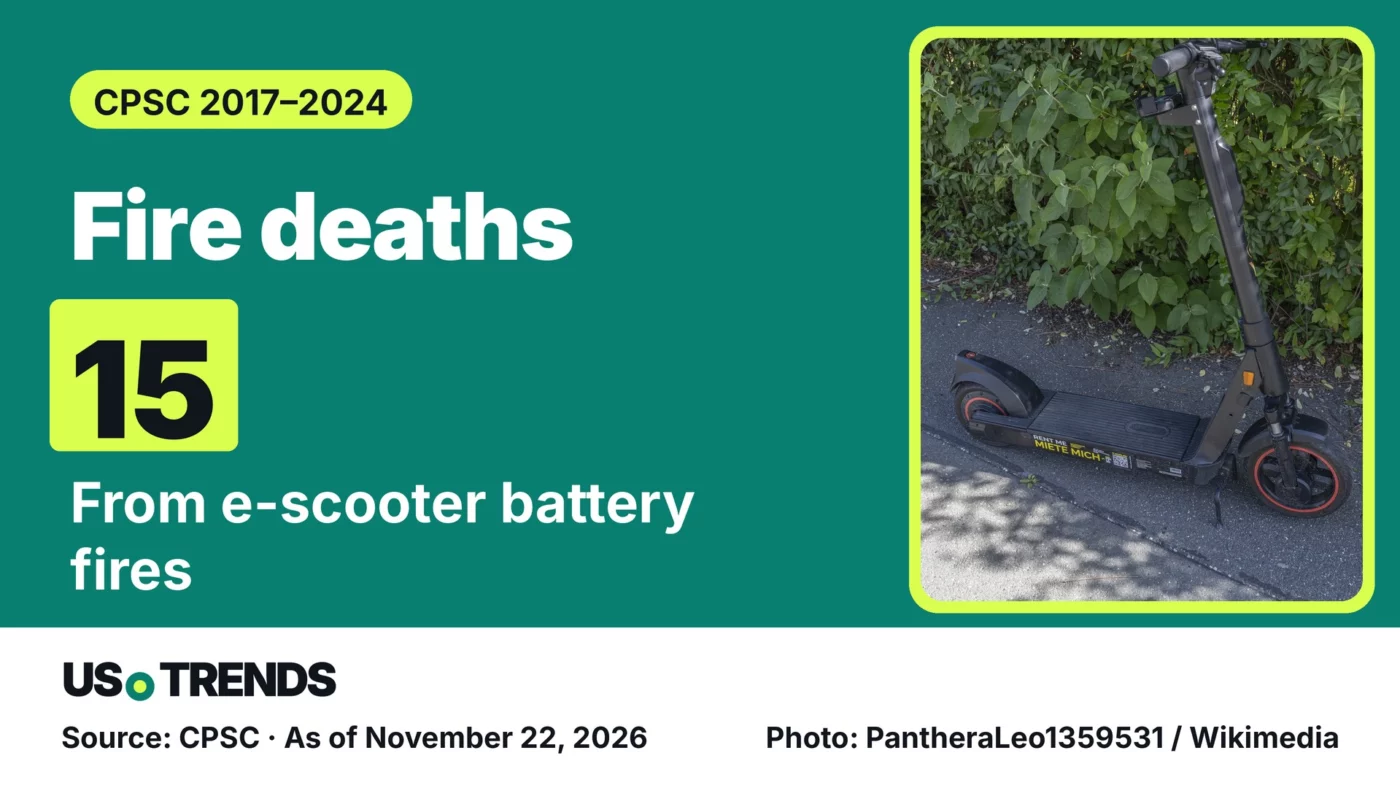
The CPSC links 15 deaths to e-scooter battery fires since 2017; charging a cold battery is one risk owners can avoid.
Key points
- The U.S. Consumer Product Safety Commission counts 15 deaths in 11 e-scooter lithium-ion battery fires from 2017 through 2024.
- Segway allows its Ninebot F25 to be charged only between 32 and 104 °F (0 to 40 °C), although it can be ridden down to 14 °F (−10 °C).
- The CPSC says to use only the charger provided with or recommended by the manufacturer.
- The agency warns never to charge micromobility products while sleeping or away from home.
A cold e-scooter battery should warm up indoors before you plug it in. The CPSC links 15 deaths from 2017 through 2024 to lithium-ion battery fires in e-scooters.
Those figures come from the CPSC’s April 2026 report on micromobility hazards. The agency notes that death counts for 2023 and 2024 may still rise because of reporting lags. The same report estimates 79,300 emergency department-treated e-scooter injuries in 2024.
Three temperature limits, not one
Being able to ride a scooter below freezing does not mean you can charge it at that temperature. The manufacturer’s specification for the Ninebot F25 lists three separate ranges:
| Use | Temperature according to Segway |
|---|---|
| Riding | 14 to 104 °F (−10 to 40 °C) |
| Charging | 32 to 104 °F (0 to 40 °C) |
| Storage | 14 to 122 °F (−10 to 50 °C) |
There is no single waiting time in minutes that applies to every model. A few minutes in a warm hallway does not prove the battery has reached a safe charging temperature. Look up the charging and storage ranges in your own scooter’s manual.
What the CPSC advises
The CPSC’s Micromobility Information Center tells owners to use only the charger provided with or recommended by the manufacturer. It also says to always be present while a micromobility product is charging and never to charge it while sleeping or when you are not at home.
According to the agency, many lithium-ion battery home fires and deaths have happened at night while batteries were charging. Replacement battery packs should be tested, approved and confirmed by the manufacturer as suitable for your device. The CPSC warns against packs that were modified or reworked by unqualified people.
Where to charge and store the scooter
Charge in a dry spot, not on or under anything flammable, and check the cable, plug and charger for damage first. A garage can be practical for storage, but in cold weather it may be below the charging range. Bring the scooter inside to warm up before you plug it in.
For long breaks, follow the manufacturer’s storage advice and check the battery level from time to time. Leaving the scooter permanently plugged in is not a substitute for that check. Rules on where you may ride e-scooters differ by state and city, so check local regulations separately.
What you can do before the next charge
A short routine means you will not have to look up the key details after a cold ride.
Before you charge after a cold ride
- Find your manual
Note the charging temperature range and the advice on longer storage for your model.
- Let the battery warm up
Bring the scooter indoors and let it reach room temperature before plugging it in.
- Use the right charger
Use only the charger provided with or recommended by the manufacturer, and check the cable for damage.
- Stay nearby
Charge only while you are at home and awake, never overnight or while you are out.
Battery temperature and road conditions are separate questions: a warm battery tells you nothing about whether the bike lane is icy.
Frequently asked questions
How long should a cold e-scooter wait before charging?
There is no general figure in minutes. The battery should first warm up indoors, and your manufacturer’s charging range applies.
How many deaths has the CPSC linked to e-scooter battery fires?
The CPSC counts 15 deaths in 11 e-scooter lithium-ion battery fires from 2017 through 2024; recent years may still be incomplete.
Can I charge my e-scooter overnight?
No. The CPSC says never to charge micromobility products while sleeping or when you are not at home.
Your view: Where do you charge your e-scooter in winter, and how do you let it warm up first? Tell us about your experience in the comments.
Sources and date
- U.S. Consumer Product Safety Commission: Micromobility Products-Related Deaths, Injuries, and Hazard Patterns: 2017–2024 (report, April 2026).
- U.S. Consumer Product Safety Commission: Micromobility Information Center (safety guidance, accessed November 22, 2026).
- Segway: F25 – Specifications (manufacturer documentation, undated, accessed November 22, 2026).
As of: November 22, 2026
Transparency note: AI-assisted tools were used in researching, structuring and writing this article. The sources used are listed in the article. Publication takes place only after manual editorial approval.
Share this article