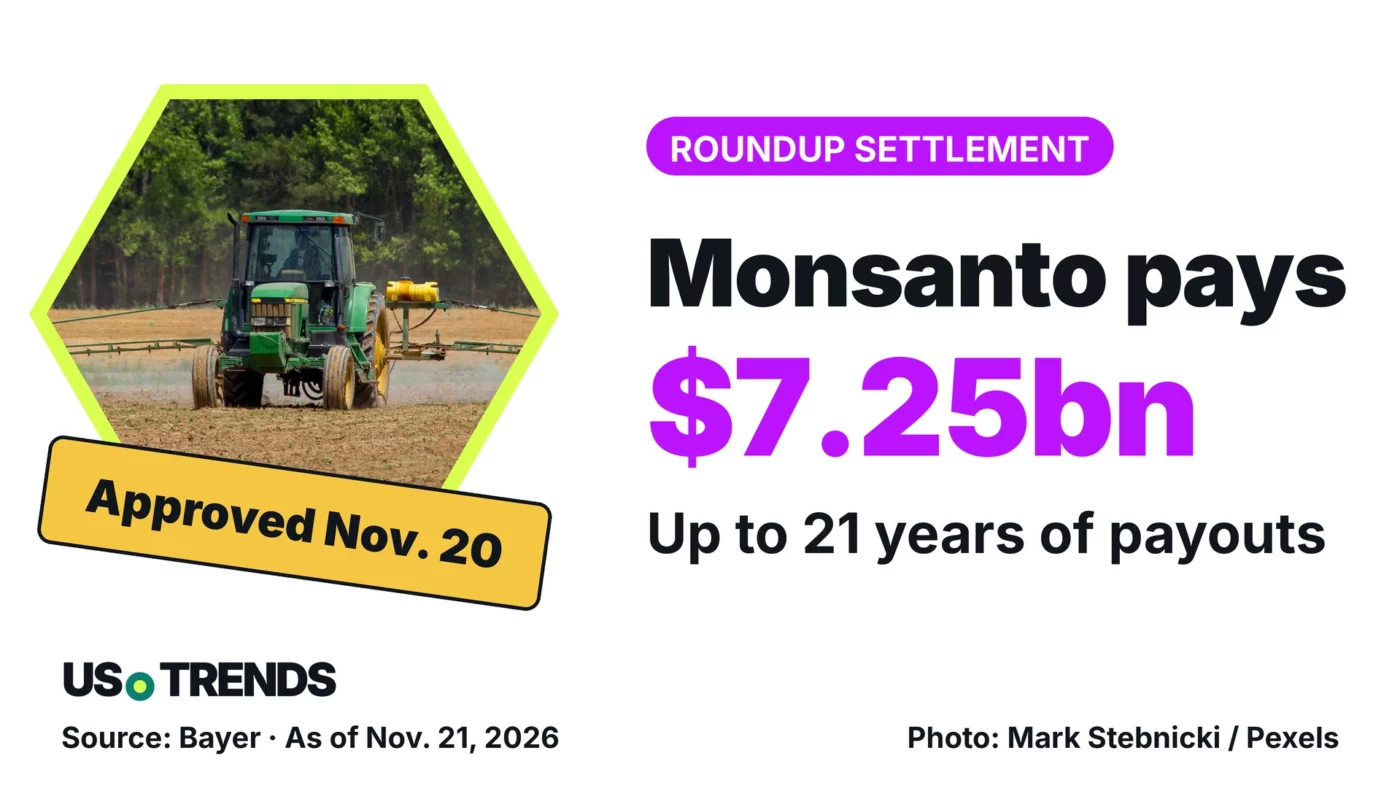
A Missouri court has approved the Roundup class settlement; appeals, opt-outs and the registration window decide what happens next.
Key points
- A Missouri state court granted final approval to Monsanto’s Roundup class settlement, Bayer announced from St. Louis on November 20, 2026.
- Monsanto will pay up to $7.25 billion over up to 21 years, including payments it has already made.
- Average awards range from $10,000 to $165,000 depending on the tier, according to the settlement notice.
- Any appeal of the approval order would pause further Monsanto payments until the appeals are exhausted.
A Missouri court has granted final approval to the Roundup class settlement, Bayer says. It covers pending and future claims linking Roundup to non-Hodgkin lymphoma and is capped at $7.25 billion.
The settlement concerns Roundup, the glyphosate-based weed killer sold by Bayer’s subsidiary Monsanto. Plaintiffs say the product caused their cancer; Monsanto denies this and admits no liability, according to Bayer. For people in the United States, the key questions are who qualifies, how much each tier pays and when money can flow.
Final approval: up to $7.25 billion
In a press release datelined St. Louis, November 20, 2026, Bayer says the court granted final approval. The settlement resolves pending and potential future claims that link Roundup to non-Hodgkin lymphoma, a cancer of the lymphatic system.
According to Bayer, Judge Timothy Boyer granted preliminary approval on March 4, 2026, and the final approval hearing took place on September 14. The case is pending in the Circuit Court of the City of St. Louis (case No. 2622-CC00325), as the settlement class notice states. Bayer also points to the Aretino case, the first Roundup trial since the U.S. Supreme Court’s Durnell decision in June, which Monsanto won according to the company.
Who is in the settlement class
The class notice draws the line narrowly. The class includes people who were U.S. citizens or lived in the United States on March 4, 2026, and who were exposed to Roundup products in the United States before February 17, 2026. People with a pending case in the federal multidistrict litigation MDL No. 2741 in California are among those excluded.
There are two subclasses. The first covers people diagnosed by March 4, 2026. The second covers people without a diagnosis by then; they can come forward later if they fall ill. Bayer gives them a window of 16 years after the agreement’s effective date. Whether exposure counts as occupational or residential affects the award: occupational means more than 80 hours of exposure while working in agriculture, industry or lawn and garden care, plus more than half of your income or over $15,000 from that work in at least one year.
Awards from $10,000 to $165,000
The notice assigns every claim to one of nine tiers, based on occupational or residential exposure, age at diagnosis and whether the lymphoma is aggressive or slow-growing. Averages range from $165,000 for occupational claimants under 60 with an aggressive form down to $10,000 for claimants aged 78 or older.
Average award per tier: from $165,000 down to $10,000
Data table
| Period | Average award |
|---|---|
| Occupational, under 60, aggressive | 165000 |
| Occupational, 60–77, aggressive | 105000 |
| Occupational, under 60, slow-growing | 85000 |
| Occupational, 60–77, slow-growing | 60000 |
| Residential, under 60, aggressive | 40000 |
| Residential, 60–77, aggressive | 30000 |
| Residential, under 60, slow-growing | 25000 |
| Residential, 60–77, slow-growing | 20000 |
| Age 78 or older, any form | 10000 |
These are averages. According to the notice, the actual award falls between 80 and 120 percent of the tier average, depending on the points assigned to each claim. Claimants with only limited proof receive $150. From the fifth payment year, amounts can rise by up to 2.5 percent a year. Residential claims in tiers 5 to 9 that were filed, or covered by a tolling agreement, before February 13, 2026 also get an expedited payment, for example $14,500 in tier 5 and $6,000 in tier 9.
Up to 21 years, $1 billion security fund
According to Bayer, Monsanto will pay a total of up to $7.25 billion into a fund over up to 21 years, including payments already made. The annual installments decline and are capped. The notice lists the building blocks: an initial $1 billion, of which $500 million had already been paid and another $500 million was due by August 31, 2026, followed by $250 million to $550 million a year for 16 years.
On top of that comes a separate $1 billion security fund, to be in place within 30 days of the effective date to cover any missed payments. For occupational claimants, up to $250 million a year is set aside for up to four additional years. Bayer does not say how much it has reserved in total; it only says it had “already taken appropriate provisions.” In the third quarter, Bayer’s free cash flow fell to minus €293 million, partly because of higher payouts to resolve litigation, according to its quarterly statement.
An appeal would pause payments
Bayer itself notes that the approval can be appealed. “Any appeal of the Court’s final approval order would pause further Monsanto payments until such appeals are exhausted,” the release says. Monsanto says it will work with class counsel to defend the settlement against challenges.
It also remains open how many people opted out. The deadline for opt-outs and objections was June 4, 2026, according to the notice. Bayer calls the number of opt-outs manageable but gives no figure. Class members who did not opt out give up claims against Monsanto over Roundup, according to the notice, including damages, medical monitoring and punitive damages.
What you can do now
If you were exposed to Roundup in the United States and have been diagnosed with non-Hodgkin lymphoma, check the official settlement website WeedKillerClass.com. For people diagnosed by March 4, 2026, the notice sets a registration deadline of 180 days after final approval. People diagnosed later must file a claim within six years of diagnosis, according to the notice. This does not replace advice from a lawyer.
Bayer shareholders can watch three points: whether an appeal is filed, whether Bayer discloses the number of opt-outs and what provisions it reports. This is not investment advice.
Frequently asked questions
Who qualifies for the Roundup settlement?
According to the class notice, people who were U.S. citizens or lived in the United States on March 4, 2026, and were exposed to Roundup products in the United States before February 17, 2026.
How long will Monsanto pay?
According to Bayer, for up to 21 years, with a total cap of $7.25 billion.
Can I still opt out?
No. The deadline for opt-outs and objections was June 4, 2026, according to the notice.
Does Monsanto admit liability?
No. According to Bayer, the agreement contains no admission of liability by Monsanto.
Your view: Do you think a settlement fund that pays out over up to 21 years is a good way to resolve mass injury claims? Share your experience in the comments.
Sources and date
- Bayer: Court Grants Final Approval to Roundup Class Settlement (press release, November 20, 2026)
- Weed Killer Class Settlement: Settlement Class Notice (notice to class members, accessed November 21, 2026)
- Bayer: Roundup Litigation, Statement on Class Final Approval Hearing (statement, updated September 17, 2026)
- Bayer: Q3 2026 quarterly statement (press release, November 3, 2026)
As of: November 21, 2026
Transparency note: AI-assisted tools were used in researching, structuring and writing this article. The sources used are listed in the article. Publication takes place only after manual editorial approval.
Share this article

Comment Tell us what you think →