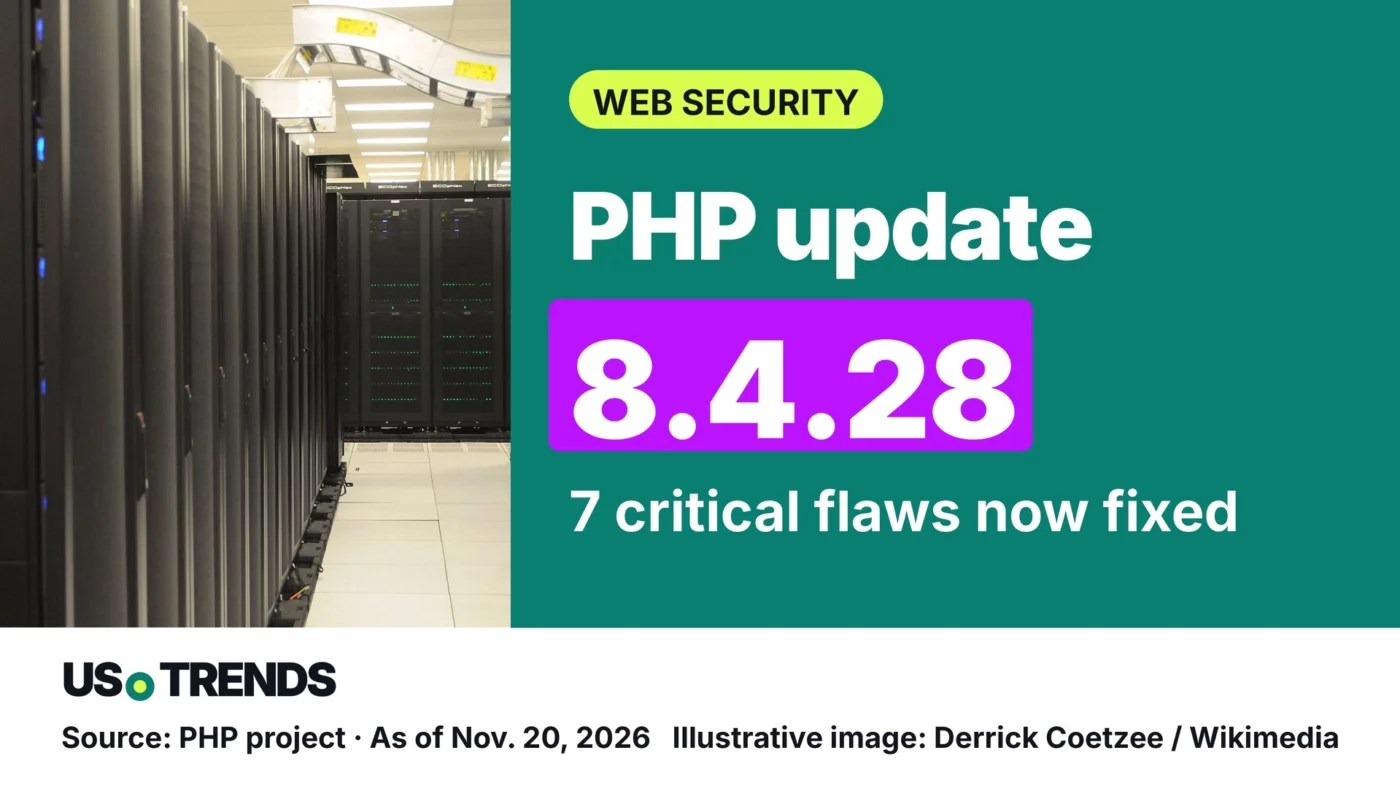
The PHP fixes shipped on Nov. 19 – what matters now is whether your host has actually applied them to your website.
Key points
- The PHP project released security versions 8.2.36, 8.3.37, 8.4.28 and 8.5.13 on November 19, 2026.
- Seven of the flaws fixed are rated critical, each with a CVSS score of 9.2.
- Several flaws only apply under particular configurations, but the update remains the real fix.
Every supported PHP branch has had a security update since Thursday. The fixes matter for U.S. websites, online stores and web services that run on PHP.
Our earlier report gave the planned release window starting at 9 a.m. ET. The version numbers are now confirmed. For anyone running a nonprofit site, a small online store or a business website, the question is no longer whether an update is coming, but whether it has reached your own site.
These versions close the gaps
| PHP branch | Affected | Fixed in |
|---|---|---|
| 8.2 | 8.2.0 to 8.2.35 | 8.2.36 |
| 8.3 | 8.3.0 to 8.3.36 | 8.3.37 |
| 8.4 | 8.4.0 to 8.4.27 | 8.4.28 |
| 8.5 | 8.5.0 to 8.5.12 | 8.5.13 |
Security release per PHP branch. Source: PHP project and CERT.at (in German), as of: 11/20/2026.
If you run PHP 8.3 today, you need 8.3.37, not necessarily a move to a new branch. PHP 8.6.0, a major release with new features, came out the same day and also contains the fixes. Pre-release builds of 8.6 (alpha, beta, release candidate) do not.
Seven critical flaws, but not every site is equally exposed
Austria’s national computer emergency response team, CERT.at, broke the flaws down in a Nov. 19 warning (in German): seven vulnerabilities, each scored 9.2 out of 10 on CVSS 4.0. They sit in session handling, the date extension, PHP-FPM and the Zend Engine, the core of PHP. Under certain configurations, attackers could run their own code.
The key limitation was already in the PHP project’s pre-announcement: the critical issues require either non-default configuration or uncommon setups. The PHP-FPM flaw, for example, only affects servers whose front-end web server reuses connections; according to CERT.at, default nginx and Apache setups that close the connection after each request are not affected. The warning does not mention attacks in the wild.
That is no all-clear for an unchecked server. Only someone who knows the configuration can judge whether a site is exposed, which usually means your hosting provider or web agency.
The version number alone proves little
CERT.at stresses a point that often surprises site owners: Linux distributions frequently backport fixes without changing the version number. A server can therefore be protected even if it does not say 8.4.28. Likewise, a generic “updates available” notice does not prove that your website is running the new code.
Ask your hosting provider to confirm in writing that the installation serving your domain includes the Nov. 19 fixes. If you run several sites, ask for a list by domain. Stopgap measures such as turning off session upload progress do not replace the update, CERT.at says.
Get written confirmation from your host now
A short, specific request to your host or agency turns a warning into a closed task. These steps help:
Make sure the PHP update reached your website
- Clarify who is responsible
Note for each website who manages the server: your hosting provider, an agency or your own IT team.
- Get the live PHP version confirmed
Ask whether the installation serving your domain includes the fixes from November 19, 2026, including backported distribution packages.
- Check the backup first
Find out which recent backup exists before anyone changes the server.
- Test key functions afterward
Check log-in, forms and, for stores, the checkout, and write down the result.
If you still run PHP 8.2, plan ahead as well: according to the PHP project’s support overview, security support for that branch ends on December 31, 2026. After that, the project will publish no further fixes for 8.2.
Frequently asked questions
Which PHP version do I need after the November 19, 2026 update?
It depends on your branch: 8.2.36, 8.3.37, 8.4.28 or 8.5.13. PHP 8.6.0 also contains the fixes.
Is my website safe with default settings?
The PHP project says the critical issues require non-default configuration or uncommon setups. That is not a guarantee; the update remains the real fix.
Why does my server show an older version number?
Linux distributions often backport fixes without changing the version number. Ask your host whether the Nov. 19 fixes are included.
Your view: Does your hosting provider confirm security updates like this one on its own, or do you have to ask? Tell us about your experience in the comments.
Sources and date
- PHP project: Releases and pre-announcement, November 2026 (project announcements, Nov. 18–19, 2026)
- PHP project: PHP 8.4.28 release announcement (project announcement, Nov. 19, 2026)
- CERT.at: Critical security flaws in PHP – updates available (warning, in German, Nov. 19, 2026)
- PHP project: Supported Versions (documentation, accessed Nov. 20, 2026)
As of: 11/20/2026
Transparency note: AI-assisted tools were used in researching, structuring and writing this article. The sources used are listed in the article. Publication takes place only after manual editorial approval.
Share this article
Comment Tell us what you think →