State laws and a July 8, 2026 FTC settlement with John Deere, not a federal law, set US repair rules today.
Key points
- There is still no comprehensive federal right-to-repair law in the United States; coverage comes from a growing patchwork of state statutes in New York, Minnesota, California, Colorado, Oregon and Washington, with Connecticut and Texas adding laws in 2026.
- On July 8, 2026, the Federal Trade Commission and five states settled their antitrust lawsuit against Deere & Company, requiring it to share repair tools with farmers and independent shops for 10 years.
- The European Union opened a new consultation on November 3, 2026 on possible tougher repairability rules for electronics, e-bikes and small appliances – a process US manufacturers selling into the EU will need to watch, even though it does not change US law.
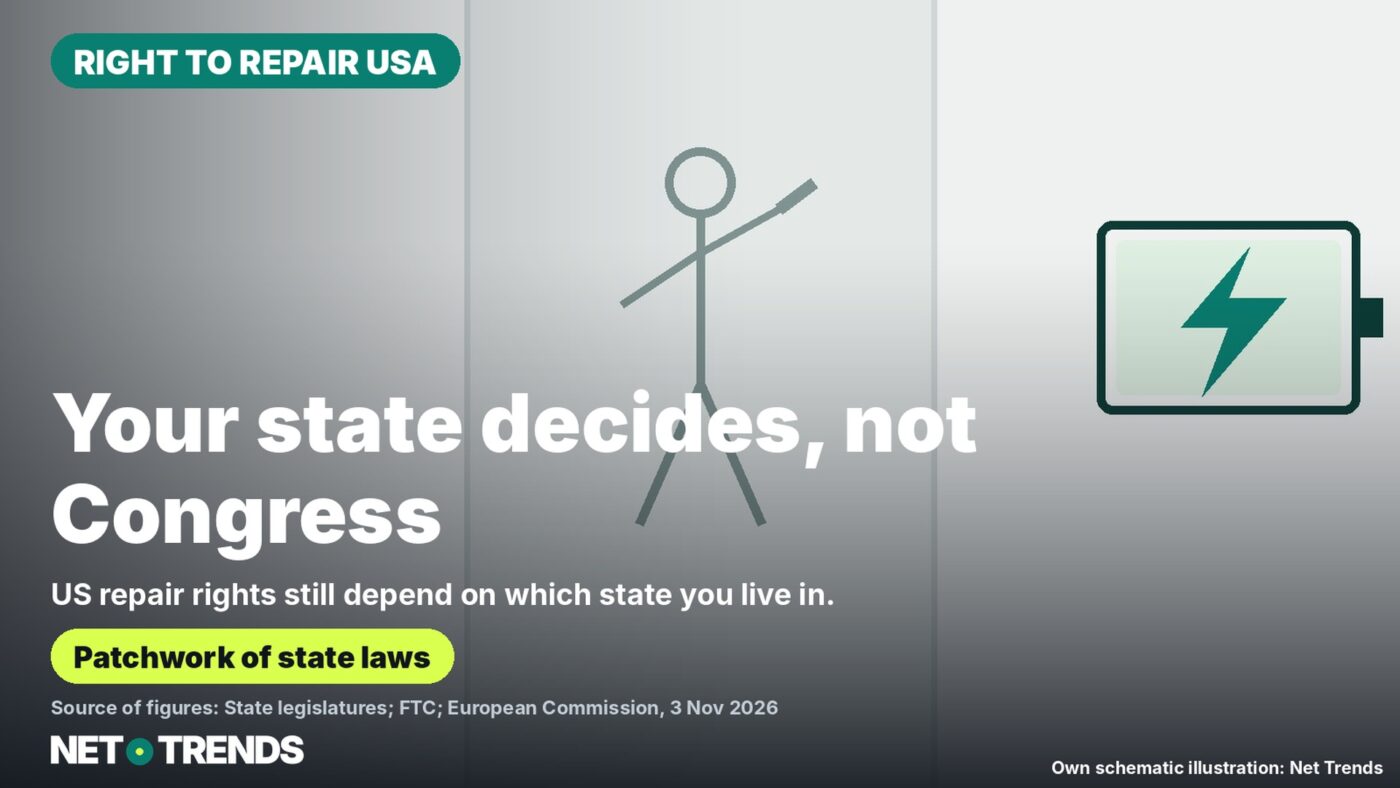
No federal law gives Americans a right to repair phones or farm equipment. State statutes and a July 2026 FTC settlement with John Deere are setting the actual rules instead.
Six states – New York, Minnesota, California, Colorado, Oregon and Washington – already have enforceable consumer-electronics right-to-repair laws on the books. Connecticut’s law takes effect in July 2026 and Texas’s in September 2026, extending coverage further without any action from Congress.
No federal law, a growing state patchwork
Congress has not passed a general right-to-repair statute, and no single federal agency sets repair rules for consumer products the way the EU’s Ecodesign for Sustainable Products Regulation does. The FTC’s 2021 “Nixing the Fix” report to Congress concluded that many manufacturer repair restrictions were not justified by legitimate safety or intellectual-property concerns, but that finding did not itself create new law.
Instead, right to repair in the US has advanced mainly through individual state legislatures passing their own electronics laws, plus targeted federal antitrust action against specific companies – producing a state-by-state patchwork rather than one nationwide standard.
Which states have already acted
New York was first: its Digital Fair Repair Act (S4104A) was signed into law and took effect for most consumer electronics on July 1, 2023. Minnesota followed with its own Right to Repair law, summarized by the Minnesota Attorney General’s office, requiring manufacturers to make parts, tools and documentation available on fair terms from July 1, 2023.
California’s Right to Repair Act (SB 244) was signed in October 2023 and took effect July 1, 2024, covering electronics and appliances priced above set thresholds. Colorado passed a broader law covering “digital electronic equipment,” House Bill 24-1121, in 2024. Oregon and Washington both added consumer-electronics right-to-repair statutes, with Washington’s Engrossed Substitute House Bill 1483 signed in 2025.
Connecticut and Texas join in 2026
Two more states extend coverage within 2026: Connecticut’s electronics right-to-repair law takes effect in July 2026, and Texas’s takes effect in September 2026. Once both are in force, advocacy group PIRG estimates that at least 35.5 percent of Americans will live in a state with some enforceable right-to-repair law, up from roughly a quarter of the population at the start of 2026 – a PIRG estimate that Net Trends could not independently verify against a single federal data source, since no federal agency tracks state-by-state repair-law coverage.
Several states have also passed narrower laws covering specific products such as wheelchairs, including Oregon, Nevada and Washington, separate from their general electronics statutes.
The FTC’s settlement with John Deere
Outside the state legislatures, the most significant 2026 right-to-repair development came from federal antitrust enforcement. The Federal Trade Commission, joined by the attorneys general of Arizona, Illinois, Michigan, Minnesota and Wisconsin, had sued Deere & Company in January 2025, alleging it restricted farmers’ and independent repair shops’ ability to fix Deere farm equipment by keeping key diagnostic tools available only to authorized dealers.
On July 8, 2026, the FTC announced a settlement: for 10 years, under FTC and state supervision, Deere must give farmers and independent repair providers the same repair resources it gives its own dealers, including fault codes, electronic part pairing, emissions-related “limp mode” restart procedures, and technical manuals. The order, filed in the US District Court for the Northern District of Illinois, still required a federal judge’s approval.
Where the EU stands now
On November 3, 2026, the European Commission opened a public consultation on possible future repairability rules under the Ecodesign for Sustainable Products Regulation (EU) 2024/1781, running until February 9, 2027. It is gathering input on spare parts, repair information, software and firmware, disassembly and repairability scores for consumer electronics, light means of transport such as e-bikes, and small household appliances. No new EU obligations have been decided yet.
The process has no direct effect on US law, but any eventual EU delegated act would still bind US-based manufacturers selling electronics, e-bikes or small appliances into the EU single market – a compliance question separate from whatever individual US states require at home.
What this means for US consumers
Where someone lives in the United States increasingly determines what repair rights they actually have for a phone, laptop or appliance: a resident of New York, Minnesota, California, Colorado, Oregon or Washington already has statutory rights that a resident of a state without such a law does not. Farmers and independent repair shops working on Deere equipment gained a specific, federally enforced set of rights through the 2026 settlement, separate from any state consumer-electronics statute.
Frequently asked questions
Is there a federal right-to-repair law in the US?
No. Congress has not passed one. Repair rights come from individual state laws and from targeted federal antitrust actions such as the FTC’s case against Deere & Company.
Which states already have electronics right-to-repair laws?
New York, Minnesota, California, Colorado, Oregon and Washington have enforceable laws as of 2026; Connecticut’s takes effect in July 2026 and Texas’s in September 2026.
Does the EU’s new repair consultation affect US shoppers?
Not directly. It is an EU process under the Ecodesign for Sustainable Products Regulation and does not change US law, though it could eventually affect US companies that sell products into the EU market.
Sources and status
- New York Digital Fair Repair Act, S4104A (New York State Senate)
- Right to Repair in Minnesota (Office of the Minnesota Attorney General)
- California Right to Repair Act, SB 244 signed (California State Assembly)
- Colorado House Bill 24-1121, Consumer Right to Repair Digital Electronic Equipment (Colorado General Assembly)
- Washington Engrossed Substitute House Bill 1483 (Washington State Legislature)
- Federal Trade Commission and Partner States Reach Settlement with Deere and Company on Right to Repair, July 8, 2026 (FTC)
- Nixing the Fix: An FTC Report to Congress, 2021 (FTC)
- Commission launches consultation on easier product repairs, November 3, 2026 (European Commission)
- Regulation (EU) 2024/1781 (Ecodesign for Sustainable Products Regulation, EUR-Lex)
Research and data as of: November 10, 2026.
Transparency note: AI-assisted tools were used in researching, structuring and writing this article. The sources used are listed in the article. Publication takes place only after manual editorial approval.
Country edition based on an article from Net Trends, researched for the US.
Own schematic illustration, not AI-generated.
Share this article