Article 50 of the EU AI Act: invisible marks vanish the moment a text is rewritten – and the UK has no comparable duty at all
Key points
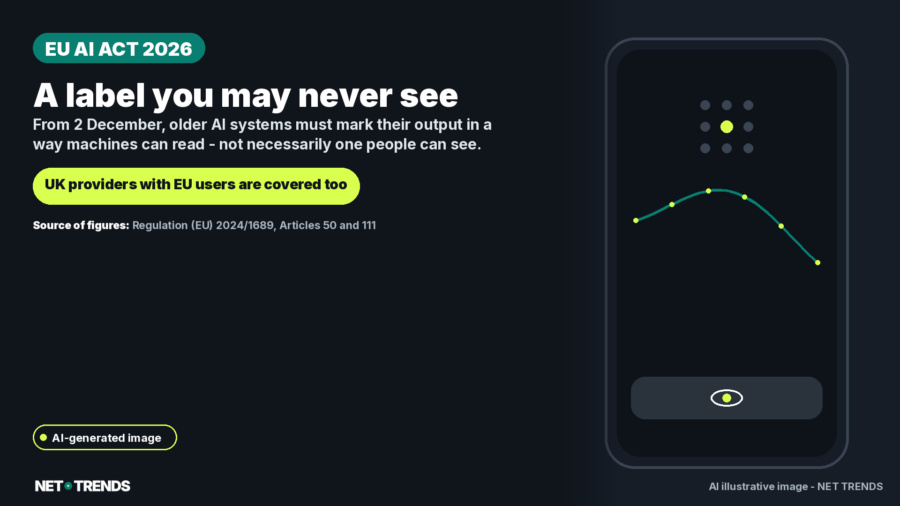
- From 2 December 2026, providers of older AI systems placed on the EU market before 2 August 2026 must machine-mark everything their systems generate: images, video, audio and text.
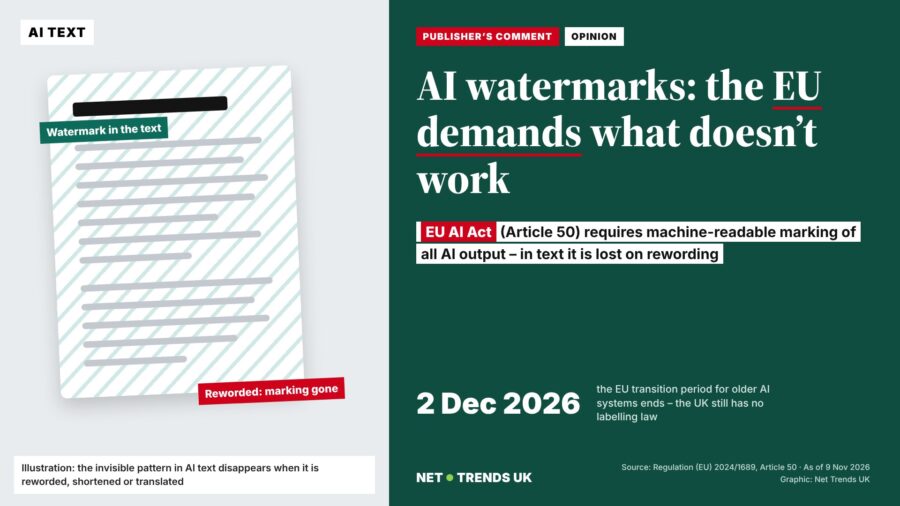
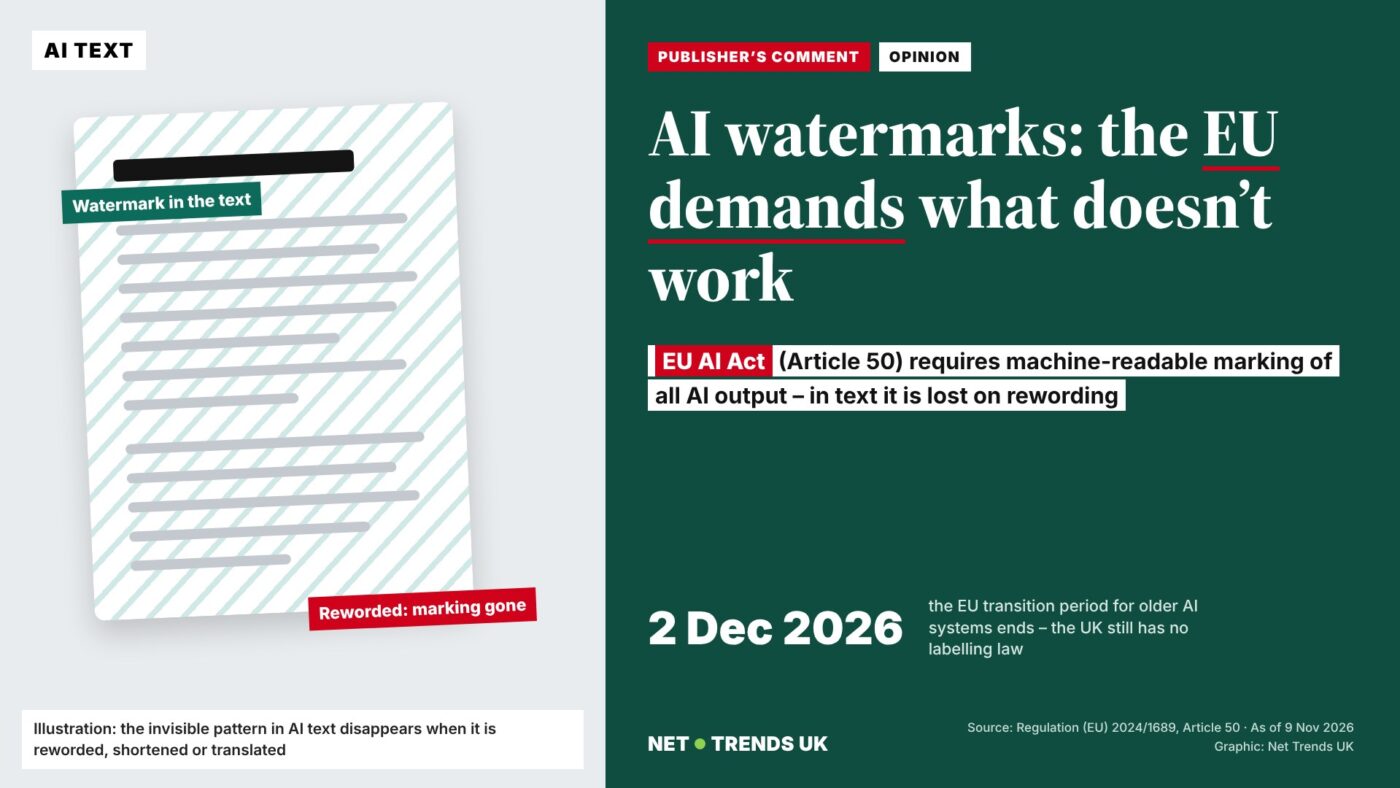
- For text, this barely works: a watermark built into word choice disappears as soon as someone rewrites, shortens or translates the text.
- The UK has no equivalent legal duty. A House of Commons Library briefing from January 2026 states plainly that there is currently no UK legal requirement to label AI content.
From 2 December 2026, even older AI systems placed on the EU market must machine-mark their output. It sounds like consumer protection, but it is mostly bureaucracy with a built-in expiry date – and the UK, notably, has chosen not to follow.
On that date, a transition period under the EU AI Act (Regulation (EU) 2024/1689) ends. It covers providers – the makers of image, video and text generators – whose systems were already on the EU market before 2 August 2026. The legal basis is Article 50(2), which requires that AI-generated content be technically detectable, for example through metadata or digital watermarks. The UK, having left the EU, is not bound by this regulation at all; its own approach, as set out below, is markedly different. What the deadline requires in detail is explained in our news report on AI labelling.
Text watermarks: little more than a pattern
The problem is clearest with text. A watermark in language is just a statistical pattern: the AI picks its words according to a hidden rule, and detection software later recognises that rule. Google already uses such a method under the name SynthID.
Anyone who reorders, translates or shortens a sentence destroys that pattern. Unlike image files, plain text carries no metadata. The regulation itself concedes the point: it only requires marking “insofar as technically feasible”. A rule that ships with its own built-in exemption ends up governing very little.
Images are barely better off
Metadata disappears the moment a platform resizes an image or someone takes a screenshot. Watermarks baked into the pixels are more robust, but not safe against deliberate tampering either. Anyone determined to spread disinformation simply uses a model outside the EU’s rules, or strips the mark.
The European Commission published a voluntary code of practice on labelling AI-generated content in June 2026. It relies on several layers of metadata and watermarking. It does not offer a reliable solution for text either.
Why the UK has no equivalent law
Unlike the EU, the UK has no binding duty to label AI-generated content, and none is firmly scheduled. A House of Commons Library research briefing published on 20 January 2026 states explicitly that there is currently no UK legal duty to label AI content. It sketches a possible future risk-based model – distinguishing “impact-based” labels for deepfakes, fraud and disinformation from “process-based” disclosure labels, and references technical standards such as C2PA content credentials – but this remains analysis, not policy.
The live government process sits within a joint consultation on copyright and AI, run by the Department for Science, Innovation and Technology (DSIT) together with the Intellectual Property Office (IPO) and the Department for Culture, Media and Sport. Labelling of generative AI output is one sub-topic within a wider package on copyright reform, digital replicas and licensing; an IPO taskforce is working through responses, with a report and an economic impact assessment due by 18 March 2026. Ofcom’s Online Safety Act powers could eventually touch AI content in future, but no specific Ofcom rule on AI watermarking exists today. For now, the UK’s approach is to consult, not to legislate.
Who the rule really hits
Large US companies build the technology in as a matter of course. Smaller European providers – and any UK company that still sells AI systems into the EU market, since the EU rule applies extraterritorially to anyone placing AI output there – must spend money, legal advice and development time they cannot easily spare in a competitive market. A rule meant to make Europe more sovereign ends up reinforcing the market leaders from overseas.
The EU has already admitted its own timetable was too ambitious. The AI Omnibus Regulation (EU) 2026/1744 pushed back several key deadlines in the AI Act – a tacit admission that the rules were written faster than the technology could follow.
A sensible rule for newsrooms
For news publishers operating in the EU, a different provision matters more, and it has applied since 2 August 2026. Under Article 50(4), AI-assisted text on matters of public interest needs no disclosure if a human has reviewed the content and a named person or company takes editorial responsibility for it. A mere spellcheck does not count, according to the European Commission’s guidelines. The UK has no equivalent statutory rule, but the same underlying principle – someone puts their name to the content and is accountable for it – is simply standard newsroom practice here too.
Deepfakes – convincingly realistic AI images of real people, places or events – must, under EU law, always be visibly labelled. There is nothing wrong with that requirement: that is exactly what accountability looks like. Breaches of the EU’s transparency duties can bring fines of up to €15 million or 3% of worldwide annual turnover under Article 99(4) of the AI Act. UK operators without an EU footprint face no such exposure – for now.
Verdict: accountability, not a technical mandate
An invisible watermark that disappears the first time someone edits a text does nothing against deception. What actually helps is newsrooms that check facts, disclose sources and stand behind what they publish. The EU should strengthen that kind of accountability rather than burden Europe’s AI providers with technical duties that miss their own target – and the UK’s current reluctance to legislate a similar duty is, on this logic, not obviously the wrong call.
Supporters of mandatory labelling argue the opposite: even an imperfect watermark makes mass-produced synthetic content detectable at scale, because platforms can read it automatically – particularly ahead of elections. That argument deserves to be taken seriously. It does not, however, justify a duty that is barely enforceable for text.
Frequently asked questions
Does the EU’s AI watermarking rule apply in the UK?
No. The UK left the EU and is not bound by the EU AI Act. UK companies that place AI systems or AI-generated content on the EU market, however, still have to comply with it.
Does the UK have its own AI content-labelling law?
Not currently. A House of Commons Library briefing from January 2026 confirms there is no UK legal duty to label AI content, though the government is consulting on copyright and AI, which touches the topic.
Do UK news outlets have to label AI-assisted articles?
There is no UK statutory requirement to do so. As standard editorial practice, though, reputable UK outlets disclose AI use and keep a named person accountable for content, much as the EU’s Article 50(4) exemption presumes.
Sources and status
- Regulation (EU) 2024/1689 (AI Act), in particular Article 50 and Article 99
- European Commission: Guidelines on transparency obligations for providers and deployers of certain AI systems
- Regulation (EU) 2026/1744 amending the AI Act (AI Omnibus)
- Google DeepMind: SynthID
- RPC: UK government publishes research briefing into labelling of GenAI content
- GOV.UK / DSIT: Copyright and artificial intelligence consultation document
Research and data as of: 9 November 2026.
Transparency note: AI-assisted tools were used in researching, structuring and writing this article. The sources used are listed in the article. Publication takes place only after manual editorial approval. Country edition based on an article from Net Trends, researched for the United Kingdom.
Share this article