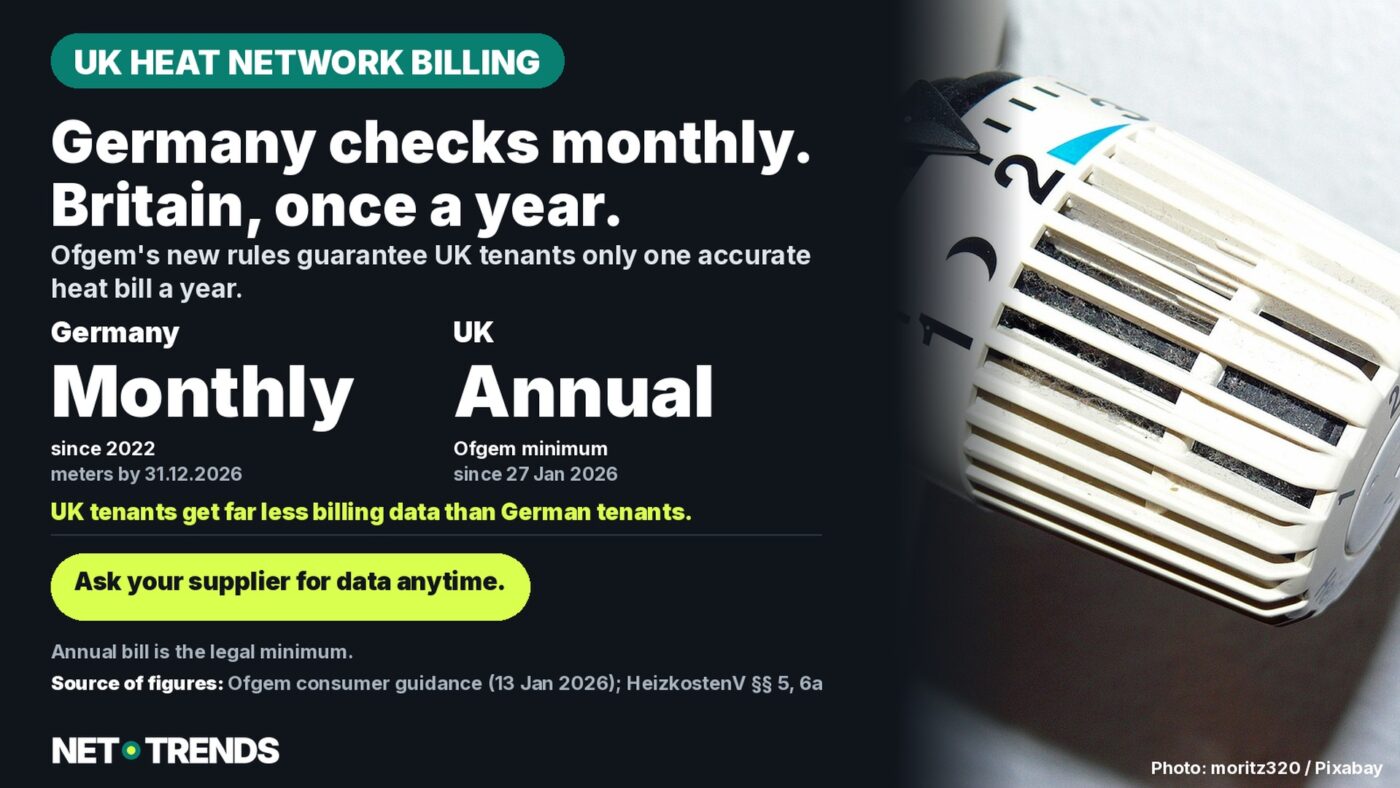
Since 27 January 2026, Ofgem has regulated heat networks in Great Britain. Its new rules guarantee tenants only one accurate consumption bill a year – not the monthly updates German tenants are getting from 2027.
Key points
- From 27 January 2026, Ofgem became the regulator for heat networks in Great Britain, replacing large parts of the Heat Network (Metering and Billing) Regulations 2014.
- Under Ofgem’s new Authorisation Condition on billing, heat network customers are guaranteed only one accurate, consumption-based bill a year – there is no legal right to monthly information as in Germany.
- Existing heat network operators must register with Ofgem once its digital service opens in spring 2026, with authorisation due by 26 January 2027.
If you live in a block of flats heated from a shared boiler or district heat network, a new regulator has been watching your supplier since 27 January 2026. Ofgem’s rules guarantee only one accurate bill a year, not the monthly consumption updates that German tenants are entitled to from 2027.
More than 500,000 households and businesses are connected to heat networks across Great Britain, according to the UK government, and that number is expected to grow as new developments are built with communal heating by default. Until recently, these customers had far weaker consumer protection than people on the mains gas or electricity grid – no energy price cap, no mandatory Ombudsman access, and no independent regulator checking whether bills were accurate.
That changed on 27 January 2026. Ofgem took over as the Heat Network Regulator for Great Britain, acting under powers created by the Energy Act 2023 and the Heat Networks (Market Framework) (Great Britain) Regulations 2026. This article explains what the new rules actually promise – and how that compares with Germany’s stricter, monthly information duty.
Who regulates heat networks in Great Britain now?
Before 2026, heat networks sat largely outside energy regulation. Suppliers only had to notify a government authority under the Heat Network (Metering and Billing) Regulations 2014 (HNMB Regulations) and meet basic metering and billing duties, with no ongoing supervision comparable to Ofgem’s oversight of gas and electricity suppliers.
The Heat Networks (Market Framework) (Great Britain) Regulations 2026 changed that from 27 January 2026. Ofgem became the Heat Network Regulator for England, Wales and Scotland, and heat suppliers and operators must now meet a set of authorisation conditions, similar in spirit to the licence conditions gas and electricity suppliers already follow. The government’s own summary confirms that “under the new Regulations, Ofgem have assumed their role as the regulator for heat networks“.
Large parts of the old 2014 Regulations – including the duty to notify under regulation 3 and the billing duty under regulation 9 – were revoked for Great Britain at the same time. Northern Ireland was not affected: the original HNMB Regulations, including the notification and billing duties, continue to apply there in full.
What must a heat network bill show?
The old billing duty has been replaced by an Ofgem authorisation condition that the regulator calls the “Provision of Billing and Price Transparency of Information” condition. Ofgem’s own consumer protection guidance, published on 13 January 2026, sets out what it actually requires for a heat network with meters installed.
The guidance states that “at least once a year a bill must be issued to the Relevant Consumer using a Supply Meter“, and that bills must be “accurate, and based on actual consumption” wherever possible. A bill must include the customer’s consumption of heating, cooling or hot water, an estimate of future charges, and – “where reasonably practical” – a comparison with the same period in the previous year.
“At least once a year a bill must be issued to the Relevant Consumer using a Supply Meter.”
Ofgem, Heat networks regulation: consumer protection guidance, 13 January 2026
There is no requirement in the guidance for monthly bills or monthly consumption statements. A supplier that issues one accurate annual bill, based on real meter readings, meets the legal minimum – even if the customer never sees a monthly figure in between.
How does this compare with Germany’s monthly rule?
Germany’s Heizkostenverordnung (Ordinance on Heating Costs) has required monthly consumption information wherever a remotely-readable meter is already installed, since 1 January 2022 under paragraph 6a. By 31 December 2026, older meters that cannot be read remotely must generally be retrofitted or replaced, which German officials expect will extend the monthly-information duty to most remaining tenancies from 2027.
Great Britain has no equivalent monthly duty. Ofgem’s rules, in force since 27 January 2026, set an annual bill as the floor, with a year-on-year comparison only “where reasonably practical” – a materially weaker guarantee than Germany’s fixed monthly, meter-based report. The underlying reason is partly historical: Germany’s duty implements the EU’s Energy Efficiency Directive (2018/2002), which the UK is no longer bound by after leaving the EU. Britain chose its own, separate framework instead, built around Ofgem’s new authorisation conditions rather than an EU-derived metering directive.
That does not mean UK tenants have no rights at all – only that they cannot rely on the same monthly check-in German tenants are gaining. Some UK suppliers already provide more frequent updates voluntarily, particularly where smart heat meters are installed, but nothing in the current rules obliges them to.
What deadlines apply to operators?
Operators of existing heat networks do not need authorisation immediately. Ofgem’s digital registration service was scheduled to open in spring 2026, and heat network operators must apply for authorisation and register with Ofgem by 26 January 2027, according to legal guidance for the sector. Until they register, existing operators are treated as automatically authorised, but after that date operating without authorisation becomes a compliance breach that Ofgem can act on.
New heat networks that start supplying customers after the rules took effect are expected to register with Ofgem before they begin operating, rather than waiting for the 2027 deadline that applies to existing networks.
Checklist: what tenants on a heat network can do
- Ask your landlord, managing agent or heat supplier in writing how often you will be billed, and whether a meter is installed.
- Request a consumption breakdown and a comparison with the previous year, even if it is not shown on your bill automatically.
- If your bill seems wrong or arrives very late, raise it with your supplier first, then use the free Energy Ombudsman service if it is not resolved.
- Keep your own meter readings or app data where possible, so you can check an annual bill against what you actually used.
None of this is a substitute for formal advice. Citizens Advice and the Energy Ombudsman can help where a bill is disputed or a supplier is unresponsive.
What can tenants and leaseholders do?
Heat network customers in Great Britain also gained a right they did not reliably have before: free access to the Energy Ombudsman redress scheme. All authorised heat networks must register with the Ombudsman, so a tenant with an unresolved billing dispute, an unplanned heat outage, or a complaint about charges no longer has to go to court to get an independent decision.
Leaseholders who pay for heat through a service charge, rather than a separate bill, are covered by a different part of Ofgem’s guidance, alongside existing protections under the Landlord and Tenant Act 1985. The same principle applies: costs should be based on actual consumption where meters exist, and charges should be transparent and explained on request.
Frequently asked questions
Do UK tenants on heat networks get monthly consumption information like in Germany?
No. Ofgem’s rules, in force since 27 January 2026, only guarantee one accurate, consumption-based bill a year. There is no UK legal right to monthly heating or hot water consumption information, unlike Germany’s monthly duty for remotely-read meters.
Who regulates heat networks in Great Britain now?
Ofgem, since 27 January 2026, acting under the Heat Networks (Market Framework) (Great Britain) Regulations 2026 and powers from the Energy Act 2023. Before that, heat networks were only lightly supervised under the Heat Network (Metering and Billing) Regulations 2014.
What if my heat network bill is wrong or very late?
Raise it with your supplier first. If it is not resolved, you can use the Energy Ombudsman’s free redress scheme, which all authorised heat networks in Great Britain must now be registered with.
Does this change affect Northern Ireland too?
No. The Heat Network (Metering and Billing) Regulations 2014, including the original notification and billing duties, continue to apply unchanged in Northern Ireland. Ofgem’s new authorisation regime applies only to England, Wales and Scotland.
Do you live on a UK heat network – and has your annual bill ever been hard to check against what you actually used? Share your experience in the comments.
Sources and status
- GOV.UK: Regulations – heat networks, accessed 8 November 2026.
- Heat Networks (Market Framework) (Great Britain) Regulations 2026 (SI 2026/7), legislation.gov.uk, in force 27 January 2026.
- Heat Network (Metering and Billing) Regulations 2014 (SI 2014/3120), legislation.gov.uk, as amended.
- Ofgem: Heat networks regulation – consumer protection guidance, 13 January 2026.
- Ofgem: Heat networks regulation – authorisation conditions decision, January 2026.
- Heizkostenverordnung, §§ 5 and 6a (in German), gesetze-im-internet.de, current version.
Research and data status: 8 November 2026.
Transparency note: AI-assisted tools were used in researching, structuring and writing this article. The sources used are listed in the article. Publication takes place only after manual editorial approval.
Country edition based on an article from Net Trends, researched for the United Kingdom.
Share this article