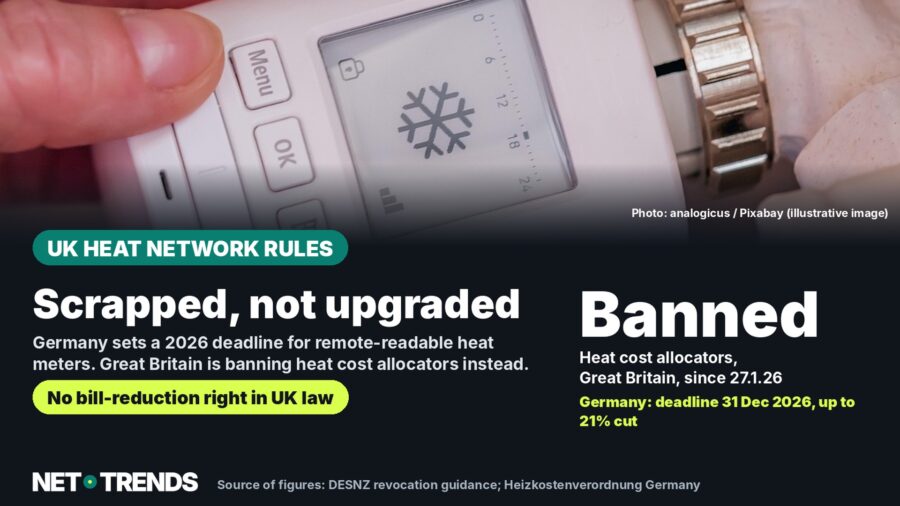
Germany forces landlords to fit remote-readable heating meters by 31 December 2026 — Britain has no such rule, but Ofgem has just taken over regulating heat networks instead.
Key points
- Germany’s Heizkostenverordnung (HeizkostenV) requires landlords to make old, non-remote-readable heat cost allocators and heat meters remotely readable by 31 December 2026, or tenants may cut their bill by up to 6%.
- The UK left the EU and never copied this rule: British heat network law, the Heat Network (Metering and Billing) Regulations 2014, covers only communal “heat networks”, not every centrally heated building, and gives tenants no percentage-based billing deduction right.
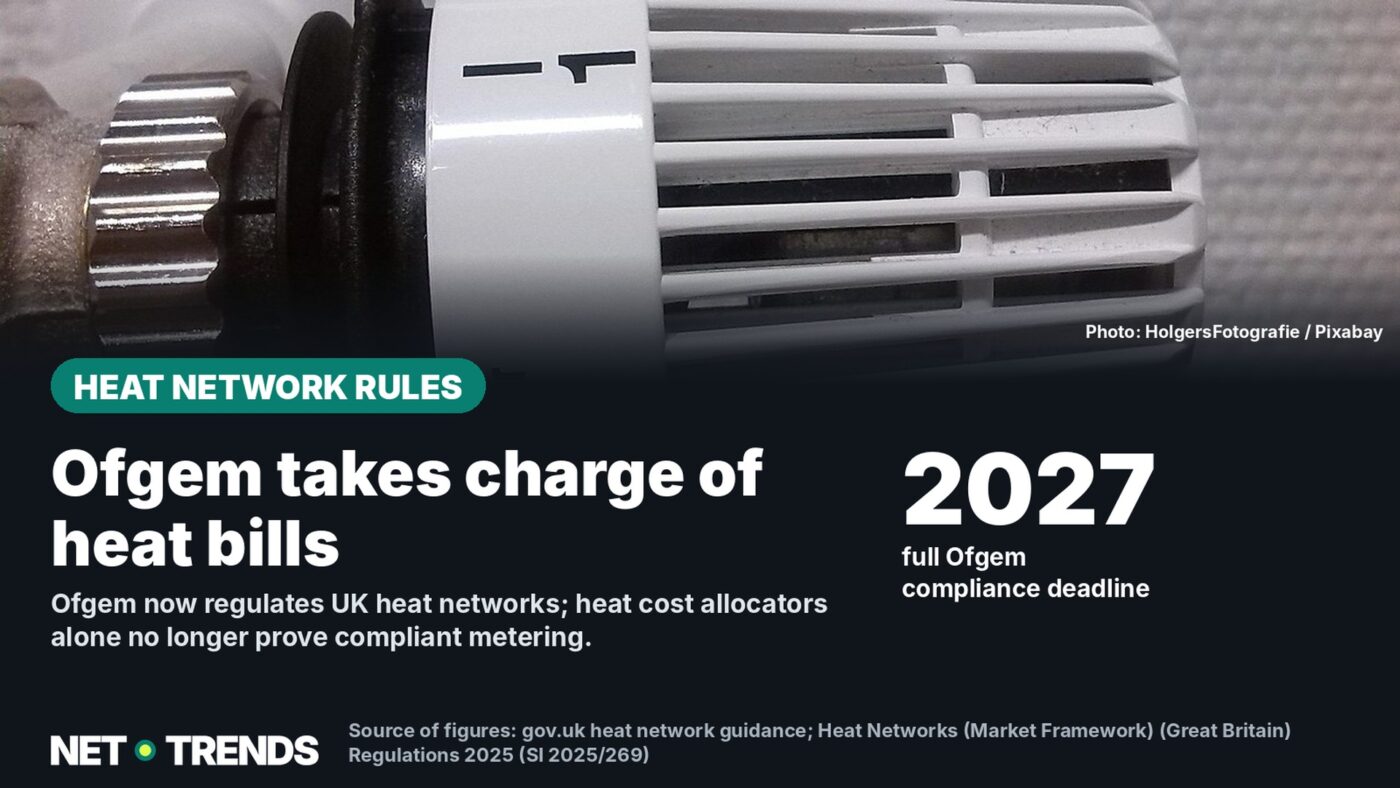
- Since 27 January 2026, Ofgem regulates UK heat networks under new market-framework rules; heat cost allocators alone no longer count as proof of compliant metering, and full compliance is due by 27 January 2027.
German landlords must make old heating meters remotely readable by 31 December 2026, or tenants may cut their bill by up to 6%. Britain has no such rule — but Ofgem has just taken charge of its own heat network rulebook.
For readers in Britain the German deadline is a useful mirror, not a warning: no UK statute forces landlords with ordinary gas central heating to fit remotely readable heat cost allocators, and no UK law lets a tenant simply dock a fixed percentage off a heating bill the way German law does. What Britain does regulate is something narrower and, this winter, newly reshaped: shared “heat networks” that pipe heat from one source to many homes, typically on housing estates, in blocks of flats or university campuses.
That narrower UK regime is in the middle of its biggest shake-up in a decade. Readers who rely on a communal heating system — rather than their own boiler — are the ones directly affected by the changes described below.
Germany’s rule: the 31 December 2026 deadline
Under Germany’s federal Heizkostenverordnung, section 5 (in German), heating allocators and heat meters installed before December 2021 in buildings with central heating or hot water must be made remotely readable “by 31 December 2026” unless an exemption applies. A second duty, under section 6a (in German), obliges landlords with remote-readable meters to send tenants a monthly consumption statement.
Under section 12 (in German), German tenants may cut their own share of the heating bill by 3% if the remote-reading upgrade is missing, and by a further 3% if the monthly statement is missing too — in practice treated as up to 6% combined, though the regulation does not say so explicitly. This is a national, EU-driven requirement: it implements the EU’s Energy Efficiency Directive (2012/27/EU, recast by (EU) 2023/1791), which obliges every EU member state to make heat and hot-water metering remotely readable. Britain, having left the EU in 2020, is no longer bound by that directive and has built its own, separate framework instead.
The UK position: heat networks, not every boiler
British law never required every landlord with central heating to fit a remotely readable heat cost allocator, and no UK statute gives a tenant a German-style percentage deduction on a disputed heating bill. The relevant UK law, the Heat Network (Metering and Billing) Regulations 2014, applies only to “heat networks” — systems that supply heating, cooling or hot water to more than one building or dwelling from a shared source, such as a communal boiler room serving a block of flats or an estate-wide district heating scheme. An ordinary rented house or flat with its own gas boiler, which is the much more common arrangement in Britain, simply falls outside this regime.
Even within that narrower scope, the 2014 Regulations required heat suppliers to bill residents on the basis of actual meter readings — taken annually, or quarterly where bills are sent electronically — rather than remote, continuous readings as such. Estimated bills were allowed where an actual reading could not be obtained. There was no automatic right for a resident to deduct a fixed percentage if a meter was not installed or not remotely read; disputes instead went through the supplier’s own complaints process, or, since 2015, the voluntary Heat Trust scheme.
Ofgem takes over: what changes from January 2026
That gap in consumer protection is exactly what the UK government has now moved to close — not by copying Germany’s deduction rights, but by handing heat networks to the same regulator that already oversees gas and electricity suppliers. Under the Heat Networks (Market Framework) (Great Britain) Regulations 2025 (SI 2025/269), Ofgem became the statutory regulator of heat networks in Great Britain from 27 January 2026, under rules set out on the government’s own heat networks guidance page.
Three changes matter most for metering, and they point in the opposite direction from the German deadline: meters must now be installed wherever a building is assessed as “viable” for metering, a cost-effectiveness exemption known as the “Open” class has been scrapped in Great Britain, and — the sharpest contrast with Germany — heat cost allocators can no longer be used on their own to demonstrate compliance with the metering duty. Existing meters on networks already supplying customers before 27 January 2026 must simply be kept in service.
On consumer protection, Ofgem’s new regime gives UK heat network customers rights Germany reaches through a completely different mechanism: back-billing is capped at the previous 12 months, suppliers must give at least 31 days’ notice of a tariff rise and may not change tariffs more than once every six months, and bills must be based on actual consumption at least once a year with an annual statement of projected charges. None of this is a percentage deduction on a disputed bill — instead, unresolved complaints can go to the Energy Ombudsman once a supplier’s own eight-week process has run its course, for complaints raised on or after 1 April 2025.
Heat suppliers are treated as “deemed authorised” from January 2026 but have until 27 January 2027 to become fully compliant with Ofgem’s conditions — almost exactly a year after Germany’s own 31 December 2026 deadline for remote-readable meters. Northern Ireland is not covered by this reform: the original 2014 and 2020 Regulations remain in force there while the Department for the Economy develops a separate framework.
Checklist: what UK heat network customers should do
- Check whether your home is on a shared heat network (a communal boiler room, district heating scheme or estate-wide system) rather than its own boiler — only heat networks fall under these rules.
- From January 2026, ask your heat supplier whether it is registered with Ofgem and what its billing and tariff-notice terms are.
- Keep copies of meter readings and bills; Ofgem’s rules let residents request up to 12 months of consumption data.
- If a complaint with your heat supplier is not resolved within eight weeks, you can escalate it to the Energy Ombudsman.
- If you rent an ordinary house or flat with its own boiler, none of this applies to you — there is no UK equivalent of Germany’s remote-meter deadline or bill-deduction right for that setup.
The practical upshot for British readers is less dramatic than the German deadline might suggest, but not nothing: anyone on a communal heat network is moving, within the space of twelve months, from a patchwork of supplier goodwill and a voluntary ombudsman scheme to statutory regulation with hard numbers attached — 31 days’ notice, 12 months of back-billing, an eight-week complaints clock.
Frequently asked questions
Do UK landlords have to fit remotely readable heating meters like German landlords?
No. There is no UK-wide duty equivalent to Germany’s 31 December 2026 deadline for ordinary centrally heated homes. UK rules on meter installation and remote reading apply only to communal “heat networks” regulated since 27 January 2026 by Ofgem, not to every landlord with a central heating boiler.
Can a UK tenant deduct a percentage from a heating bill, as in Germany?
No. German tenants can cut their bill share by up to 6% if remote-reading and monthly statements are missing (section 12 HeizkostenV). UK law gives no such automatic percentage deduction; UK heat network customers instead rely on Ofgem’s billing rules and, for unresolved disputes, the Energy Ombudsman.
What changed in the UK on 27 January 2026?
Ofgem became the statutory regulator of heat networks in Great Britain under the Heat Networks (Market Framework) (Great Britain) Regulations 2025 (SI 2025/269). Heat cost allocators alone can no longer prove compliance with the metering duty, and heat suppliers have until 27 January 2027 to be fully compliant with Ofgem’s conditions.
Does this affect Northern Ireland too?
No. The reform applies to Great Britain (England, Wales and Scotland). In Northern Ireland, the original Heat Network (Metering and Billing) Regulations 2014 and 2020 amendments remain in force while a separate framework is developed.
Are you on a communal heat network, and has your supplier told you anything about Ofgem registration yet? Let us know in the comments.
Sources and status
- Bundesministerium der Justiz / Bundesamt für Justiz (Germany): Heizkostenverordnung (HeizkostenV), sections 5, 6a and 12 (in German)
- UK Government: Regulations: heat networks (metering and billing), gov.uk guidance
- UK legislation: The Heat Networks (Market Framework) (Great Britain) Regulations 2025 (SI 2025/269)
- UK legislation: The Heat Network (Metering and Billing) Regulations 2014
Research and data as of: 7 November 2026.
Transparency note: AI-assisted tools were used in researching, structuring and writing this article. The sources used are listed in the article. Publication takes place only after manual editorial approval. Country edition for the UK, researched from a German-language original on Net Trends. Featured image: own graphic card built by the editorial team using a Pixabay photograph of a radiator thermostat (HolgersFotografie), with figures sourced as shown above.
Share this article