NHTSA campaign 26V030 covers about 43,881 Volkswagen ID.4 electric SUVs; ID.3, ID.7 and new ID. Buzz orders are not part of the US lineup
Key points
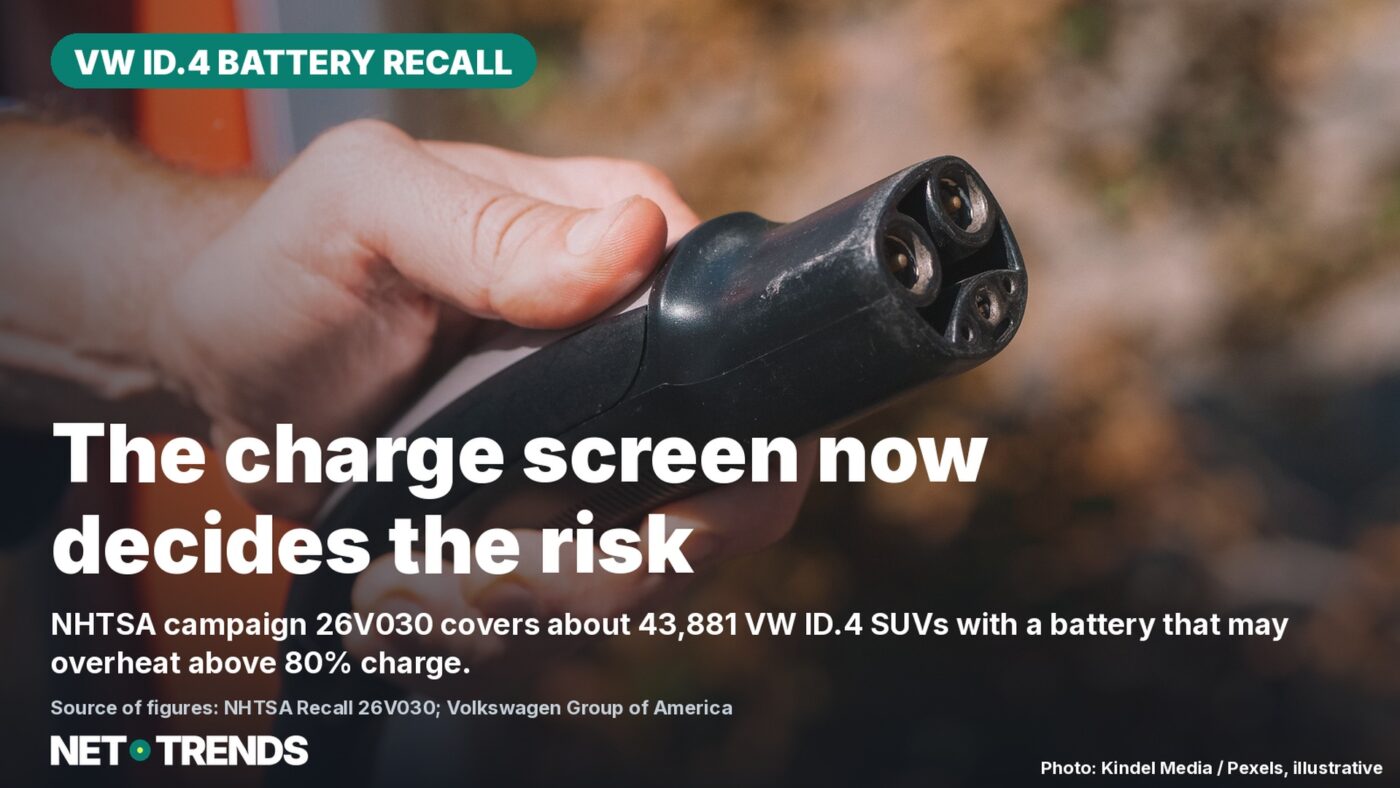
- The National Highway Traffic Safety Administration (NHTSA) has opened recall campaign 26V030 for about 43,881 model year 2023–2025 Volkswagen ID.4 electric SUVs over a high-voltage battery that may overheat.
- Volkswagen’s internal code for the US campaign is 93EA; the same underlying defect is covered in Europe under actions 93MF and 93MV for the ID.3, ID.4, ID.7 and ID. Buzz.
- Only the ID.4 is affected in the US market — the ID.3 and ID.7 are not sold here, and new ID. Buzz orders for the US have been paused, so most vehicles in the campaign are ID.4 SUVs built in Chattanooga, Tennessee.
Certain model year 2023–2025 Volkswagen ID.4 electric SUVs can see their high-voltage battery overheat if charged above 80%. The National Highway Traffic Safety Administration has logged the defect as recall campaign 26V030, and Volkswagen plans to limit affected vehicles to an 80% charge until they are checked. For owners, two things matter now: keep to that charge limit, and check your Vehicle Identification Number (VIN) with a Volkswagen dealer or on NHTSA’s own recall lookup.
The campaign does not cover every ID.4 built in the affected period automatically. According to Volkswagen’s filing with NHTSA, certain high-voltage batteries contain components from a specific supplier that may not meet required specifications. Model year alone is only a first clue — Volkswagen can give a reliable answer only through the 17-character VIN.
What NHTSA’s filing says
According to NHTSA’s recall confirmation document for campaign 26V030, Volkswagen Group of America notified the agency on 26 January 2026 about roughly 43,881 model year 2023–2025 ID.4 vehicles. The filing describes the defect as a high-voltage drive battery that may overheat, with a resulting fire risk. Volkswagen’s internal number for the US action is 93EA — related to, but filed separately from, the European actions 93MF and 93MV covering the ID.3, ID.4, ID.7 and ID. Buzz in the EU.
Owners can check their own vehicle for free at NHTSA’s recall search by entering their 17-character VIN, or search by make and model. As with any database search, the agency notes that results reflect only the details on file — because the issue may trace to a specific battery supplier batch, the exact status is best confirmed directly with a Volkswagen dealer using the VIN.
Why charging above 80% raises the risk
According to Volkswagen’s description of the related actions, certain high-voltage batteries from a specific supplier may contain components that fail to meet quality requirements. If an affected battery is charged above 80%, it can overheat, with the risk of fire and resulting injury or property damage. Volkswagen’s filing does not report confirmed injuries tied to the US campaign, though it describes isolated cases of vehicle damage in related actions abroad — that is the manufacturer’s own account, not proof that every affected vehicle already has a fault, since the defect is not reliably visible from outside the car.
Practical safety rule
- Set your charge target to 80% or below until your vehicle has been checked.
- Do not override a charge limit your ID.4 has already applied automatically.
- If a battery warning light appears, contact your Volkswagen dealer promptly.
- If you notice smoke or fire, pull over and stop in an open area if possible, turn off the vehicle, get out, and call 911.
Per Volkswagen, the 80% limit lowers the strain on the high-voltage battery and increases the safety margin. It applies to the maximum charge level, not the charging method — DC fast charging remains possible as long as the 80% limit is respected. For US owners, the recall notification letter from Volkswagen and your dealer’s instructions take precedence over general guidance.
VIN, not model year, decides
The VIN is printed on a label on the driver’s side doorjamb and is also visible through the windshield on the dashboard. Owners should have it ready when contacting a Volkswagen dealer about campaign 26V030 / 93EA. Anyone who has already received a recall notice should follow the steps it describes and schedule the requested appointment.
Volkswagen states that, for many affected vehicles that are online, the maximum charge capacity has already been limited to 80% remotely; depending on settings, this may not yet have taken effect on every car. Owners can check in the infotainment system or the myVW app whether the charge target can still be set above 80%. If an affected car has not received the remote limit, the Battery Care mode should be switched on manually in the meantime.
Not having received a letter yet is not a good reason to ignore a relevant warning — a change of address, ownership transfer or simple mailing delay can affect delivery. A direct VIN check with an authorized dealer remains the most reliable way to confirm status.
What applies until your appointment
Volkswagen considers continued use acceptable in principle as long as the charge limit is observed. That is not a blanket approval for every symptom: if a warning light comes on, or you notice an unusual odor, excessive heat, smoke or other abnormal signs, the vehicle should not simply keep being driven. In that case, the vehicle’s display, Volkswagen’s service network, and if necessary the fire department, are the right points of contact.
Anyone who lends their ID.4 to another driver or shares it within the household should make sure every driver knows about the charge limit. Any tag or marking applied as part of the recall should not be removed. Before a longer road trip in particular, it is worth confirming appointment availability, since the temporary limit reduces usable range.
What happens at the dealer
According to Volkswagen’s description of the remedy, the condition of the high-voltage battery is assessed first. If the check finds no issue, the temporary charge limit can be lifted once that check is successfully completed. Where irregularities are found, the limit stays in place until the affected battery modules have been replaced.
Volkswagen also points to a software update that can be part of the remedy. Depending on the vehicle, a physical battery inspection is required, and battery modules are replaced where necessary. Once all required work is finished, the original charge capacity and normal range should be restored. The manufacturer describes the remedy work under the campaign as free of charge to the owner. The specific repair and time needed depend on the individual vehicle.
In the United States, NHTSA oversees vehicle safety recalls under federal motor vehicle safety law, and manufacturers are required to notify owners and provide a free remedy once a safety-related defect is confirmed. Whether a buyer additionally has a claim against a dealer or seller depends on the purchase contract, applicable state law and the specific circumstances — the federal recall itself does not decide that separate question.
Frequently asked questions
Can I keep driving my ID.4 if it’s part of the recall?
Volkswagen considers continued use acceptable in principle if the battery is charged to no more than 80% and there is no warning light or other abnormal sign. Your recall notification letter and your dealer’s instructions take precedence over general guidance.
Which Volkswagen models does this affect in the US?
Only the model year 2023–2025 ID.4 is covered under NHTSA campaign 26V030 in the United States. The ID.3 and ID.7 are not sold in the US, and new ID. Buzz orders here have been paused.
What do the numbers 26V030 and 93EA mean?
26V030 is NHTSA’s campaign number for this US recall; 93EA is Volkswagen’s internal code for the same action. Either number helps when searching NHTSA’s recall lookup or contacting a dealer.
Does the 80% charge limit stay in place permanently?
No. According to Volkswagen, once the inspection and any necessary repair work are complete, the original charge capacity and range should be restored.
What has your experience been?
Did you get a recall notice for campaign 26V030, and how fast could your dealer schedule an inspection? Share your experience in the comments without posting your full VIN or other personal information.
Sources and status
- NHTSA: Recall confirmation, campaign 26V030 (Volkswagen ID.4)
- NHTSA: Recall search (VIN lookup)
- European Commission: Safety Gate, notice SR/03126/26 (in German/international, related EU actions 93MF/93MV)
- Volkswagen: safety information on the related actions 93MF and 93MV
Research and data as of: 7 November 2026.
Transparency note: AI-assisted tools were used in researching, structuring and writing this article. The sources used are listed in the article. Publication takes place only after manual editorial approval. Country edition based on an article from Net Trends, researched for the United States.
Share this article