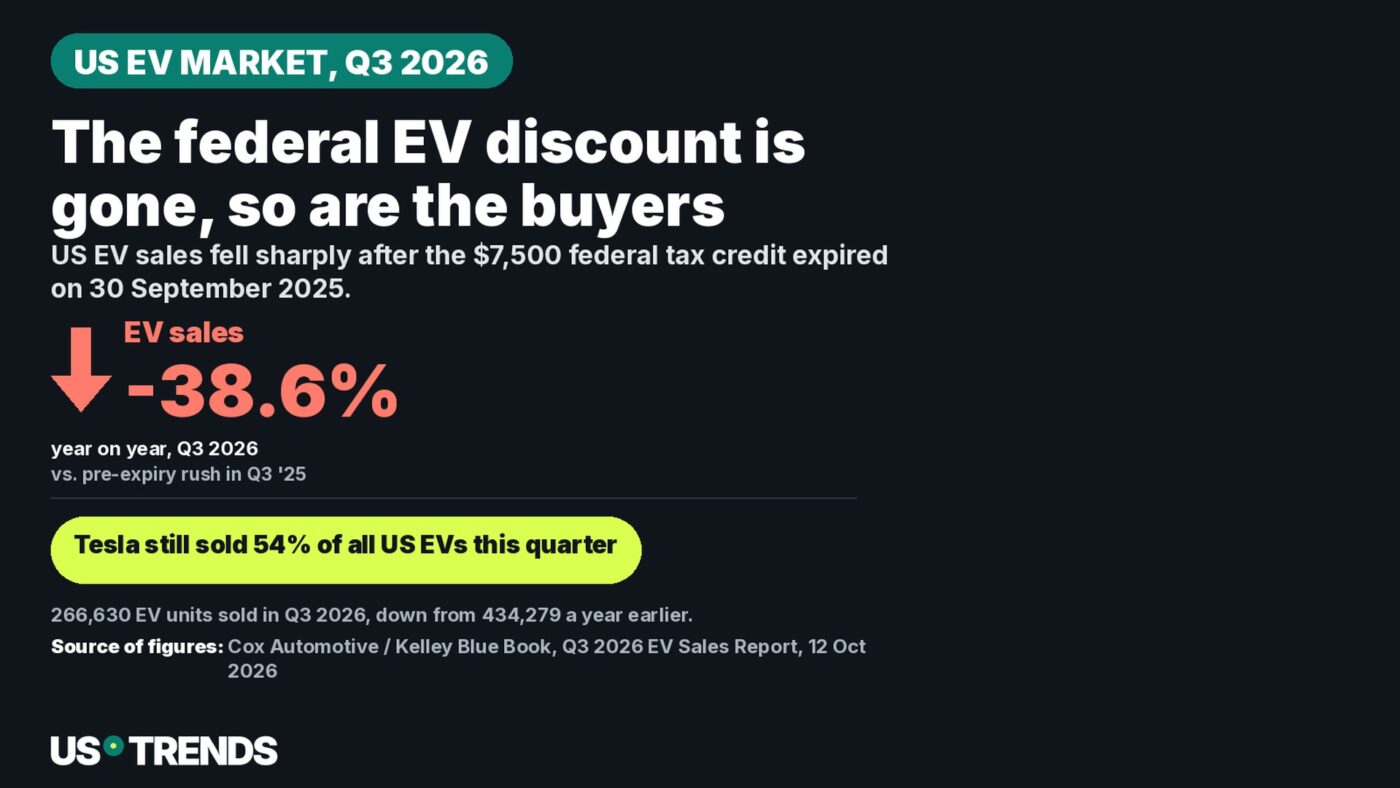
US electric vehicle sales fell 38.6% year over year in the third quarter of 2026, a year after the $7,500 federal tax credit expired – a sharp contrast to the record EV growth reported in Germany for October.
Key points
- US EV sales totaled 266,630 units in Q3 2026, down 38.6% from 434,279 units in Q3 2025, according to Cox Automotive’s Kelley Blue Book EV Sales Report.
- The decline follows the expiration of the federal $7,500 EV tax credit on September 30, 2025, which had pulled a surge of buyers into Q3 2025 before the deadline.
- Tesla still dominates the segment, with 144,094 units sold and a 54.0% share of all US EV sales in the quarter.
US electric vehicle sales dropped sharply in the third quarter of 2026, down 38.6% from a year earlier, according to Cox Automotive’s Kelley Blue Book EV Sales Report, updated October 12, 2026. The comparison period, Q3 2025, was itself inflated by a rush of buyers trying to claim the $7,500 federal EV tax credit before it expired on September 30, 2025 — so part of the year-over-year drop reflects that one-time pull-forward effect rather than a sudden collapse in demand.
The US picture looks very different from Germany’s, where battery electric cars reached a record 37.0% share of new car registrations in October 2026, up 79% year on year, according to Germany’s VDA and KBA. Without a federal purchase incentive, American EV buyers have lost one of the main financial reasons to choose an electric car over a gasoline one.
Tesla’s grip on the US EV market
Tesla sold 144,094 EVs in the US in Q3 2026, or 54.0% of the entire electric vehicle segment, per the Kelley Blue Book data. The Model Y alone accounted for 99,037 units (37.2% of the segment), with the Model 3 adding another 40,346 units (15.1%). The next-largest brands — Rivian (19,239 units), Cadillac (12,358) and Toyota (12,904) — trail far behind, underlining how concentrated the US EV market remains around a single manufacturer.
For buyers, the end of the federal credit means the sticker price of an EV in the US is now, in most cases, the full price — no automatic $7,500 reduction at the point of sale. Some states still run their own incentive programs, and manufacturers have at times offered their own discounts to offset the gap, but neither replaces the federal credit nationwide.
What the Q3 2026 numbers do and don’t show
- The -38.6% figure compares against an unusually strong quarter (Q3 2025), inflated by the tax-credit deadline rush.
- Kelley Blue Book’s report does not break out the EV segment’s share of all new-vehicle sales for Q3 2026.
- Quarterly sales figures do not show month-to-month trends within the quarter.
Frequently asked questions
Why did US EV sales fall so much in Q3 2026?
Largely because Q3 2025, the comparison quarter, was unusually strong: buyers rushed to purchase EVs before the $7,500 federal tax credit expired on September 30, 2025. Q3 2026 had no such rush and no federal credit.
Is the federal EV tax credit coming back?
Not based on current law. The credit expired on September 30, 2025, and this report does not indicate any federal replacement program as of Q3 2026.
Does Tesla still dominate the US EV market?
Yes. Tesla held 54.0% of all US EV sales in Q3 2026, led by the Model Y and Model 3, according to Cox Automotive’s Kelley Blue Book data.
Sources and status
- Cox Automotive: Q3 2026 Kelley Blue Book EV Sales Report, updated October 12, 2026.
- VDA (in German): Pkw-Produktion und -Markt in Deutschland im Oktober 2026 (in German), 3 November 2026.
Research and data as of: November 6, 2026.
Transparency note: AI-assisted tools were used in researching, structuring and writing this article. The sources used are listed in the article. Publication takes place only after manual editorial approval. Länderfassung auf Basis eines Artikels von Net Trends, für die USA recherchiert.
Share this article