No UK law requires winter tyres, but the Highway Code, EU tyre label and independent tests still shape the real buying decision.
Key points
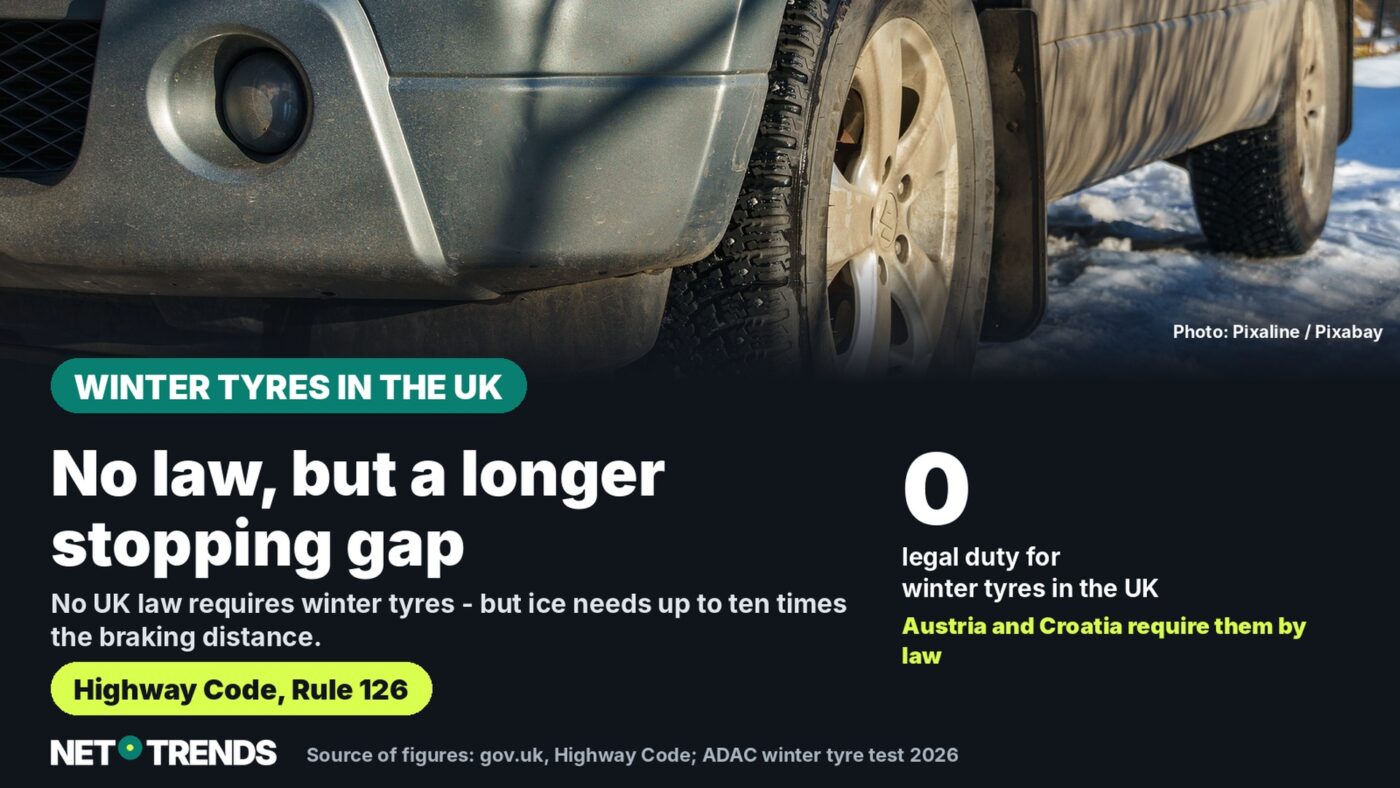
- The UK has no legal requirement to fit winter tyres at any time of year, unlike Austria or Croatia.
- The Highway Code (Rule 126) tells drivers to leave up to ten times the normal stopping distance on icy roads – that gap depends heavily on tyre choice.
- The EU tyre label grades wet grip and rolling resistance from A to E, but a 2026 ADAC test found braking-distance gaps of nearly 12 metres between tyres of the identical size.
A good letter on the EU tyre label is a useful start when buying winter tyres, but it is not the whole decision. What matters is the size approved for your car, the snowflake (3PMSF) symbol, and a balanced test on dry, wet and winter surfaces.
What the law says
R
u
What the EU label shows
The European Commission’s tyre label rates rolling resistance and wet grip from A to E, plus an external noise value in decibels and a noise class from A to C. Tyres built for severe snow or ice carry extra symbols. A QR code links to the EPREL database entry for that exact tyre type – useful for checking a specific model, since different sizes within one model line can carry different label values. The label does not rate dry handling, steering precision, or full winter balance.
Why tyre size decides
In the 2026 ADAC winter tyre test, Germany’s motoring organisation examined 32 products in two sizes, 185/65 R15 and 225/50 R17. In the larger size, the best and weakest tyres differed by nearly 12 metres in wet braking from 80 km/h (detailed results). One tyre scored well on snow yet failed overall because of weak dry and wet performance – proof that a single strong score is not enough, and that results from one size cannot be assumed for another.
Buying checklist
- Confirm the exact tyre size, load and speed index from the vehicle handbook or door-sill sticker.
- Look for the 3PMSF snowflake symbol, not just an M+S mark, if winter grip is the priority.
- Check the EU label and the EPREL record for the specific tyre type, especially wet grip and rolling resistance.
- Read an independent test of exactly this size, covering dry, wet and winter surfaces together.
- Factor in fitting, balancing, a tyre-pressure monitor reset and disposal when buying a full set.
Frequently asked questions
Is winter tyre use a legal requirement in the UK?
No. There is no UK law requiring winter tyres at any time of year. Rule 126 of the Highway Code only asks drivers to leave a much larger stopping gap on icy roads.
Does a good EU label grade guarantee the best tyre?
No. The label only covers wet grip, rolling resistance and noise. The 2026 ADAC test found nearly 12 metres of braking difference between tyres of the same label class and size.
Can I use results from a different tyre size?
Not reliably. Construction and tuning can differ by size and version, so look for a test of your exact size and check the full type code.
Which tyre size do you drive, and do you weight wet grip, mileage or snow performance most? Share your experience in the comments.
Sources and status
- gov.uk / The Highway Code, Rule 126.
- European Commission: tyre label and EPREL.
- Regulation (EU) 2020/740 on tyre labelling.
- ADAC winter tyre test 2026 (in German).
Research and data as of: 6 November 2026.
Transparency note: AI-assisted tools were used in researching, structuring and writing this article. The sources used are listed in the article. Publication takes place only after manual editorial approval. Länderfassung auf Basis eines Artikels von Net Trends, für Großbritannien recherchiert. Bildhinweis des Originals: KI-generiertes Symbolbild.
Share this article