Vienna’s specialist unit, Spain’s National Police and Europol struck simultaneously in Vienna and Marbella on 6 October
Key points
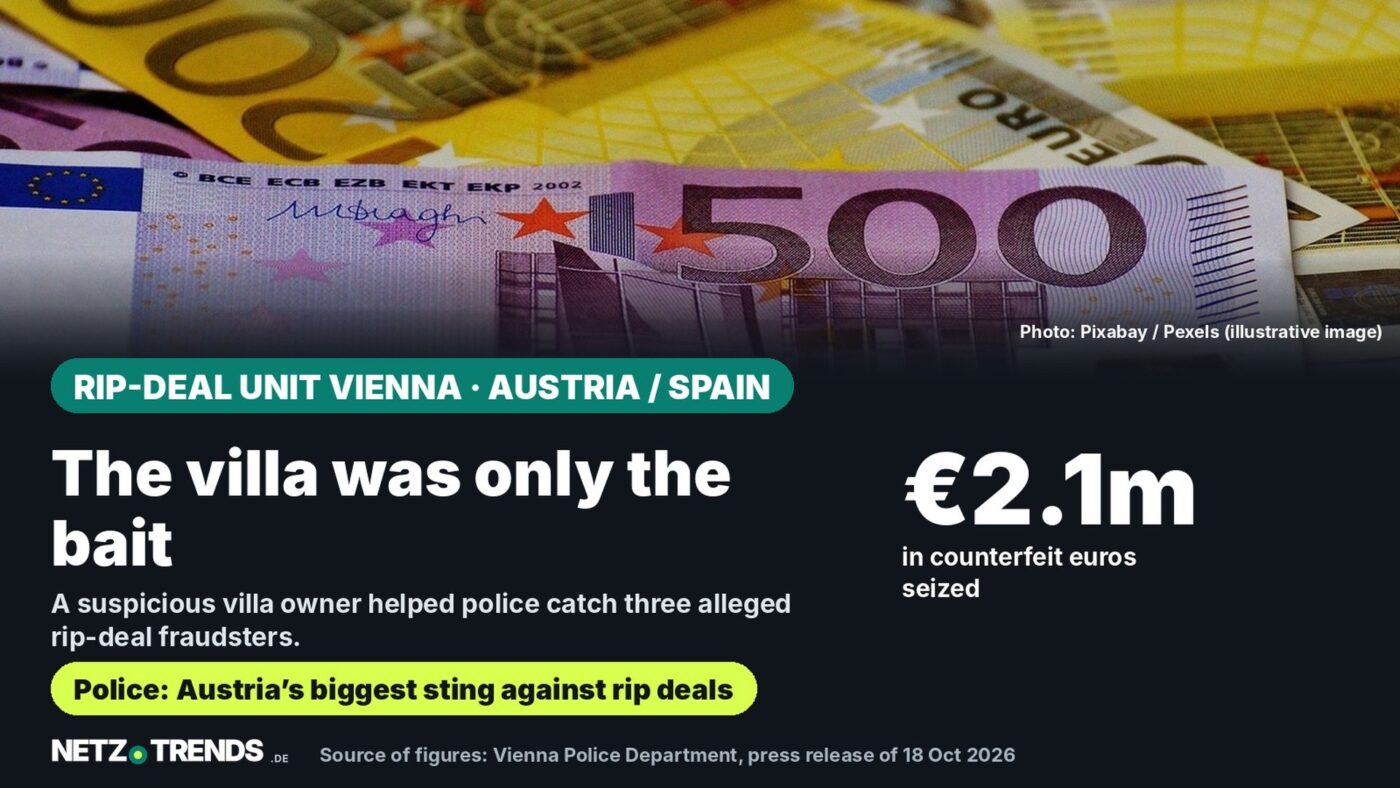
- Using a sting, police authorities from Austria and Spain, together with the EU police agency Europol, broke up an alleged rip-deal group: three arrests, around €2.1 million in counterfeit money seized.
- The bait was a luxury villa in Marbella advertised online. According to the police, a €1.8 million cash deposit and a €300,000 “commission” in gold coins were planned.
- For context: across the euro area, around 444,000 counterfeit banknotes were withdrawn from circulation in 2025 – 14 per 1 million genuine notes.
Police authorities from Austria and Spain have stopped an alleged rip-deal gang with a sting operation: three arrests in Vienna and Marbella, around €2.1 million in counterfeit money seized. The bait was a luxury villa in Marbella (Spain) offered for sale online.
The Vienna Regional Police Directorate (Landespolizeidirektion Wien, LPD Wien) made the case public on 18 October 2026 under the name “OP CASTILLO” in a press release. According to the police, it is the biggest sting success against rip-deal crime in Austria’s criminal history so far. All suspects are presumed innocent; no court has yet ruled on the allegations.
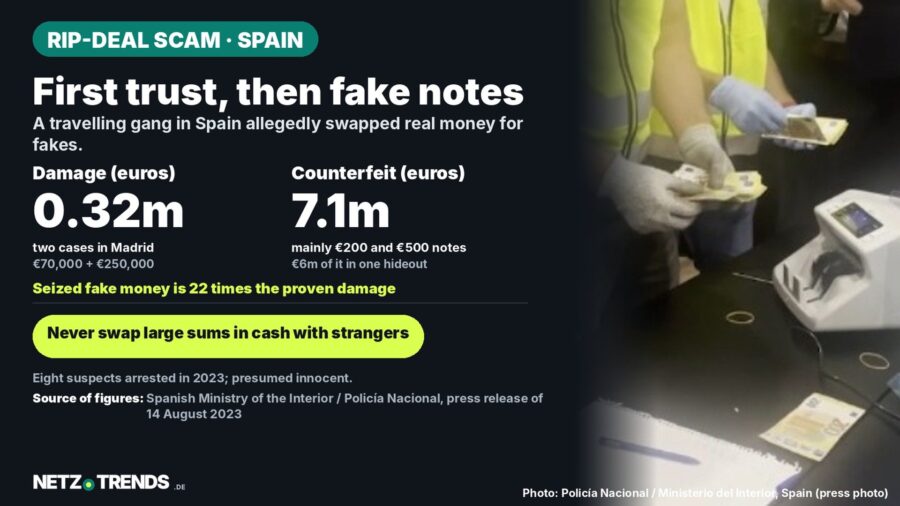
A rip deal is a scam in which perpetrators set up a supposedly lucrative deal, for example involving property, watches, cars, jewellery or a currency exchange. They build trust over weeks, often lure their counterpart abroad and, at the handover, slip in counterfeit money or steal genuine cash. NETZ-TRENDS recently described the scam using the example of a gang broken up in Spain.
The sting: two handovers, two cities
The LPD Wien describes the sequence of events as follows: at the beginning of August 2026, an Austrian property entrepreneur advertised a luxury villa in Marbella online. People then got in touch who claimed to represent a Swiss property consortium. A viewing together with the seller’s lawyer and several meetings in Marbella followed.
According to the police, it was agreed that a €1.8 million cash deposit on the purchase price would be handed over in a hotel in Marbella on 6 October 2026. At the same time, a relative of the seller was to hand one of the supposed investors an “agency commission” of €300,000 in gold coins in Vienna. According to the police, the group’s aim was to obtain the gold and to put a large amount of counterfeit money into circulation undetected.
The seller became suspicious beforehand, researched online, came across Vienna’s specialist unit for such cases and contacted the police. According to the LPD Wien, he then took part in the sting.
Vienna, Marbella, Madrid, The Hague: who was involved
The operation was led by the “Rip-Deal Unit Vienna” of the Vienna State Criminal Police Office. According to the press release, the following also took part:
- Europol, the European Union’s police agency based in The Hague,
- Austria’s Federal Criminal Police Office,
- Spain’s Policía Nacional in Marbella, Economic and Tax Crime Unit (Unidad de Delincuencia Económica y Fiscal, UDEF),
- the liaison office of the Austrian Ministry of the Interior in Madrid.
On 6 October 2026, officers struck simultaneously in Vienna and Marbella in a coordinated undercover operation. Three suspects aged 27, 30 and 53 were arrested. According to the police, they have a combined 30 relevant previous convictions in at least five EU member states, including for aggravated fraud, counterfeiting and rip-deal offences. Counterfeit euro banknotes worth around €2.1 million were seized.
The press release does not say exactly where the counterfeit money was found or how good the fakes were.
Why villas and gold suit rip deals
In its statement, the police name warning signs that explain why luxury deals in particular are vulnerable. With high purchase prices, a cash payment in the millions initially looks like a sign of liquidity to many sellers. Viewings, appointments with lawyers and several meetings create the framework of a genuine deal. The LPD Wien explicitly highlights one conspicuous feature: buyers who make no attempt to negotiate the price.
In the case described, the gold is the actual loot. Editorial assessment: unlike a bank transfer, gold coins leave no account movement, are easy to transport and can be traded anywhere. The counterfeit money serves as bait and as the consideration that is meant to look genuine to the other side.
“There is little counterfeit money in Germany: purely arithmetically, there were seven counterfeit banknotes per 10,000 inhabitants per year.”
Lutz Lienenkämper, Member of the Executive Board of the Deutsche Bundesbank, 7 August 2026
Counterfeit money in the euro area: 14 in 1 million notes
The amount seized is large, but the overall volume of counterfeit money is small. The European Central Bank (ECB) now publishes its counterfeit statistics once a year. According to its latest press release of 27 February 2026, around 444,000 counterfeit euro banknotes were withdrawn from circulation in 2025, 20 per cent fewer than in 2024. There were 14 counterfeits per 1 million genuine banknotes in circulation, i.e. around 0.0014 per cent. 96.8 per cent of the counterfeits were detected in euro area countries.
For Germany, the Deutsche Bundesbank reported on 7 August 2026 around 30,000 counterfeit banknotes with a combined face value of €1.75 million in payments for the first half of 2026, 4.3 per cent fewer than in the second half of 2025.
| Indicator | Area and period | Value |
|---|---|---|
| Counterfeit banknotes withdrawn from circulation | Euro area, 2025 | around 444,000 |
| Counterfeits per 1 million genuine banknotes | Euro area, 2025 | 14 |
| Share of €20 and €50 notes in all counterfeits | Euro area, 2025 | 80.2% |
| Share of €200 and €500 notes in all counterfeits | Euro area, 2025 | 4.1% |
| Counterfeit banknotes in payments | Germany, H1 2026 | 30,007 |
| Face value of these counterfeits | Germany, H1 2026 | €1.75m |
Important for context: the ECB and the Bundesbank record counterfeits withdrawn from cash circulation; the Bundesbank explicitly counts notes that were used as means of payment. In Germany, the Federal Criminal Police Office publishes its own annual report on police seizures. A police seizure such as the €2.1 million from Marbella and Vienna is therefore a different category. The comparison thus only shows orders of magnitude: a single operation was in the range of what turns up as counterfeit money in payments in Germany in half a year.
A trend described by the Bundesbank is also striking: increasingly, crude fakes with imprints such as “MovieMoney”, “Prop copy” or “Facsimile” are circulating that do not imitate any security features. Whether such notes were also used in the “OP CASTILLO” case is not known.
What counterfeiting costs in Germany
In Germany, counterfeiting money is a serious criminal offence (Verbrechen). Under Section 146 of the German Criminal Code (Strafgesetzbuch, StGB), anyone who makes counterfeit money, procures it or puts it into circulation as genuine faces a prison sentence of at least one year. If someone acts on a commercial basis or as a member of a gang, the minimum sentence is two years. For those affected, according to the Bundesbank, counterfeit money is not reimbursed. The Bundesbank recommends checking notes using the “Feel – Look – Tilt” principle.
The LPD Wien also gives four recommendations: do not travel abroad to sell your own, especially luxury, items; become suspicious if buyers do not negotiate; check business partners and ask for references; and after a rip deal, report it not only abroad but also in your home country.
Frequently asked questions
What is a rip deal?
A scam in which perpetrators fake a lucrative deal, such as buying a property, watch or car or a currency exchange, build trust and slip in counterfeit money or steal genuine money at the handover.
How much counterfeit money was seized?
According to the Vienna Regional Police Directorate, counterfeit euro banknotes worth around €2.1 million. Three suspects were arrested on 6 October 2026; they are presumed innocent.
How common is counterfeit money in the euro area?
According to the ECB, there were 14 counterfeits per 1 million genuine banknotes in circulation in 2025. In total, around 444,000 counterfeit notes were withdrawn from circulation.
Which notes are counterfeited most often?
In the euro area in 2025, the €50 note (53.2 per cent) and the €20 note (27.0 per cent). In Germany, the €50 note was also in the lead in the first half of 2026; according to the Bundesbank, counterfeits of €100 notes increased.
Would you accept a cash payment for a sale worth millions? Feel free to share your view in the comments.
Sources
- Vienna Regional Police Directorate: “OP CASTILLO – Rip-Deal Unit Vienna zerschlägt erneut Rip-Deal OCG”, press release of 18 October 2026, 12:33
- European Central Bank: “Number of counterfeit euro banknotes remains low in 2025”, press release of 27 February 2026
- Deutsche Bundesbank: “Weniger Falschgeld im Umlauf”, press release of 7 August 2026
- German Federal Ministry of Justice: Section 146 StGB – Counterfeiting money
Transparency note: AI-assisted tools were used in researching, structuring and producing this article, including the translation from the German original. The sources used are listed in the article. Publication takes place only after manual editorial approval.