The key points
- Infrastructure investor CVC DIF announced on 14 August 2026 that it is acquiring a majority stake in the Frankfurt colocation operator firstcolo. The company’s two existing Frankfurt data centres are described in the announcement as „near-fully-utilised“.
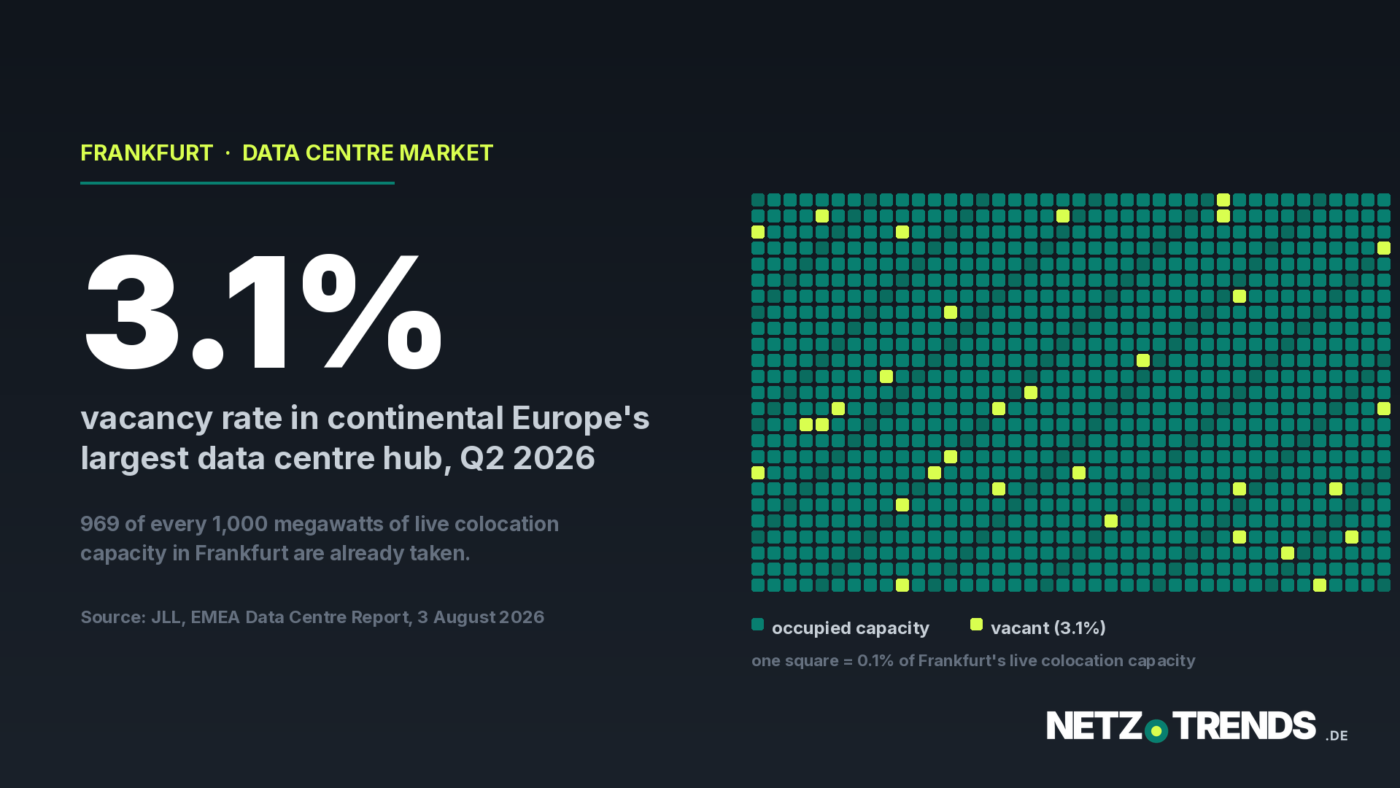
- Frankfurt had a vacancy rate of 3.1 percent in the second quarter of 2026 — the tightest of Europe’s five largest data centre markets, which averaged 6.4 percent.
- The binding constraint is electricity, not capital: grid connection lead times in Frankfurt run to 24 months or more, according to JLL.
- Germany’s federal government wants to double national data centre capacity and quadruple AI and HPC capacity by 2030. On industry figures, roughly three quarters of the planned growth is AI capacity.
- What nobody can put a number on is water: Germany’s average water usage effectiveness of 0.49 cubic metres per megawatt-hour is worse than the EU average of 0.40, and fewer than half of the data centres obliged to report their consumption actually did so for 2025.
A mid-sized German colocation operator changing owner would not normally be international news. But the sentence buried in the announcement is: firstcolo’s two Frankfurt data centres are „near-fully-utilised“. On 14 August 2026 the infrastructure investor CVC DIF announced that it is buying a majority stake in the Frankfurt company from Cube Infrastructure Managers. What it is really buying is a position in a market that has almost nothing left to sell.
Frankfurt is continental Europe’s largest data centre hub and, by the most recent industry measurement, its tightest. In the second quarter of 2026 the vacancy rate stood at 3.1 percent — meaning that for every 1,000 megawatts of live colocation capacity in the metro, roughly 969 were already spoken for.
A buyer paying for capacity that does not exist yet
firstcolo was founded in 2007 and serves more than 350 enterprise customers with colocation, dedicated hardware, connectivity and managed services. Its founders remain in place: Jerome Evans as CEO, Nicolaj Kamensek as COO, with Dennis Bergfeld as CFO. The transaction is expected to close by the end of September 2026; the price was not disclosed.
The strategic logic is stated plainly in the release. The money is meant to fund FRA7, a new site in Rosbach in the Frankfurt metropolitan region with 24 megawatts of gross capacity, plus further builds in other German markets. Kamensek describes FRA7 as „designed as a highly efficient, AI-ready facility with the power, cooling, connectivity and operational processes required for demanding high-density workloads“.
CVC DIF managing partner Willem Jansonius is equally direct about why the asset is attractive, calling it „a rare opportunity to invest in a high-quality, founder-led colocation platform in an attractive and supply-constrained FLAP-D data centre markets“. Supply-constrained is the operative word. In a market with 3.1 percent vacancy, the scarce commodity is not customers.
What FLAP-D and „vacancy rate“ mean
FLAP-D is the industry shorthand for Europe’s five established data centre markets: Frankfurt, London, Amsterdam, Paris and Dublin. Together they accounted for 3.8 gigawatts of live colocation capacity in mid-2026, up from 1.8 gigawatts in 2019.
The vacancy rate measures how much of the built, powered and commissioned capacity is not yet contracted. It says nothing about how much is planned. A market can have a large pipeline and almost no availability at the same time — which is precisely Frankfurt’s situation.
Frankfurt is the tightest of the five big European markets
The figures come from JLL’s EMEA data centre report published on 3 August 2026. Across the FLAP-D markets, average vacancy in the second quarter of 2026 was 6.4 percent. Frankfurt, at 3.1 percent, was less than half that. In the first half of 2026 the five metros between them delivered 194 megawatts of new capacity — a modest figure set against the demand that operators report.
| Q2 2026 | Frankfurt | FLAP-D total |
|---|---|---|
| Vacancy rate | 3.1 % | 6.4 % (average) |
| Live capacity | approx. 1.0 GW (Q2 2025) | 3.8 GW |
| Under construction | 311 MW | 1.4 GW |
| Planned | 687 MW | 2.0 GW |
| Delivered in H1 2026 | — | 194 MW |
Vacancy, pipeline and FLAP-D figures: JLL, EMEA Data Centre Report, 3 August 2026. Frankfurt live capacity: CBRE, 14 August 2025 (1.02 GW in Q2 2025).
The constraint is the grid, not the money
The pipeline numbers show that capital is not the bottleneck. Frankfurt has 311 megawatts under construction and a further 687 megawatts planned. What JLL identifies as the pacing item is the electricity connection: lead times of 24 months or more.
That constraint has been visible for a while. When CBRE reported in August 2025 that Frankfurt had crossed one gigawatt of live capacity — 1.02 gigawatts, just 114 megawatts behind London — the firm noted in the same breath that additional demand was „unlikely to be met by providers in the city’s largest data centre clusters given electricity grid constraints“. Growth, CBRE said, would move to submarkets outside the primary clusters. firstcolo’s FRA7 in Rosbach, some 25 kilometres north of the city, is exactly that pattern in practice.
The market has compounded at roughly 20 percent a year over the past decade. The grid has not.
Berlin wants to double the national total by 2030
Against that backdrop, Germany’s federal government adopted a national data centre strategy on 18 March 2026. The targets are explicit: double overall data centre capacity by 2030, and quadruple capacity for artificial intelligence and high-performance computing. Federal Digital Minister Karsten Wildberger framed it as a supply problem — „sufficient land, affordable secure electricity, and expedited approvals“. The strategy contains 28 measures, all of which were to be implemented within twelve months.
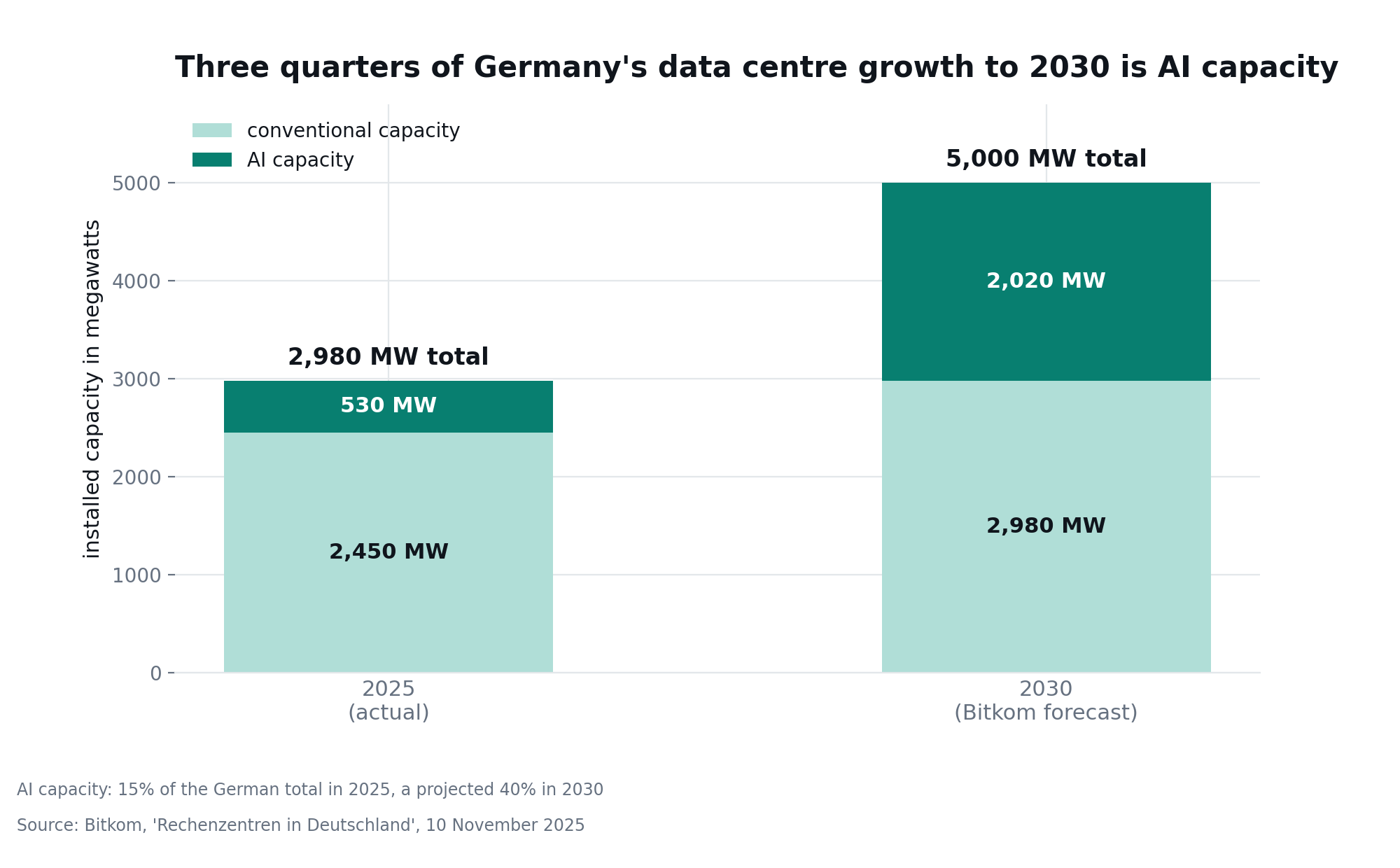
Own illustration by NETZ-TRENDS based on data from Bitkom, „Rechenzentren in Deutschland“, 10 November 2025.
The industry’s own baseline comes from the digital association Bitkom, whose study published on 10 November 2025 put installed German data centre capacity at 2,980 megawatts in 2025, a nine percent rise on the previous year, spread across roughly 2,000 facilities above 100 kilowatts and about 100 above five megawatts. Electricity consumption reached 21.3 billion kilowatt-hours in 2025, up from 20 billion in 2024 and 12 billion in 2015. Operators invested some 12 billion euros in IT hardware and a further 3.5 billion in building infrastructure in 2025 alone.
Three quarters of the planned growth is AI capacity
Bitkom’s forecast for 2030 is around 5,000 megawatts, a 70 percent increase. The composition matters more than the total. AI capacity accounted for 530 megawatts in 2025, or 15 percent of the German total. By 2030 the association expects 2,020 megawatts — 40 percent of a much larger base.
Put differently: of the roughly 2,000 megawatts of additional capacity Germany expects to build by 2030, close to 1,500 megawatts is AI capacity. Around three quarters of the growth is one workload class. That is a concentration risk worth naming, because AI capacity is also the densest, the most power-hungry per rack and the hardest to connect — which is what makes it collide directly with the 24-month grid queue.
The number the strategy does not contain: water
Neither the strategy nor the industry study answers the question of what all this will cost in cooling water. On 10 August 2026, netzpolitik.org reported that the federal government itself says only limited figures exist.
The figures that do exist are not flattering. On the European Commission’s data centre dashboard, the German average water usage effectiveness stands at 0.49 cubic metres per megawatt-hour, against an EU average of 0.40 — that is, German facilities use roughly a fifth more water per unit of energy than the European mean, while the country plans to double its capacity.
Reporting compliance is the second gap. Under section 19 of the German Energy Efficiency Act, larger data centres must report consumption data annually. According to the ministry figures cited by netzpolitik.org, only 482 reports had reached the Federal Office for Economic Affairs and Export Control by 6 July 2026 for the 2025 reporting year, against an estimated 1,000 or so obligated facilities — a compliance rate of roughly half. Sites below 300 kilowatts are not covered at all, and one federal IT service provider declined to disclose its figures citing security risks.
Water usage effectiveness, briefly
WUE expresses how many cubic metres of water a data centre consumes per megawatt-hour of energy used. Lower is better. It is not a substitute for absolute consumption: a highly efficient facility that doubles in size still draws more water from the same local supply. That absolute figure is the one Germany currently cannot state.
Industry says the targets are too small, not too big
The criticism from the sector runs in the opposite direction from what an environmental reading would suggest. Bitkom’s response to the strategy, issued the same day, called it an important signal but faulted it for remaining „too often in the vague“ and resting on general declarations of intent. Association president Ralf Wintergerst argued the growth targets are insufficient by international comparison, putting US data centre capacity at roughly sixteen times Germany’s.
Bitkom’s demands are concrete where the strategy is not: relief on electricity costs for data centres and telecommunications networks, better access to the grid, and faster planning and permitting. Energy costs are a live issue in Germany quite apart from data centres — the national carbon price alone is set to sit in a corridor of 55 to 65 euros per tonne in 2027 (in German), after every one of the 2026 auctions closed at the maximum price.
Both positions can be true at once. Germany can be building too slowly for the compute demand its industry expects, and still be expanding faster than its grid connections, its water reporting and its own measurement systems can keep up with.
What happens next
The firstcolo transaction is expected to close by the end of September 2026, after which FRA7 becomes the test case: 24 megawatts of gross capacity in the Frankfurt periphery, aimed squarely at high-density AI workloads, in a region where the grid queue is measured in years rather than months. Whether it lands on schedule is a more informative indicator of German build-out capability than any target figure.
The federal strategy’s own timetable runs out in March 2027, twelve months after adoption, when all 28 measures were to be in place. Bitkom’s next annual data centre study will show whether the 2025 growth rate of nine percent held. And the 2026 reporting round under the Energy Efficiency Act will show whether the compliance rate moves above half — the point at which Germany could, for the first time, say with confidence how much water its AI infrastructure actually consumes.
How do you see it? Is Germany’s data centre build-out constrained more by its electricity grid or by its permitting? Tell us in the comments.
Sources
- CVC: „CVC DIF to acquire leading German data centre operator firstcolo from Cube Infrastructure Managers“, press release of 14 August 2026
- JLL: EMEA Data Centre Report, mid-year edition of 3 August 2026
- CBRE: „Frankfurt Becomes a 1GW Data Centre Market, Narrowing the Gap with London“, press release of 14 August 2025
- Federal Ministry for Digital Affairs and State Modernisation (BMDS): „Bundesregierung beschließt Rechenzentrumsstrategie“, press release of 18 March 2026
- Bitkom: „Rechenzentren in Deutschland: KI treibt das Wachstum“, press release of 10 November 2025
- Bitkom: „Bitkom zur Nationalen Rechenzentrumsstrategie“, press release of 18 March 2026
- netzpolitik.org: „KI und Rechenzentren: Bundesregierung weiß nicht, wieviel Wasser ihre Ausbaupläne schlucken werden“, 10 August 2026, including the WUE figures from the European Commission’s data centre dashboard and the ministry’s reporting figures
- Energy Efficiency Act (EnEfG), section 19, on data centre reporting obligations
Transparency notice: AI-assisted tools were used in the research, structuring and production of this article. The sources used are listed above. Publication takes place only after manual editorial approval.
Transparenzhinweis: Bei Recherche, Strukturierung und Erstellung dieses Beitrags kamen KI-gestützte Werkzeuge zum Einsatz. Die verwendeten Quellen sind im Artikel aufgeführt. Die Veröffentlichung erfolgt erst nach manueller redaktioneller Freigabe.