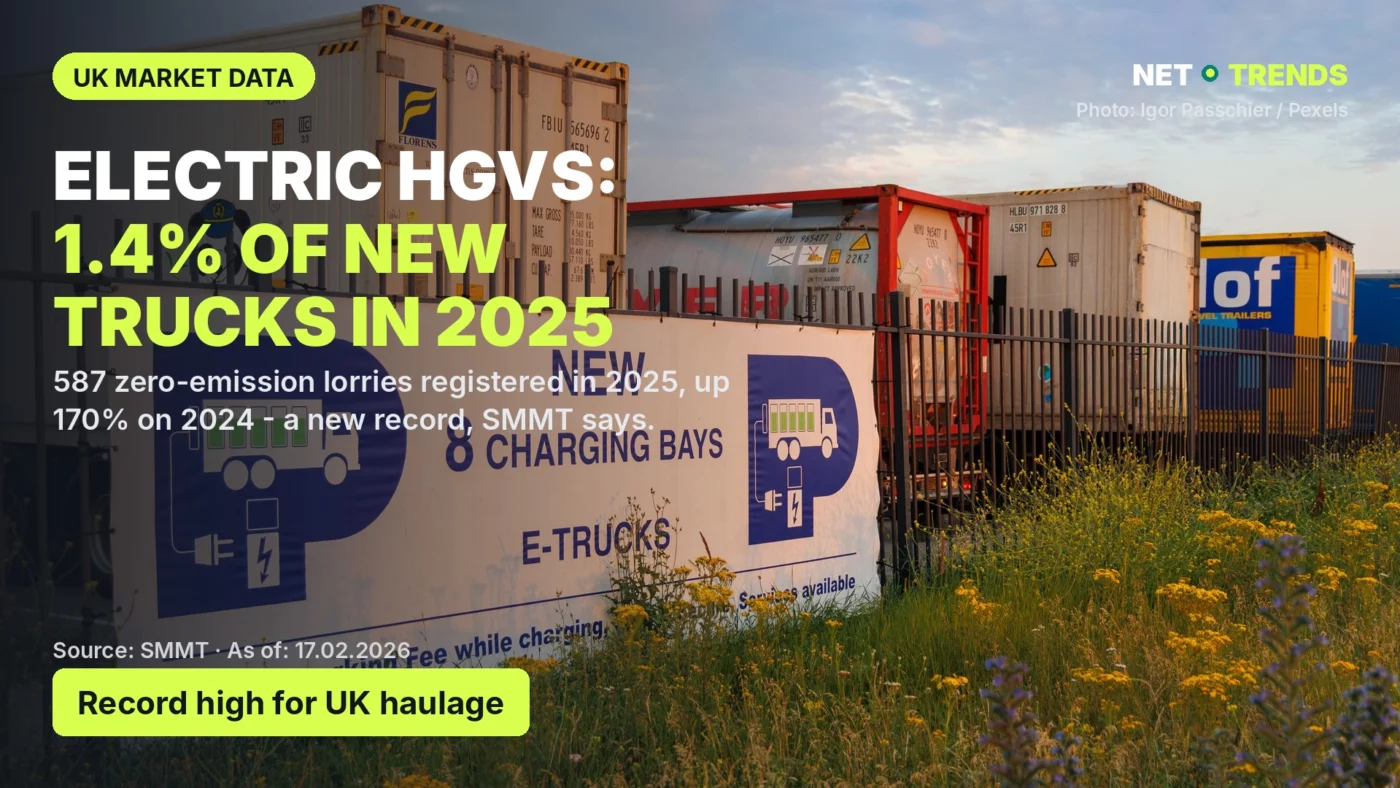
Zero-emission lorry registrations rose 170% in 2025 to a record 587 units, but that is still only 1.4% of the UK’s new heavy truck market, SMMT figures show.
Das Wichtigste in Kürze / Key points
- 587 zero-emission HGVs over 3.5 tonnes were registered in the UK in 2025, up 170.5% on 2024’s total, the Society of Motor Manufacturers and Traders (SMMT) reports.
- That is a record for the UK market, but it is still only a 1.4% share of all 40,504 new HGVs registered in 2025 (down 10.0% on 2024).
- For comparison: Germany’s Federal Statistical Office (Destatis) reports 11.7% of new German trucks over 3.5 tonnes were battery-electric in 2025, against an EU average of 7.7%. The UK is not in the EU figures and uses a different “zero-emission” category.
- The UK government has pledged to end sales of new diesel HGVs up to 26 tonnes by 2035, and all new HGVs by 2040.
Britain registered more zero-emission lorries in 2025 than ever before. Even so, diesel still powers almost 99 in every 100 new trucks on UK roads.
The Society of Motor Manufacturers and Traders (SMMT) published its full-year 2025 commercial vehicle figures on 17 February 2026. They show 587 new zero-emission HGVs over 3.5 tonnes were registered in the UK last year, up 170.5% on 2024. It is the highest number on record for the British market. At the same time, the overall new HGV market shrank by 10.0% to 40,504 units, as hauliers held off on fleet renewal.
Put together, the two trends mean zero-emission trucks reached a 1.4% share of new UK registrations in 2025 — roughly one truck in 71. That is a smaller share than Germany’s 11.7% for battery-electric trucks over 3.5 tonnes in the same year, reported by the German Federal Statistical Office (Destatis, Zahl der Woche Nr. 47), and well below the EU-27 average of 7.7%.
What the UK figures actually measure
SMMT’s “zero-emission” category for heavy goods vehicles covers battery-electric and hydrogen fuel-cell trucks together, not battery-electric vehicles (BEVs) alone. That is an important difference from the German Destatis figure, which counts only rein batterieelektrische Lkw (purely battery-electric trucks). In practice, the vast majority of the UK’s 587 zero-emission HGVs are battery-electric, since hydrogen trucks remain a very small, largely trial-based segment on British roads. But the two national statistics are not built on an identical definition, so the 1.4% UK figure and Germany’s 11.7% are not a precise apples-to-apples comparison — only a broad one.
The 40,504 total also covers all new HGVs over 3.5 tonnes registered with the Driver and Vehicle Licensing Agency (DVLA) in a single calendar year. As in Germany, this is a flow measure: it describes what entered the market in 2025, not how many zero-emission trucks are already running on UK roads. The existing fleet remains overwhelmingly diesel, since commercial vehicles typically stay in service for many years before being replaced.
“Zero emission truck registrations may be at a record high, but the overall market contraction masks the scale of the challenge still facing the sector.”
Society of Motor Manufacturers and Traders (SMMT), commercial vehicle registration figures, 17 February 2026
Why the UK trails Germany and the EU average
Several structural factors separate the UK market from Germany’s. Britain left the European Union’s single market in 2021, so UK hauliers do not benefit from EU-wide purchase incentive schemes or from the EU’s Alternative Fuels Infrastructure Regulation (AFIR), which obliges EU member states to build heavy-vehicle charging pools along the TEN-T core road network by set deadlines. The UK instead runs its own, separate charging and grant policy, and electric HGV charging infrastructure on UK motorways remains limited outside a small number of logistics hubs and trial corridors.
Price is the other recurring obstacle cited by the industry: a new battery-electric HGV costs considerably more to buy than an equivalent diesel truck, and UK government purchase support for zero-emission HGVs has been smaller and less consistent than carmakers and hauliers have called for. Combined with a shrinking overall truck market — itself a sign of a cautious freight sector — that makes 2025’s 1.4% share look like gradual, early-stage progress rather than a breakthrough.
Government targets: 2035 and 2040
The UK government’s current policy, confirmed by the Department for Transport in November 2021 and not reversed since, is that sales of new diesel and petrol HGVs weighing up to 26 tonnes should end by 2035, with all new HGVs — including the heaviest articulated lorries — required to be zero-emission by 2040 (gov.uk, 10 November 2021). Those are sales targets for new vehicles, not a ban on existing diesel trucks continuing to operate, and they say nothing about how much charging infrastructure needs to exist by any given date along the way.
A 1.4% share in 2025 is a long way from either milestone. Reaching the 2035 target for lighter HGVs would require the zero-emission share of new sales to climb from roughly 1 in 71 trucks today to effectively all of them within a decade — a pace of change the current figures do not yet show.
What it means for UK hauliers
For a haulage business weighing up its next vehicle order, the national percentage is context, not a verdict on any individual purchase. What matters operationally is whether a given route, depot and duty cycle suit an electric truck today: available range, depot charging capacity, grid connection costs, and whether drivers can charge during mandatory rest breaks rather than losing paid driving time. SMMT’s figures say nothing about total cost of ownership, resale values or the price hauliers actually pay after any available grant — those depend on the specific vehicle, operator and route.
The record 587 registrations do show that more UK fleets are willing to trial zero-emission trucks than a year ago. Whether that growth continues at the same pace, or depends on further government support once current grant schemes wind down, is not something the registration statistics alone can predict.
Frequently asked questions
How many zero-emission HGVs were registered in the UK in 2025?
587, according to SMMT — a record for the UK market and up 170.5% on 2024.
What share of the UK truck market is that?
1.4% of the 40,504 new HGVs over 3.5 tonnes registered in 2025, which was itself a 10.0% smaller market than 2024.
How does the UK compare with Germany and the EU?
Germany reported 11.7% of new trucks over 3.5 tonnes as battery-electric in 2025 (Destatis), against a 7.7% EU-27 average. The UK’s 1.4% zero-emission share also includes hydrogen trucks and is not in the EU figures, so the comparison is broad rather than exact.
By when must new HGVs in the UK be zero-emission?
Under the government’s 2021 pledge, new HGVs up to 26 tonnes should be zero-emission by 2035, and all new HGVs by 2040.
What’s holding back electric HGV uptake at your depot or on your routes? Tell us about it in the comments.
Quellen und Stand / Sources and status
- SMMT: 2025 commercial vehicle registration figures, published 17 February 2026.
- Statistisches Bundesamt (Destatis): “7,7 % der im Jahr 2025 neu zugelassenen Lkw in der EU fahren rein elektrisch”, Zahl der Woche Nr. 47, 17 November 2026.
- UK Government (gov.uk): “UK confirms pledge for zero-emission HGVs by 2040 and unveils new chargepoint design”, Department for Transport, 10 November 2021.
Research and data status: 17 November 2026. UK figures cover calendar year 2025; the German and EU comparison figures use the same reference year but a narrower vehicle definition (battery-electric only).
Transparency note: AI-assisted tools were used in researching, structuring and writing this article. The sources used are listed in the article. Publication takes place only after manual editorial approval.
Share this article
Comment Tell us what you think →