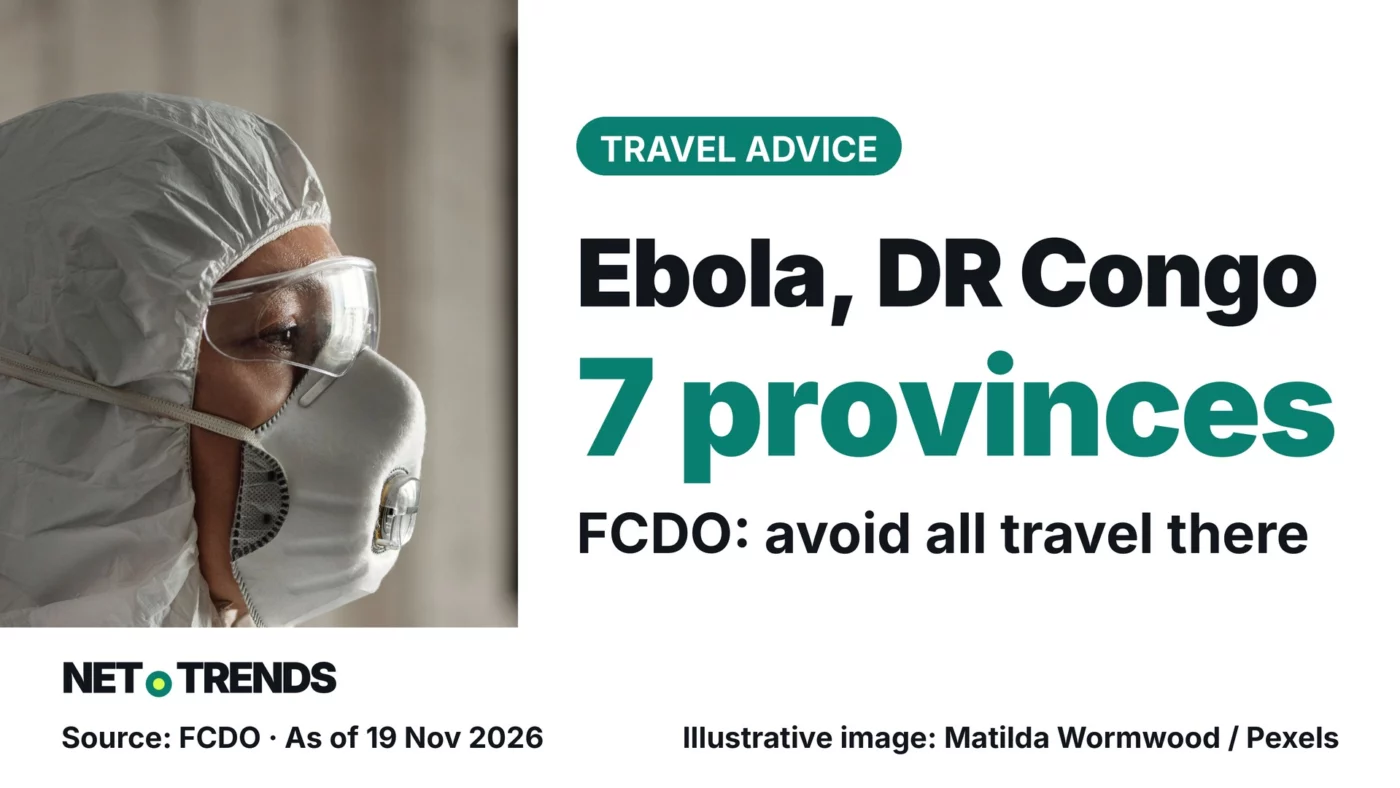
With 11,613 confirmed Ebola cases in DR Congo, the FCDO advises against all travel to seven provinces, including Ituri and North Kivu.
Key points
- WHO counts 11,613 confirmed Ebola cases and 5,678 deaths in the Democratic Republic of the Congo (data as of 17 November 2026).
- The FCDO advises against all travel to Haut-Uélé, Ituri, North Kivu, South Kivu, Maniema, Tanganyika and Haut-Lomami.
- There is no licensed vaccine or specific treatment against Bundibugyo virus disease.
- Anyone who falls ill within 21 days of returning to the UK should call NHS 111 or their GP first.
WHO counts 11,613 confirmed Ebola cases in DR Congo, and 5,678 people have died. The FCDO advises against all travel to seven provinces, and travellers cannot be vaccinated against this strain.
The outbreak is caused by Bundibugyo virus, one of the Ebola viruses, and was reported in May 2026. In its outbreak report of 20 November, the World Health Organization (WHO) says it remains a public health emergency of international concern, as confirmed on 18 November.
11,613 confirmed cases in DR Congo
The confirmed cases are spread across 68 health zones in eight provinces, with active transmission in 48 of them. Of those infected, 5,678 have died and 3,148 have recovered, a crude fatality rate of 48.9 per cent. Contact tracing reached only 81 per cent of contacts, against a target of 95 per cent.
Ituri and North Kivu carry the outbreak
Data table
| Period | Confirmed cases |
|---|---|
| Ituri | 7946 |
| North Kivu | 2996 |
| Haut-Uélé | 534 |
| Tshopo | 109 |
The chart shows the four provinces with the most cases. Ituri alone accounts for 7,946 of the 11,613 confirmed cases.
Outside the DRC, WHO lists nine confirmed cases in Kenya and one imported case in Nigeria. WHO rates the risk as very high in the DRC and low for countries with strong connections and high response capacity.
What the FCDO advises
The Foreign, Commonwealth and Development Office (FCDO) travel advice for the DRC was still current on 19 November 2026. It advises against all travel to Haut-Uélé, Ituri, North Kivu, South Kivu, Maniema, Tanganyika and Haut-Lomami, to areas within 50km of the border with the Central African Republic and to Kwamouth territory. These warnings also reflect the security situation, not only Ebola.
On Ebola, the FCDO writes: “The outbreak is highly active, evolving and geographically widespread.” It also warns that some countries have additional health screening requirements or entry restrictions for people who have been in the DRC.
No vaccine, no specific treatment
According to the UK’s National Travel Health Network and Centre on TravelHealthPro, “there are no licensed vaccine or specific therapeutic treatments” against Bundibugyo virus disease. WHO says two candidate vaccines have joined a trial, but none is approved.
How likely is a case in the UK?
TravelHealthPro says imported Ebola cases are “extremely rare in the UK”. Since 1976, four confirmed cases have been reported in the UK: one laboratory-acquired case in 1976 and three health workers linked to the 2014 to 2015 outbreak in West Africa. There have been no UK deaths from Ebola disease.
If you travel or have travelled to the region
- Check the FCDO travel advice and TravelHealthPro before booking.
- If you become ill within 21 days of returning, call NHS 111 or phone your GP rather than turning up in person.
- Mention your travel dates, itinerary and any possible exposure.
Malaria is also a risk in the DRC. TravelHealthPro advises seeking medical help straight away for malaria symptoms, even up to a year after returning. WHO has said updated recommendations will follow in the coming days.
Frequently asked questions
Can I get vaccinated against Bundibugyo Ebola?
No. There is no licensed vaccine or specific treatment against this disease.
Which DRC provinces does the FCDO advise against all travel to?
Haut-Uélé, Ituri, North Kivu, South Kivu, Maniema, Tanganyika and Haut-Lomami, plus areas near the Central African Republic border and Kwamouth territory.
What should I do if I feel unwell after returning?
If you fall ill within 21 days of returning, call NHS 111 or phone your GP and mention your travel.
Does WHO support travel bans?
No. WHO advises against restrictions on travel to or trade with the affected countries.
Your view: Would you go ahead with a planned trip to a country bordering DR Congo right now? Share your experience in the comments.
Sources and date
- WHO: Ebola disease caused by Bundibugyo virus – Democratic Republic of the Congo, Kenya and Nigeria (Disease Outbreak News, 20 November 2026)
- FCDO: DRC travel advice (still current at 19 November 2026)
- TravelHealthPro: Ebola disease in DRC and Uganda (news update, 23 October 2026)
As of: 22 November 2026
Transparency note: AI-assisted tools were used in researching, structuring and writing this article. The sources used are listed in the article. Publication takes place only after manual editorial approval.
Share this article