

Since 20 May 2025, the Berlin-based journalist Hüseyin Doğru has been on the EU's Russia sanctions list: accounts frozen, EU-wide travel ban, de-facto professional ban. German authorities have meanwhile also frozen the accounts of his wife and his mother – neither of whom appears on any sanctions list. An investigation into the first sanctions case against a German journalist, the legal fractures behind it, and the international response .
Background report & analysis | As of 28 May 2026
It is an unprecedented event in the recent history of the Federal Republic of Germany: a German citizen is placed by a supranational authority – the Council of the European Union – on a sanctions list that was originally created for actors of Russia's war of aggression against Ukraine. Without criminal proceedings, without a hearing, without judicial review. Within hours his account is frozen, he is excluded from the economic life of the EU, and may neither travel nor work. His name: Hüseyin Doğru, journalist, Berliner, 40 years old.
The case is, legally, a precedent; politically, a textbook example; and humanely, a catastrophe – not only for Doğru himself, but also for his wife and his mother, whose accounts have meanwhile likewise been frozen by German authorities, although neither is on any sanctions list (source: Berliner Zeitung). The entire family is affected, including – according to consistent reporting – three small children. This article reconstructs the case on the basis of the official EU documents, the German court decisions to date, the international media coverage and voices from politics, civil society and academia – and places it in legal context: under the German Basic Law, EU law, the European Convention on Human Rights and international humanitarian law.* * *
1. Who is Hüseyin Doğru?
Hüseyin Doğru was born in Berlin and is a German citizen of Turkish-Kurdish origin; his father comes from Turkey. He has been working as a journalist for around 15 years. His earliest assignments dealt with German-Turkish and Kurdish topics; later he turned to international conflicts. His media project red.media is consistently described in international reporting as belonging to the left-wing media spectrum – the English-language Wikipedia entry on Hüseyin Doğru literally characterises the platform as a »socialist, anti-fascist news outlet«. Doğru himself, in his interview with The Left Berlin, explicitly placed himself within the international Left with the statement »If we organize ourselves as leftists, we must do so as journalists, activists, media makers, influencers«. The German-language Lower Class Magazine titled its September 2025 interview with him »EU sanctions list for anti-imperialist journalism« – self- and external descriptions consistently use the terms »left« and »anti-imperialist«. His own X profile is available under @hsyndogru.
In early 2023 he founded the platform red.media (short: »Red«), operated through the Istanbul-based company AFA Medya A.Ş.In English, German and other languages, the small team produced documentaries and short-form videos about social movements worldwide – with a clear focus on the war in Gaza and on state repression against the Palestine solidarity movement in Germany and Europe. red.media was not a mass medium, but reached six- to seven-figure audiences on Instagram, TikTok and YouTube. The platform ceased operations on 16 May 2025 – just days before the EU listing; among others, Peoples Dispatch reported on this on 20 May 2025.
His earlier career includes a stint at the Berlin video portal Redfish, a subsidiary of the Russian state agency Ruptly. Doğru has never publicly denied this employment; he emphasises, however, that he ended the relationship years ago and that red.media has no financial or organisational ties of any kind to Russia. red.media was financed from his own savings and donations – a representation he reiterates in an extensive interview in Lower Class Magazine of 3 September 2025 and in the JACOBIN magazine (German edition).
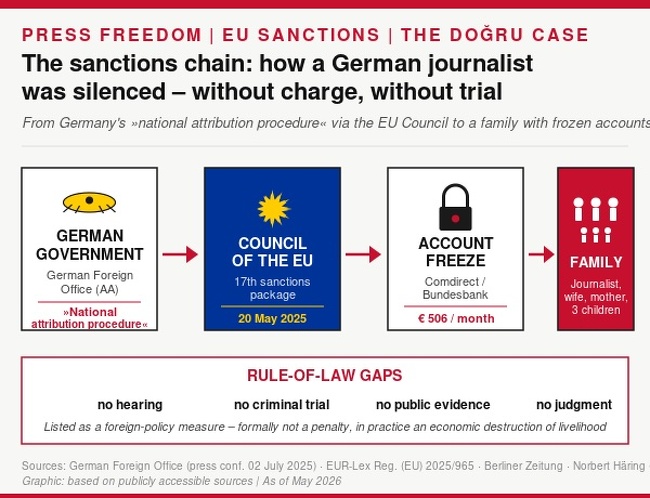
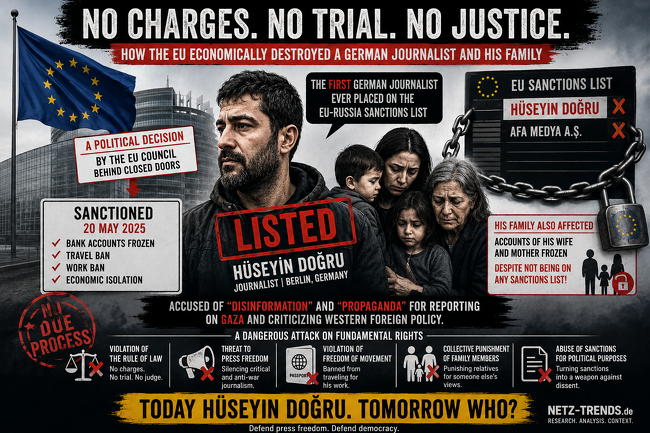
On 20 May 2025 the Council of the EU adopted its 17th sanctions package against Russia. In the corresponding legal acts – Implementing Regulation (EU) 2025/965 and Decision (CFSP) 2025/966 – two newly listed entries appear that constitute a novelty in EU sanctions practice: Hüseyin Doğru as a natural person and his company AFA Medya A.Ş. This makes Doğru the first German citizen against whom the EU has imposed personal sanctions, and the first journalist worldwide to be caught up in the Russia sanctions regime despite living and working exclusively on EU territory.
* * *
2. What does the EU specifically accuse Hüseyin Doğru of?
The reasoning for the listing can be found in the EU's Official Journal (EUR-Lex, Implementing Regulation (EU) 2025/965). The central passage on AFA Medya A.Ş. reads, in essence:
“AFA Medya A.Ş. is a media company based in Istanbul that operates »RED«, comprising media platforms with close financial and organisational connections with Russian state propaganda entities and actors. RED has used its media platforms to systematically spread false information on politically controversial subjects with the intent of creating ethnic, political and religious discord amongst its predominantly German target audience, including by disseminating the narratives of radical Islamic terrorist groups such as Hamas.” (Official Journal of the EU, Implementing Regulation (EU) 2025/965, 20 May 2025)
The reasoning contains three independent accusations, each of which must be weighed differently in legal terms. First, the Council claims a »close financial and organisational connection« to Russian propaganda structures; specific public evidence for this is not contained in the listing document – the evidence is said to be in the Council's non-public files (so-called WK documents). Second, the Council accuses the company of having »systematically spread false information« without naming even a single concrete article in the public document as proof. Third, the accusation of sowing »ethnic, political and religious discord« does not aim at any criminal offence under the German Criminal Code, but at an evaluation of the journalistic content itself.
The complaint Doğru and AFA Medya v. Council – Case T-429/25, filed on 3 July 2025 with the General Court of the European Union (GCEU) in Luxembourg, documents that the evidence presented by the Council consists to a substantial extent of publicly available social media posts, journalistic texts and video reports by Doğru himself. The legal documents cite, among other things, reporting on »anti-Israel riots« as an indicator of Russian influence.
Doğru contests all three core accusations. He argues that, in substance, the sanction is a punitive measure for his reporting on the Gaza war and on the repression of pro-Palestinian voices in Germany. In an extensive interview with The Left Berlin he said:
“It's not about us. You don't have to like Red Media, you don't have to have liked Redfish – maybe you even hated it, that's fine. But fundamentally this isn't about us, it's about your rights right now – because they start with us.” (Interview with Hüseyin Doğru, The Left Berlin, published 2025)
In the Doğru case the German federal government is not a passive co-decider in the Council of the EU – it actively drove the case and relied on findings of its own security services. In the Federal Press Conference of 2 July 2025 a Foreign Office spokesperson, Martin Giese, stated verbatim:
“We can today say with binding force that »red.« is being used by Russia specifically for information manipulation. We were able to establish this in the context of a national attribution procedure. The basis for this is a comprehensive analysis by the German security authorities.” (Federal Foreign Office, government press conference (translation by the author), 2 July 2025)
“Together with our EU partners we have imposed sanctions on those behind »red.«.” (Federal Foreign Office, government press conference (translation by the author), 2 July 2025)
This means: officially documented. Doğru's listing rests on a national attribution procedure by German security services; at the end of it the federal government together with its EU partners imposed the sanctions. A purely »Brussels« measure in which Germany would have been only marginally involved is not what this is. The federal government has subsequently reiterated its position at the press conferences of 11 May 2026 and 27 May 2026.
Several journalists pressed the matter in the press conference – and met with consistent evasive manoeuvres. To the central question of whether the allegations involved Russian money or another form of influence, the Foreign Office spokesperson replied:
“I did not use the word »intelligence-related« at all. These are all sorts of findings – including many findings that are publicly accessible. […] There is a legal remedy. An orderly legal procedure against it is possible.” (Federal Foreign Office, government press conference (translation by the author), 2 July 2025)
Asked how a sanctioned person with frozen accounts is supposed to pay for legal counsel, the spokesperson replied that, according to his information, there was »legal representation«; this »seemed to be possible« – without further justifying that statement. The Federal Ministry of Justice, represented by spokesperson Kirschner, expressly refused any comment on the fundamental-rights compatibility of the measure:
“I cannot comment on the concrete individual case. This is a European legal framework for the sanctioning. Within the federal government the Federal Foreign Office is responsible for it. I have nothing to add.” (Federal Ministry of Justice, government press conference (translation by the author), 2 July 2025)
To a critical objection by one journalist that the EU's argument – Doğru had »indirectly strengthened the actions of the Russian Federation« by reporting critically on pro-Palestinian protests in Germany – had »an Orwellian ring«, the Foreign Office spokesperson merely pointed generally to the – allegedly – publicly accessible listing reasoning. In the same press conference it also became known that the family's health insurance had ceased to provide services – the wife in the seventh month of a high-risk pregnancy. No substantive reaction from the federal government followed. The contradictory delineation of responsibilities between the ministries has been characterised by the Ostdeutsche Allgemeine Zeitung as »entanglement in contradictions«.
Note: The following review is identified as evaluation and is to be distinguished from the preceding factual section.
Three findings are remarkable from the author's perspective. First, the term »national attribution procedure« refutes the often-heard reading that this is »only« an EU measure in which Germany was marginally involved. The federal government itself makes clear: the underlying evidence analysis comes from German security services. Political and rule-of-law responsibility therefore lies substantially in Berlin as well, not only in Brussels.
Second, the federal government dodges substantive scrutiny by pointing to the »publicly accessible« listing reasoning – while at the same time refusing any statement on what concrete findings support the central charge of a financial or operational connection to Russia. This constellation – public assertion, non-public evidence – is precisely the constellation against which the Federal Constitutional Court warns in its press-freedom case law. Interferences against journalists are subject to a particularly strict duty of justification; mere references to »all sorts of findings« do not meet that standard.
Third, the silence of the Federal Ministry of Justice on a question for which it would originally be competent (protection of the fundamental rights of German citizens) is legally questionable. The refusal of any constitutional-law comment with a reference to a »European legal framework« is not tenable: the Federal Republic remains bound by fundamental rights even within the scope of EU law – this is the substance of the Federal Constitutional Court's settled case law on the »Solange« doctrine since BVerfGE 73, 339 (1986). For the Federal Ministry of Justice to point to the Foreign Office and itself decline responsibility is a political answer – legally it does not hold.
* * *
3. The sanctions and their practical consequences
For a person living in the EU, the listing entails what are arguably the most far-reaching consequences EU law knows outside criminal law. Concretely, four interventions have applied to Doğru simultaneously since 20 May 2025. First, the complete freezing of all accounts, assets and economic resources within the EU. Second, an EU-wide travel ban that effectively confines him to Germany, because no exit permission has so far been granted. Third, a de-facto professional ban, because no one in the EU may make »economic resources« available to him – which includes employment, fees, leases in his name, electricity bills and even paying a lawyer without an administrative special permit. Fourth, a cascade of social knock-on effects, from account terminations and insurance cancellations to platform suspensions.
According to public statements by Doğru and his lawyers, after the sanctions took effect the family was left at one point with around 60 euros in cash (sources: Berliner Zeitung, Lower Class Magazine). Doğru, his wife (a German citizen of Turkish origin) and, according to consistent German reporting, three small children have since faced the existential question of how to pay for rent, electricity, food and medical care.
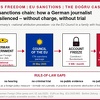
Listings are decided by the Council of the EU (the foreign ministers of the member states) on the proposal of the High Representative for Foreign Affairs and Security Policy – in practice prepared by the European External Action Service (EEAS) and national intelligence services. The decision is taken unanimously. The person concerned is neither heard nor informed in advance; they typically learn of their listing on the day of publication in the Official Journal. Judicial protection is available only after the fact – via an action for annulment before the General Court of the EU in Luxembourg, with average proceedings of 18 to 30 months. Until a possible ruling the listing remains in force.
Doğru's case is pending under reference number T-429/25 before the General Court. A decision is expected in the coming months. In parallel, he has sought before German courts to have individual bank accounts released – with mixed results: the Frankfurt am Main District Court (Amtsgericht Frankfurt am Main) rejected an urgent application by which Doğru sought to have his house bank, Comdirect (a subsidiary of Commerzbank), allow him to settle, from his account, invoices for insurance, debt-collection agencies and similar claims – over and above the monthly allowance of 506 euros set by the Deutsche Bundesbank (President: Joachim Nagel). The court held that the bank is directly bound by EU sanctions law – as reported by Norbert Häring on 25 March 2026 and the Berliner Zeitung on 24 March 2026. By contrast, in April 2026 a German court ruled in a separately conducted proceeding concerning the account freeze of his wife that the freeze was subject to »serious doubts« and constituted a »massive interference« with her rights; the freeze was provisionally suspended – as reported by the Berliner Zeitung on 5 April 2026 and nex24.news in April 2026. Which specific court issued the ruling does not emerge unambiguously from the public reporting.
* * *
4. The extension to the family: kin liability in the 21st century?
In March 2026 – almost a year after Doğru's listing – the German customs administration, coordinated through the Central Office for Sanctions Enforcement (ZfS), additionally froze the accounts of his wife. The justification: it was suspected that EU sanctions might be circumvented through those accounts. Shortly afterwards, according to reporting in the Berliner Zeitung, the account of his mother was also frozen. Both are law-abiding German citizens; no sanctions listing exists against either of them. The Berliner Zeitung documented the family's plight under the headline »We can no longer feed our children« in a report from March 2026.
“We can no longer feed our children.” (Berliner Zeitung, March 2026)
The case thus reaches a dimension that gives even observers from the political mainstream pause: the economic existence of an entire family is shut down because one family member is on an EU list – a list which, in turn, is based on non-public intelligence findings and has not yet been judicially reviewed. A written question (E-001321/2026) was tabled in the European Parliament concerning the extension of the sanctions to relatives.
German public broadcasting and most major daily newspapers did not report on the matter for months – a finding documented by, among others, the investigation at Counterfire and the analysis by Patrick Lawrence on the Substack magazine »The Floutist«. Only in spring 2026, following the extension of the sanctions to family members, did broader media coverage begin, initially driven by the Berliner Zeitung, junge Welt, and JACOBIN, accompanied internationally by The Electronic Intifada, Palestine Chronicle and the World Socialist Web Site.
* * *
5. International press review
The Doğru case has by now become a litmus test for the question of who defends press freedom under what conditions. A review of the coverage in German-, English-, Turkish- and French-language media reveals a clear pattern: attention comes almost exclusively from alternative, left-wing or Palestine-solidarity outlets and from a few larger non-Western outlets. The German mainstream media – from Süddeutsche Zeitung through Die Zeit to the public broadcasters – have largely ignored the case or addressed it only in passing.
The Berliner Zeitung – an independent Berlin daily under Holger Friedrich – has reported extensively since March 2026, under headlines such as »How the EU is undermining democracy and press freedom« and »We can no longer feed our children«, as well as on the account freeze of the wife and the account freeze of the mother. It was the first major German newspaper to track the case systematically.
The daily junge Welt spoke in March 2026 of »inhumane madness«; an extensive background piece appeared on the anniversary of the sanctions on 22 May 2026 under the title »EU truth regime: one year of sanctions«. The DKP-affiliated Unsere Zeit speaks of »economic destruction for inconvenient reporting«.
The German edition of JACOBIN conducted a long-form interview with Doğru under the title »You are reduced to existential zero«. Lower Class Magazine published an extensive conversation on 3 September 2025 under the title »EU sanctions list for anti-imperialist journalism«.
On the political-party level, the Sahra Wagenknecht Alliance (BSW) adopted a party-executive resolution expressing solidarity with Doğru and called for the lifting of the sanctions. BSW members of the Bundestag and the European Parliament have submitted inquiries; in the European Parliament there is also a written question (E-001321/2026) concerning the extension of the sanctions to relatives.
Particularly noteworthy is the position of the German journalism organisations: Reporters Without Borders Germany has declined comment on the case according to reporting by multiple media; the German Journalists' Union (dju in ver.di) publicly endorsed the sanctions through statements by its state chairwoman, which the investigative blog of Matthias Monroy documents as a breaking of a professional taboo.
The US-based Palestine investigative outlet The Electronic Intifada called the case a »shocking first« for press freedom in the EU. Jacobin magazine (US edition) placed the case, in March 2026 under the title »Europe Is Sanctioning Critics of Israel and Militarism«, within a broader sanctions policy against Israel-critical voices. The World Socialist Web Site, Counterfire (UK), the Palestine Chronicle, People's World and The Left Berlin all report extensively and uniformly critically of the sanction.
From Turkey: the independent media network Bianet (English-language sister portal) published an extensive report on 2 April 2026 under the title »EU strips journalist Hüseyin Doğru of livelihood over pro-Palestine reporting«, which was picked up by numerous Kurdish and Turkish diaspora outlets.
In the United States the Information Rights Project launched a campaign »Free Hüseyin Doğru«, while WeMove Europe is collecting signatures across Europe for a petition demanding the lifting of the sanctions.
On X, prominent international voices have spoken out. The former Greek finance minister Yanis Varoufakis wrote on 27 June 2025 in an extensive thread:
“It seems that our rulers, here in the ‘liberal’ West, have homed in on a new way of turning a person into a non-person. Here is a man, Hüseyin Doğru, a German journalist (of Turkish origins, but not a dual citizen) whom the EU authorities have found a novel, immensely cruel, way of punishing for his coverage of, and views on, Palestine.” (Yanis Varoufakis on X, 27 June 2025)
The UN Special Rapporteur on the situation of human rights in the occupied Palestinian territories, Francesca Albanese, publicly expressed solidarity with Doğru in February 2026 – a step of particular weight given that she herself was simultaneously subject to sanctions imposed by the United States. The exact wording of her statement is documented through multiple secondary sources; a fully verified original publication was not unambiguously available to the author at the editorial deadline. The solidarity is referenced inter alia in the Wikipedia entry on Hüseyin Doğru as well as in the context of international reporting on the attacks on Albanese (Pressenza, February 2026).
On YouTube, interviews with Doğru have reached six-figure view counts, including a conversation with the Swiss political scientist Pascal Lottaz under the title »Eurocrats Trying To KILL This German Journalist (with his Family)«, as well as the interview »Leben unter Sanktionen / Life under Sanctions – Interview with red.media founder Hüseyin Doğru«. On Substack, Patrick Lawrence (»The civil death of Hüseyin Doğru«) and Pascal Lottaz (»Death by Sanctions«) have published several long-form pieces framing the case as a symptom of a new authoritarian wave in Europe.
A systematic search of Le Monde, Libération, El País, Corriere della Sera, the New York Times and the Washington Post did not, at the time of this research, surface any independent reporting on the case. For the French- and Spanish-speaking sphere, translations of English-language pieces dominate.
* * *
6. Legal assessment
The central legal questions arrange themselves on four levels: German constitutional law, the EU Charter of Fundamental Rights, the European Convention on Human Rights and international humanitarian law including the prohibition of collective punishment. A preliminary clarification: EU sanctions are formally not penalties in the criminal-law sense. They are »restrictive measures« of foreign and security policy. This classification is decisive in legal terms – and politically cynical. For the practical consequences amount to economic destruction of life, while the rule-of-law guarantees of criminal procedure (hearing, presumption of innocence, burden of proof, choice of defence counsel) formally do not apply.
Article 5(1) of the Basic Law guarantees the freedom of expression, freedom of the press and freedom of reporting. Article 5(2) allows restrictions only by general laws, for the protection of youth and in the right to personal honour. EU sanctions regulations are directly applicable law in Germany (Art. 288 TFEU). They are, however, not »general laws« in the sense of Art. 5(2) of the Basic Law, but individualised administrative acts against a person named by name. The Federal Constitutional Court has held in settled case law – e.g. BVerfGE 7, 198 (the »Lüth« decision) – that interferences with Article 5 are subject to a particularly strict proportionality test when directed at journalists. A complete economic destruction on account of undisputed journalistic activity is unlikely to clear this bar, as long as the underlying allegations have not been proven in a rule-of-law procedure.
Under Art. 6 TEU, the EU is bound by the Charter. Art. 11 of the Charter guarantees freedom of expression and information, explicitly including media pluralism. Art. 47 of the Charter guarantees the right to an effective remedy before an impartial tribunal – within a reasonable time. The General Court has held, in earlier sanctions cases such as Kadi (C-402/05 P), that sanctions decisions must also be subject to full legal review; in particular, the Council must disclose the incriminating facts. In the Doğru case, substantial parts of the alleged evidence remain under seal – a structural problem that effectively places him in a position of evidentiary need.
The European Court of Human Rights applies a three-step test to interferences with freedom of expression: legal basis, legitimate aim, necessity in a democratic society. Especially for journalists, the Court demands a particularly careful proportionality analysis; chilling effects on public debate are to be weighed as an independent factor of interference. A measure that permanently excludes a journalist from economic life undoubtedly has a chilling effect – not only on him, but on all colleagues reporting on comparable issues.
Article 33 of the Fourth Geneva Convention (Protection of Civilian Persons in Time of War) explicitly prohibits collective penalties. This norm applies primarily in armed conflict and not in peacetime; yet Article 33 is recognised as an expression of a more general legal principle which is echoed in numerous human rights documents. In the UN sanctions context, Marc Bossuyt, in his 2000 report for the UN Commission on Human Rights, clarified that comprehensive economic sanctions that collectively affect the civilian population are not compatible with international law. The extension of the financial repression to Doğru's wife and mother – neither of whom is on the sanctions list – has moved into very thin legal air. Even if one considered the listing of the person Doğru lawful, the freezing of accounts of unrelated family members solely on the basis of a »circumvention suspicion« is an interference that clearly crosses the threshold to kin liability in any rule-of-law sense.
A definitive evaluation can only be made by the General Court in Luxembourg. From the file, however, this much can be said: the Doğru case combines at least three particularly sensitive fundamental-rights positions – press freedom, effective judicial protection and the right to property – with a deliberately constructed legal grey zone: sanctions as foreign-policy measure, to which the rule-of-law guarantees of criminal law do not apply. This has been a known constructional flaw of the EU sanctions regime for years; in the Doğru case it is, for the first time, fully executed against a German journalist within the EU.
* * *
7. Assessment and commentary
Notice: The following section is identified as commentary. It contains the author's evaluations and is to be clearly distinguished from the preceding factual presentation.
From my point of view: no – at least not in its concrete form. German citizenship is, under Article 16 of the Basic Law, especially protected against unjustified interference; press freedom under Article 5 belongs to the core substance of our constitution. A measure that excludes a German journalist entirely from economic life without a hearing and without criminal proceedings is hardly compatible with the spirit and substance of the Basic Law. The fact that the federal government has actively participated in this listing in the Council – or at least not objected to it – raises a constitutional-political question of its own that, in my view, has so far received too little discussion.
Here too there are considerable doubts. Personal sanctions are permissible under certain conditions in international law – but they must be proportional, individualised, judicially reviewable and appropriate, and must not appear arbitrary, which, in the Doğru case, in the author's view, gives rise to serious doubts. Even the procedure against the journalist, conducted outside any judicial evaluation, appears hard to reconcile with the rule of law. The extension to family members exceeds that framework in any event. Marc Bossuyt's fundamental finding in the UN report of 2000 – that sanctions which disproportionately affect civilians come into conflict with international humanitarian law – applies here one to one.
If one strips the EU reasoning of its legal language, three verifiable claims remain. First: that he received money or organisational support from the Russian side. Second: that he disseminated false information. Third: that he relayed Hamas narratives. Each of these claims would call for a rule-of-law procedure with access to the file, hearing and evaluation of evidence – not an intelligence-prepared listing by way of foreign policy. As long as this evidence is not made available, the presumption of Doğru's harmfulness is nothing other than that: a presumption.
Clearly put: It is not. There is no constitutional state on earth that can consider the economic shutting-down of a wife and a mother – with the resulting consequences for three small children – proportionate so long as these persons are neither on a sanctions list nor accused of any specific offence. The fact that a German court has now expressed »serious doubts« is the very minimum that was to be expected. The fact that the Amtsgericht Frankfurt am Main has, at the same time, treated the negative consequences of the account freeze as having to be accepted shows: German justice is divided, because EU law leaves a vacuum here. That very vacuum is the problem.
EU sanctions practice already knows comparable third-party effects from the complex around Russian oligarchs. According to consistent media reporting – e.g. by OCCRP and Reuters/Investing.com – the Munich II Public Prosecutor's Office also investigated a security firm and its management for guarding, on behalf of the sanctioned Alisher Usmanov, his properties at Tegernsee; the fee volume was around EUR 1.5 million. The proceedings against Usmanov himself were later terminated through a settlement (around EUR 10 million). This is how people are turned into outlaws – made bird-free. It is a mechanism that somehow recalls medieval practices of outlawry.
There is no established academic debate on the EU and the difficult, unease-inducing behaviour it shows in such cases – not to a sufficient extent. What there is, however, is a growing concern in parts of the European public that, with measures such as the Doğru listing, a threshold is being crossed beyond which arbitrary administrative action begins. This concern is, in the present case, not to be dismissed: what is taking place here has, to a not inconsiderable extent, the character of arbitrariness – not in the criminal-statutory sense, but in the sense of missing rule-of-law foreseeability, missing hearing and missing proportionality.
Formally the EU is a democratically legitimised, constitutional union with functioning courts and parliamentary oversight – but this has been critically debated in political science for three decades under the heading »democratic deficit« (classically: Habermas, Scharpf, Streeck, Majone). More than twenty years ago, in advanced seminars and lectures by political scientists at the Ludwig-Maximilians-Universität Munich and at the Otto-Suhr-Institut of the Freie Universität Berlin, I heard extensive papers on this. Little has been done. The deficit has, if anything, grown – as this case also shows.
Fact is: the EU has, in its sanctions regime, created a worrying rule-of-law blind spot – a procedure in which the line between foreign-policy measure and criminal-law sanction is deliberately blurred, in which intelligence findings replace evidence, and in which the persons concerned must wait years for judicial protection while their existence is destroyed. This is, in legal terms, not arbitrariness as a statutory matter – but it is an institutionalised susceptibility to precisely the arbitrariness that citizens rightly fear. And in the individual case – the Doğru case – this susceptibility translates into manifest disproportionality.
The political damage is enormous. The EU, which rightly stands up internationally for press freedom in Turkey, Russia or Hungary, deprives one of its own citizens, overnight, of the possibility to work as a journalist – and thereby supplies every autocrat in the world with a template for invoking European practice when silencing critical voices. Turkey, China and Russia have long since taken note of the case.
Four steps appear compulsory. First, the German federal government must move in the Council to lift the sanctions against Doğru and his family, or at the very least explain in an honest public statement why it is not doing so. Unfortunately, the federal government is itself participating in the procedure in a leading role. Second, the freezing of the wife's and mother's accounts must be lifted immediately as long as no concrete circumvention has been substantiated – which, in the author's view, certainly cannot mean that relatives provide the journalist with food, pay rent or electricity, enable a public-transport ticket or an internet connection, or guarantee him the minimum participation in social life that is taken for granted in Germany. Third, the EU sanctions regime itself must be structurally reformed: prior judicial review of individualised sanctions against EU citizens is overdue. Fourth, the German media industry – including Reporters Without Borders and the dju – must be honest with itself: press freedom is indivisible. It also applies to journalists whose reporting is politically inconvenient.
* * *
8. Conclusion
The Doğru case is not a closed chapter – it is a public proceeding that will be decided in the coming months before the EU General Court. What can already be said: it has long ceased to be about a single journalist. It is about whether the EU is prepared to apply its own rule-of-law standards to itself – or whether, in the name of fighting Russian disinformation, it makes use of an instrument that, in its construction, contains everything it criticises in authoritarian regimes: secret evidence, individualised listings without judicial proceedings, collective consequences for families, lack of proportionality, de-facto professional bans. Press freedom is not one freedom among many. It is the precondition for a democratic society to be able to correct itself. If it is up for negotiation, democracy is up for negotiation.
Whether German politics, German justice and the German media public have understood that will show in the coming months. History is watching.
* * *
Sources and further reading
Implementing Regulation (EU) 2025/965 of 20 May 2025 (EUR-Lex) – Official listing reasoning.
Council Decision (CFSP) 2025/966 of 20 May 2025 (EUR-Lex) – Political decision of the Council.
Case T-429/25 – Doğru and AFA Medya v. Council (filed 3 July 2025) – Application before the General Court of the EU.
Written question E-001321/2026 – European Parliament – On the extension of sanctions to relatives.
Federal Foreign Office: statements at the government press conference of 2 July 2025 – Official statement on the »national attribution procedure« and the sanctions reasoning.
Federal Foreign Office: government press conference of 11 May 2026
Federal Foreign Office: government press conference of 27 May 2026
Ostdeutsche Allgemeine Zeitung: »Federal Foreign Office tangled in contradictions«
Berliner Zeitung: »Court expresses serious doubts about wife's account freeze« (5 April 2026)
Berliner Zeitung: »How the EU is undermining democracy and press freedom« (2026)
Berliner Zeitung: »Bank now also freezes his mother's account« (2026)
Berliner Zeitung: »We can no longer feed our children« (March 2026)
Berliner Zeitung: »Court confirms account freeze« – Frankfurt ruling (24 March 2026)
JACOBIN (German edition): »You are reduced to existential zero«
junge Welt: »Sanctions tightening: Inhumane madness« (30 March 2026)
junge Welt: »EU truth regime: One year of sanctions« (22 May 2026)
Unsere Zeit: »Economic destruction for inconvenient reporting«
Lower Class Magazine: Interview with Hüseyin Doğru (3 September 2025)
BSW: »Solidarity with Hüseyin Doğru – for the rule of law and freedom of opinion«
nex24.news: »Wife's account freeze lifted« (April 2026)
Bianet (Turkey/English): »EU strips journalist Hüseyin Doğru of livelihood« (2 April 2026)
The Electronic Intifada: »EU sanctions German journalist in shocking first over Gaza reporting«
Jacobin (USA): »Europe Is Sanctioning Critics of Israel and Militarism« (March 2026)
World Socialist Web Site: »EU imposes professional ban on German citizen« (9 October 2025)
Counterfire: »The not so mysterious disappearing of Hüseyin Doğru«
Palestine Chronicle: »German Journalist Sanctioned by EU over Gaza Reporting«
People's World: »How the EU is using sanctions to destroy journalists«
The Left Berlin: »It's Not About Us«
Peoples Dispatch: »Red.media to shut down amid anti-Palestinian repression in Germany« (20 May 2025)
Information Rights Project: campaign »Free Hüseyin Doğru«
WeMove Europe: petition »End EU Sanctions on Journalist Hüseyin Doğru«
Pressenza: »Solidarity with Francesca Albanese« (February 2026)
OCCRP: »German Police Raid Property Tied to Russian Oligarch Alisher Usmanov«
Reuters via Investing.com: »Germany raids Russian oligarch's properties in money-laundering probe«
JURIST: »Germany to drop Russian oligarch investigation following €10M settlement« (December 2025)
Patrick Lawrence / The Floutist: »The civil death of Hüseyin Doğru«
Pascal Lottaz / Substack: »Death by Sanctions«
YouTube: Interview Lottaz & Doğru – »Eurocrats Trying To KILL This German Journalist«
YouTube: »Life under Sanctions« – Interview with Hüseyin Doğru
Yanis Varoufakis on X (27 June 2025)
Hüseyin Doğru on X (@hsyndogru)
OpenSanctions: Hüseyin Doğru entry
* * *
Methodological notice and disclaimer
About the author and the purpose of this article: The author holds a doctorate in political science (Freie Universität Berlin, cum laude), is a trained publishing professional (Axel Springer SE) and a former journalist (writing among others for DIE WELT, DER SPIEGEL, Focus, BILD and SÜDDEUTSCHE ZEITUNG). This contribution was written exclusively in a private capacity and reflects an academic and journalistic engagement of the author, as a political scientist, with a publicly debated case of European sanctions policy. It stands in no connection to the position of any employer of the author; an institutional representational effect is expressly not intended. The article is to be understood as an academic and journalistic analysis within the scope of the freedoms of expression and academic inquiry protected by Article 5(1) and Article 5(3) of the German Basic Law.
Method and sourcing: The contribution rests on publicly accessible sources and contains a clearly identified commentary section. The research was supported by Claude.ai and counter-checked using Google Gemini AI. The evaluations contained in the commentary section are to be understood as personal assessments of the author, supported by the events presented and sourced in the factual section. Factual claims regarding the EU's allegations against Mr. Doğru are throughout attributed as claims of the respective side (Council of the EU or Mr. Doğru) and not reproduced as established facts. The naming of the house bank Comdirect (a subsidiary of Commerzbank) and of the monthly allowance of 506 euros in the proceedings before the Amtsgericht Frankfurt am Main rests on the reporting of the long-time Handelsblatt business editor and now independent business journalist Dr. Norbert Häring (norberthaering.de, »Geld und mehr«) of 25 March 2026 and on the report of the Berliner Zeitung of 24 March 2026; no statement by Comdirect Bank, Commerzbank or the Deutsche Bundesbank was obtained as part of this research. The complex of third-party effects of oligarch sanctions (Usmanov / security firm at Tegernsee) mentioned in the factual section refers to publicly documented investigations of the Munich II Public Prosecutor's Office; a final conviction of the security firm referenced there is not known to the author. Pointers to factual errors or new developments – in particular concerning the outcome of the General Court proceedings T-429/25 – are welcome. Why this text? Because freedom is freedom – and must always be argued for and fought for again.