State of health, warranty coverage and lemon-law protection before you buy
Key points
- Before buying a used EV, ask for a traceable battery health report, not just the dashboard percentage.
- The range shown on screen is not an independent battery test.
- Remaining manufacturer warranty, mileage, service records and written battery statements belong together.
- Consumer protection for used cars varies by state — a manufacturer warranty does not replace it.
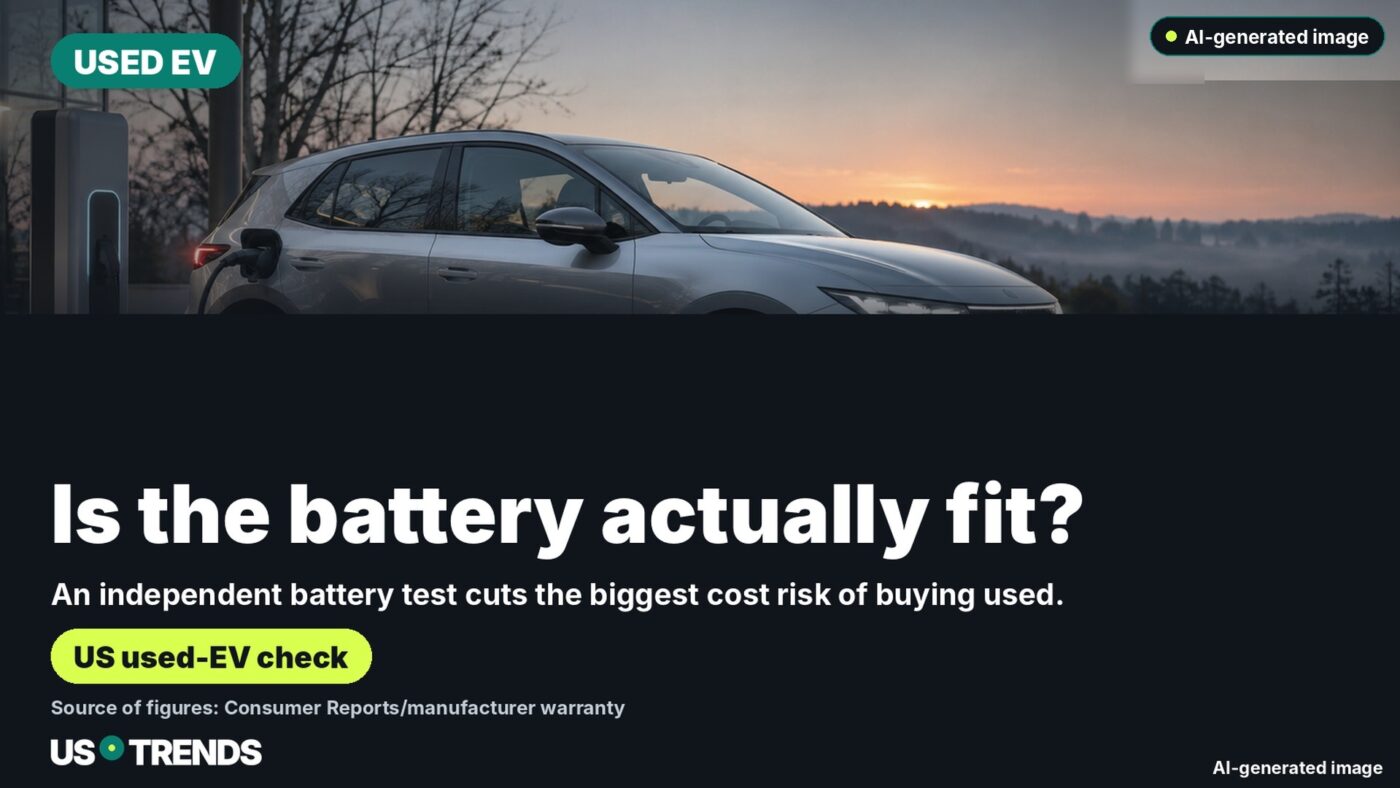
The battery is the most expensive and most range-critical part of an EV, so a used-car buyer should trust neither the odometer alone nor a percentage on a screen. What matters is a traceable battery test, the terms of any remaining warranty, and a test drive that matches your own routine.
How SoH compares internationally
Consumer Reports and J.D. Power publish general reliability and ownership guidance on used EVs, but a single, universally quoted State of Health (SoH) percentage threshold comparable to the German ADAC figures was not found from a US organization for this article. As an international reference point only — not a US standard — this article uses ADAC’s own orientation values: at least 92% SoH at 50,000 km (about 31,000 miles), 88% at 100,000 km (about 62,000 miles), 84% at 150,000 km (about 93,000 miles) and 80% at 200,000 km (about 124,000 miles). State of Charge (SoC, how full the battery is now) and State of Health (SoH, remaining capacity versus new) are different things; the dashboard range estimate reflects neither independently, since it is calculated from recent driving, temperature and speed.
Paperwork that matters
Ask for every available battery and service record: test certificates, repair invoices, and documentation of any module or full pack replacement, including whether a new or transferred warranty applies. Match the VIN across the title, the car and the service history, and get the first-registration date and mileage confirmed in writing.
Warranty vs. your legal rights
Volkswagen’s US warranty terms, published at vw.com, set out high-voltage battery coverage for eligible EV models sold in the US market; the exact duration and mileage limit depend on model year, so check the document for the specific vehicle rather than assuming the German terms (8 years / 160,000 km) apply unchanged. A manufacturer warranty is a separate, voluntary promise with its own exclusions — it does not replace the legal protections below.
Federal and state consumer protection
Used-car buyers in the US are protected at the federal level by the FTC Used Car Rule (the dealer’s Buyers Guide window sticker) and, where a written warranty exists, by the Magnuson-Moss Warranty Act. Beyond that, protection depends heavily on the state: most states have their own “lemon laws” and implied-warranty rules under the Uniform Commercial Code (UCC), and coverage for used cars differs significantly by state — for example California’s used-vehicle lemon-law protections differ from those in Texas or Florida. Always check the specific state’s statute for the sale.
Test drive and total cost
Plan a test drive on roads that resemble your real routine — city, highway, or both — and note the state of charge at the start so you can judge real-world consumption rather than the on-screen estimate alone. Check charging at a Level 2 AC point and, if possible, a DC fast charger, watching for error messages. Compare total running costs including insurance, registration fees, maintenance, financing and expected depreciation, and remember that most listed EV charging prices are quoted before any state or local sales tax.
Tick these off before you sign
- VIN on the title, the car and the service history all match.
- A dated battery health report with a stated test method exists, or an independent test is booked before you commit.
- Workshop, battery and any accident history (e.g. via a vehicle history report) are documented as fully as possible.
- Remaining manufacturer warranty, mileage limit and transferability are confirmed in writing for this specific car.
- The applicable state’s lemon-law and used-car disclosure rules have been checked.
- Test drive, charging ports, charging speed and safety systems have been checked.
- Total cost — purchase, financing, insurance, charging and likely repairs, including sales tax — has been compared with your own usage.
Frequently asked questions
What SoH should a used EV have?
There is no single SoH figure confirmed by a US organization for this article. As an international reference only, Germany’s ADAC estimates at least 92% at 50,000 km, 88% at 100,000 km, 84% at 150,000 km and 80% at 200,000 km — treat these as orientation, not a guarantee, and ask for a dated, vehicle-specific test.
Can I rely on the range shown on the dashboard?
No. The figure is calculated from recent driving, temperature and speed, and does not independently describe battery health. Ask for a proper test report and take a test drive that matches your own routine.
How long does the battery warranty last on a used EV?
It depends on the manufacturer, model year, mileage and the specific warranty document. Some manufacturers quote 8 years or a mileage limit for the US market, but this is not automatically the same for every model — get the remaining coverage confirmed in writing for the VIN.
Which consumer protections apply to a used EV in the US?
At the federal level, the FTC Used Car Rule requires a Buyers Guide, and the Magnuson-Moss Warranty Act governs written warranties. Beyond that, lemon-law and implied-warranty protection for used cars varies significantly by state, so check the rules of the state where you buy.
Sources and status
- Consumer Reports: buying a used electric car
- Volkswagen US: new vehicle limited warranty
- Federal Trade Commission: Used Car Rule (Buyers Guide)
- Magnuson-Moss Warranty Act (16 CFR Part 700)
- ADAC (Germany): battery check for electric cars — used here only as an international reference point (in German)
Research and data status: November 14, 2026.
Transparency note: AI-assisted tools were used in researching, structuring and writing this article. The sources used are listed in the article. Publication takes place only after manual editorial approval. Translation and adaptation of a Net Trends original for the US market, researched separately.
Share this article