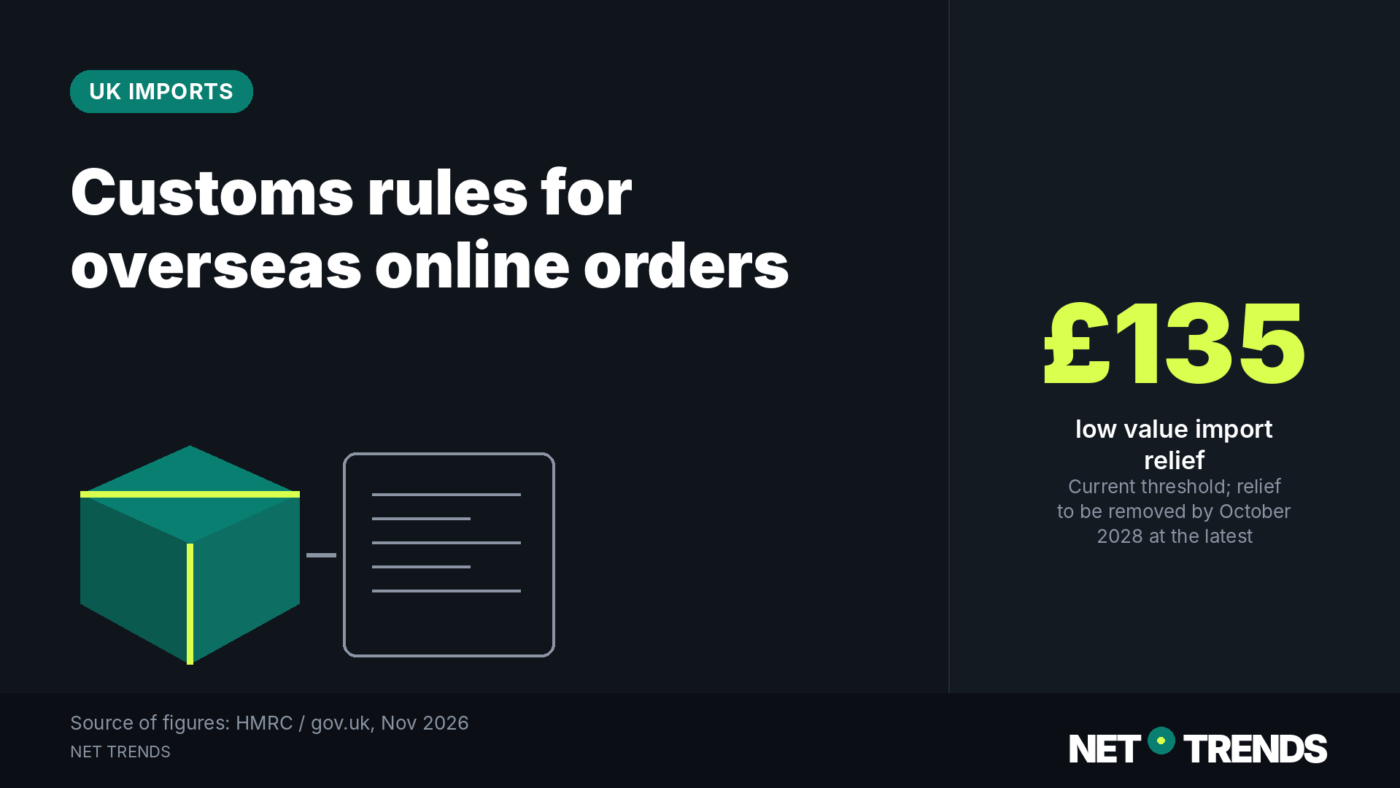
Since 1 November 2026 the EU charges a 2-euro processing fee per customs-declared item on online orders imported from outside the bloc, under Regulation (EU) 2026/2152. As a non-EU state since Brexit, the United Kingdom is not covered by that rule — but its own customs relief for low-value parcels is also under pressure, with the £135 threshold due to be scrapped by October 2028 at the latest.
Key points
- The EU’s new 2-euro processing fee, in force since 1 November 2026, applies only to goods imported into the EU — it does not apply to parcels sent to the UK.
- In Great Britain, overseas sellers shipping consignments worth £135 or less must currently charge UK VAT at the point of sale under the low value import (LVI) relief, instead of VAT being collected as customs duty at the border.
- At Autumn Budget 2025 the government confirmed it will scrap the £135 relief and move to full UK Global Tariff rates on low-value parcels, with delivery “accelerated” to October 2028 at the latest.
UK shoppers ordering from overseas sellers are not affected by the EU’s new parcel fee, which only applies to imports into the EU. The relevant UK rule is the £135 low value import relief — and the government has now set out how it plans to remove it.
The EU fee took effect on 1 November 2026 under the Delegated Regulation (EU) 2026/2152, based on Regulation (EU) 2026/2108, Article 20, and explained in the European Commission’s customs guidance of 5 October 2026 (in German). As a non-EU country, the UK sits outside the EU customs union, so this regulation has no direct effect on parcels shipped to UK addresses — the UK’s own, separate customs and VAT rules decide what a UK buyer pays.
The EU fee does not apply here
The EU’s 2-euro processing fee is charged per declared item in a customs declaration for goods entering the EU, regardless of value, according to the Commission’s guidance. A separate, temporary 3-euro duty under Regulation (EU) 2026/382 (in German) applies only to items in EU-bound shipments worth up to 150 euros in total, since 1 July 2026 and until 1 July 2028. Both rules govern imports into the EU’s customs territory — Great Britain and Northern Ireland left the EU customs union after Brexit, so neither charge is collected on parcels addressed to UK recipients.
UK shoppers do not need to track these EU figures for their own orders. What matters for a parcel arriving in the UK is HM Revenue & Customs (HMRC) and UK customs law, covered below.
How UK VAT on low-value imports works now
Since the UK’s post-Brexit VAT changes, consignments sent from outside the UK and sold directly to a customer in Great Britain, valued at £135 or less, are covered by the low value import (LVI) relief. Under current gov.uk guidance, the overseas seller — not the courier at the border — must charge and account for UK VAT at the point of sale, and must be VAT-registered in the UK to do so. The £135 threshold is calculated on the “intrinsic value” of the whole consignment, generally excluding transport, insurance and separately shown taxes.
Above £135, normal import VAT and customs duty apply when the goods are imported, collected in the ordinary way at the border rather than through the seller. Separately, the old low value consignment relief that exempted very cheap parcels (£15 or less) from import VAT altogether has already been removed, so even small-value imports above £135 face normal import VAT.
Why the £135 relief is being scrapped
The government ran a consultation, “Reforming the customs treatment of low value imports into the United Kingdom,” from 26 November 2025 to 6 March 2026. In its consultation response, announced alongside Autumn Budget 2025, the government confirmed it will remove the £135 customs duty relief and replace it with mandatory new LVI customs arrangements applying full UK Global Tariff rates — with no simplified schedule — to consignments of £135 or less.
“The government has decided to remove the Low Value Imports (LVI) relief and replace it with new customs arrangements for consignments valued at £135 or less.”
HM Treasury / HMRC, Low Value Imports consultation response, Autumn Budget 2025
Under the new system, overseas sellers and online marketplaces — not customers — will pay duty quarterly, aligned with VAT return cycles, and sellers or marketplaces without a UK presence will need a UK fiscal representative. The government says it has accelerated delivery of the reform by six months, targeting full implementation by October 2028 at the latest; an additional fee on low-value imports is also planned, with details still to be set out. The VAT collection model itself — whether VAT keeps being charged at the point of sale or moves to the border — had not been finally decided at the time of the consultation response. The existing £39 relief for non-commercial gifts between private individuals is being kept.
| Rule | Amount and basis | Status |
|---|---|---|
| Low value import (LVI) relief | £135 per consignment, VAT charged by seller at point of sale | In force now; to be removed by October 2028 at the latest |
| Low value consignment relief | Previously exempted parcels worth £15 or less from import VAT | Already removed |
| Gift relief | £39 for non-commercial gifts between individuals | Retained under the reform |
What this means for UK shoppers
For now, nothing changes immediately at checkout: a registered overseas seller should still be charging UK VAT upfront on consignments of £135 or less, so there is normally no separate customs bill on delivery for orders within that threshold. Once the reform takes effect, by October 2028 at the latest, low-value parcels will also attract UK Global Tariff customs duty, which sellers are expected to build into their quarterly duty payments rather than charge item by item at the border.
Until draft secondary legislation and a confirmed start date are published, Net Trends cannot say exactly when individual sellers will start applying the new duty, so check the seller’s own checkout disclosures for the latest position on any order placed close to the transition.
Frequently asked questions
Does the new EU parcel fee affect orders delivered to the UK?
No. The EU’s 2-euro processing fee under Delegated Regulation (EU) 2026/2152 applies only to goods imported into the EU customs territory. The UK left the EU customs union after Brexit, so this fee is not charged on parcels sent to UK addresses.
Is the £135 low value import relief still in force?
Yes, as things stand. The government has confirmed it will remove the relief and apply full UK Global Tariff rates instead, but implementation is targeted for October 2028 at the latest, following draft legislation and a transition period.
Who currently charges VAT on a £100 parcel from outside the UK?
The overseas seller, if it is VAT-registered in the UK, charges and accounts for UK VAT at the point of sale for consignments of £135 or less sold directly to a UK customer — not the courier or Royal Mail at the border.
Will UK shoppers pay customs duty at the door after the reform?
The government’s stated approach has sellers and marketplaces paying duty quarterly rather than customers paying per parcel at delivery, but the final VAT collection model had not been confirmed in the consultation response, so the exact checkout experience is not yet settled.
Sources and status
Research as of 9 November 2026. Sources used:
- Delegated Regulation (EU) 2026/2152 (in German) — EU processing fee, applicable from 1 November 2026 (for context only; not applicable in the UK).
- Regulation (EU) 2026/2108 (in German), Article 20 — legal basis for the EU processing fee.
- Regulation (EU) 2026/382 (in German) — temporary 3-euro EU duty for shipments up to 150 euros.
- European Commission customs guidance, 5 October 2026 — scope of the EU processing fee.
- gov.uk: VAT and overseas goods sold directly to customers in the UK — current £135 low value import relief rules.
- gov.uk: Reforming the customs treatment of low value imports into the United Kingdom — consultation, 26 November 2025 to 6 March 2026.
- gov.uk: consultation response on reforming low value imports, Autumn Budget 2025 — decision to remove the £135 relief and timeline.
Transparency note: AI-assisted tools were used in researching, structuring and writing this article. The sources used are listed in the article. Publication takes place only after manual editorial approval. Country edition based on an article from Net Trends, researched for the United Kingdom. Lead image: own schematic illustration (no photo).
Share this article