ABI data show the average motor repair claim up 8% in a single quarter, while Thatcham Research phases out the familiar 1-50 insurance groups.
Key points
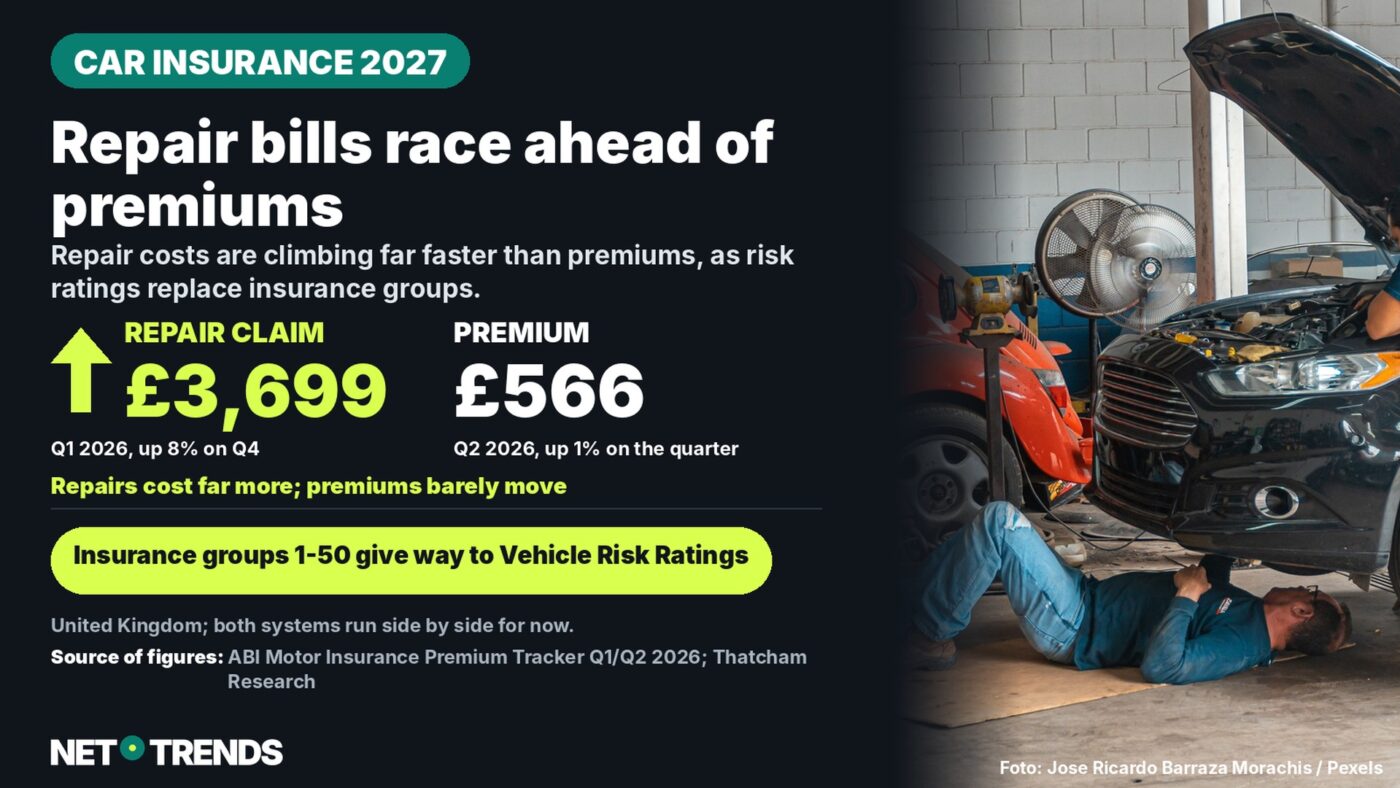
- The Association of British Insurers (ABI) recorded an average motor repair claim of £3,699 in Q1 2026, up 8% on the previous quarter.
- Average car insurance premiums held broadly stable at £566 in Q2 2026, up just 1% on the quarter and actually £14 lower than a year earlier once inflation is taken into account.
- Thatcham Research is phasing out the familiar 1-50 insurance groups in favour of a new Vehicle Risk Rating (VRR), scored 1-100 across five risk factors.
- There is no single UK renewal deadline like Germany’s 30 November: each policy renews on its own anniversary, and insurers must set out the new price in good time beforehand.
Repair bills are rising far faster than the premiums drivers actually pay. The ABI’s own data show claims costs climbing quarter after quarter in 2026, even as insurers hold average premiums close to flat. At the same time, the rating system that has decided a slice of every quote since the 1980s is being replaced.
Both trends matter for anyone renewing a car insurance policy over the coming months: what repairs cost shapes what insurers eventually charge, and how a car is risk-rated decides which band it falls into. Neither change is announced with a single fixed date, unlike the German system this article is adapted from – which makes it easy to miss both.
Repair costs: up again in every ABI quarter of 2026
According to the ABI’s Motor Insurance Premium Tracker for the first quarter of 2026, the average accidental damage claim rose 8% on the previous quarter to £3,699. Insurers paid out £2.9 billion in total motor claims in the quarter, of which £1.9 billion went on vehicle repairs – itself up 3% on the final quarter of 2025.
The second-quarter tracker found the trend continuing: insurers paid out a record £3.2 billion to motor customers, up 5% on Q1 and 7% on the same quarter of 2025, with the average claim payout reaching £4,900. Even windscreen repairs, usually one of the cheaper claims, rose 7% to £283. Chris Bose, the ABI’s Director of General Insurance and International Policy, said motor insurers were “working hard to keep premiums competitive and affordable for customers” despite the pressure on claims costs.
Premiums barely moving – for now
Average premiums have not followed repair costs upward at anything like the same pace. The ABI tracker put the average motor premium at £560 in Q1 2026, up just £1 on the previous quarter and, once inflation is factored in, £38 lower than a year before. By Q2 2026 the average had edged up to £566, a rise of £6 (1%) on the quarter but still £14 lower than Q2 2025 after inflation.
That gap between fast-rising claims costs and a largely flat average premium is the same tension German insurers describe through their own loss ratio. The ABI has not published a single figure of that kind for the UK market, so this article does not attribute one to it; what the ABI’s own tracker figures do show is repair cost inflation running well ahead of premium inflation across both quarters published so far in 2026.
Insurance groups 1-50 give way to Vehicle Risk Ratings
Separately from the cost data, the system used to rate how risky a car is to insure is changing. Thatcham Research, which has run the insurance group panel since the 1980s, is introducing a Vehicle Risk Rating (VRR) that scores every new car from 1 to 100 across five categories: performance, damageability, repairability, safety and security. Unlike the old 1-50 groups, which were fixed for a model’s lifetime, a VRR score can be revised as a car’s real-world risk profile changes.
Every new car sold in the UK is rated under the new system from launch, but the two schemes run in parallel: Thatcham says group ratings will stay in use for at least 18 months, and insurers’ own pricing systems are expected to take up to two years to fully absorb VRR data. The ABI has welcomed the move; the Society of Motor Manufacturers and Traders (SMMT) has said carmakers would have preferred more lead time to prepare.
What the ABI numbers actually show
- Repair claims: £3,699 average in Q1 2026, up 8% quarter-on-quarter – and a record £3.2 billion paid out across all motor claims in Q2 2026.
- Premiums: £566 average in Q2 2026, up only 1% on the quarter and lower than a year ago once inflation is taken into account.
Repair costs have moved far faster than premiums in every ABI quarter published so far in 2026. That is a reading of the ABI’s own published tracker figures, not a forecast for any individual policy: a driver’s own renewal price depends on their insurer’s pricing model, driving history, postcode and now, increasingly, their car’s Vehicle Risk Rating rather than its old insurance group alone.
No fixed deadline: how UK renewals actually work
Unlike German Kfz-Versicherung, which can only be cancelled once a year by a fixed date, UK car insurance renews on the anniversary of each individual policy. Insurers are required to set out the renewal price in good time before that date and, under rules the Financial Conduct Authority (FCA) introduced from 1 April 2017, to show the previous year’s premium alongside the new one so drivers can see at a glance how much it has changed.
Checklist: before your car insurance renews
- Compare the new renewal price against last year’s premium, shown on the same renewal letter or email.
- Check whether your car’s insurance group has stayed the same – some insurers already factor in Thatcham’s new Vehicle Risk Rating as well.
- Get at least one comparison quote before the renewal date; switching remains the most reliable way to counter a price rise.
- If a quote is cheaper, cancel the old policy in good time so cover does not lapse between the two.
- Review excess, courtesy car cover and any add-ons – a lower premium is not automatically better value once cover is included.
Drivers who miss their own comparison window are not locked in for a year in the way a missed 30 November deadline locks in German policyholders: most UK insurers allow a mid-term switch, though an early cancellation fee can apply. Shopping around shortly before renewal, rather than waiting for the automatic renewal to go through, remains the ABI’s own standing advice to drivers facing a price rise.
Have your say
Has your car insurance premium gone up or down at your last renewal, and did you switch provider? Let us know in the comments.
Frequently asked questions
Is there a fixed date by which I must cancel my UK car insurance?
No. Unlike the German system, UK car insurance renews on each policy’s own anniversary date, not a single date for the whole market. Insurers must give you the new price in good time before that date.
What is the Vehicle Risk Rating replacing?
It replaces the familiar 1-50 car insurance groups set by Thatcham Research. The new score runs from 1 to 100 across five categories – performance, damageability, repairability, safety and security – and can be updated as a car’s real-world risk profile changes, unlike the old fixed groups.
Are UK car insurance premiums rising as fast as repair costs?
No. ABI data show average premiums up only around 1% in Q2 2026, while the average repair claim rose 8% in Q1 2026 alone and total claims payouts hit a record £3.2 billion in Q2.
Does a lower insurance group or Vehicle Risk Rating guarantee a cheaper premium?
Not on its own. Insurers also weigh postcode, driving history, annual mileage, where the car is kept overnight and the policyholder’s age, alongside the car’s own risk rating.
Sources and status
- Association of British Insurers (ABI): “Motor premiums remain stable but cost of repairs still high”, Motor Insurance Premium Tracker Q1 2026
- Association of British Insurers (ABI): “Record £3.2 billion paid out to support motor insurance customers in Q2 2026”
- Thatcham Research, via Auto Express: details of the Vehicle Risk Rating replacing insurance groups 1-50
- Financial Conduct Authority: ICOBS 6.5 renewal disclosure rules, in force since 1 April 2017
Research and data as of: 7 November 2026.
Transparency note: AI-assisted tools were used in researching, structuring and writing this article. The sources used are listed in the article. Publication takes place only after manual editorial approval. Country edition for the United Kingdom, researched from UK primary sources, based on an article by Net Trends.
Share this article