Open-source 6G tools link network simulation, AI training and real 5G test rigs
Key points
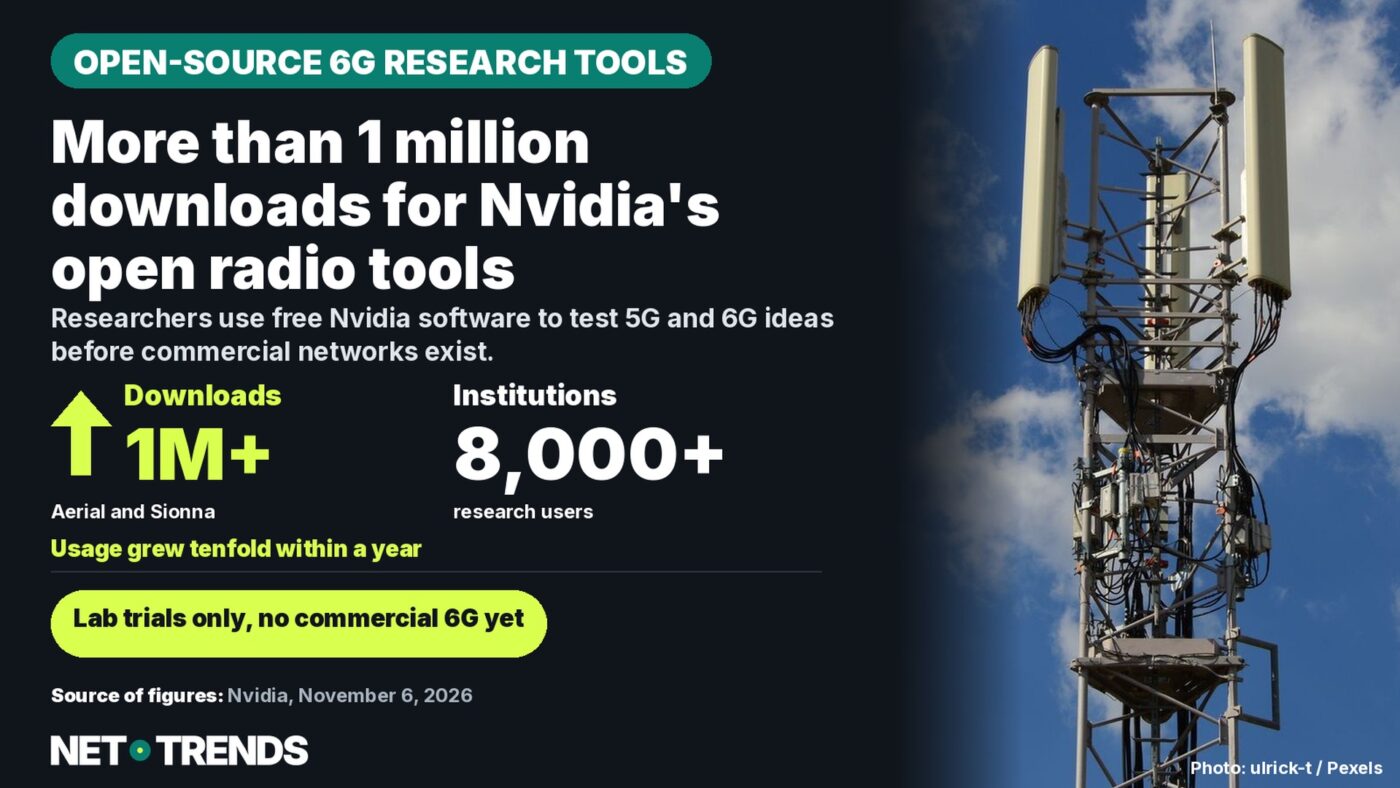
- Nvidia reports more than 1 million downloads of its open 5G and 6G tools, used at more than 8,000 research and higher-education institutions.
- Recent trials show gains in robotics, radio reception, energy use and simulation speed. The figures come from limited test setups and are not a forecast for future mobile network performance.
- For the United States, such tools mainly feed research infrastructure: the National Science Foundation has funded academic 6G and next-generation wireless research through its RINGS program with industry and federal partners since 2021. There is no commercial 6G network for consumers yet.
Open-source software is pulling 6G research out of pure simulation and closer to real radio hardware. On November 6, 2026, Nvidia published a roundup of its Aerial and Sionna platforms, drawing together several recent trials. The examples range from a robotic arm to a self-learning radio receiver to automatically switching off unused base-station capacity.
The headline numbers sound big, but they need a clear yardstick. What was tested were individual functions in laboratory and trial systems, mostly built on 5G technology. None of this proves a finished 6G specification or the performance of a future commercial network. For U.S. research institutions and companies, the release is still relevant: open-source code can make experiments easier to reproduce and shorten the path to building a test rig of one’s own.
Open code for radio and simulation
Aerial CUDA-Accelerated RAN (github.com/NVIDIA/aerial-cuda-accelerated-ran) provides building blocks for a GPU-accelerated mobile base station: physical-layer processing, a radio resource scheduler, Python interfaces and reference models. It is released under the Apache 2.0 license. Parts of it rely on Nvidia’s CUDA environment and matching hardware.
Sionna (github.com/NVlabs/sionna) is also published under Apache 2.0: a Python library for simulating individual radio links, whole systems and radio-wave propagation.
Nvidia puts usage at more than 1 million downloads and more than 8,000 research and higher-education institutions, with use said to have grown tenfold within a year. These are the vendor’s own figures, not an independent breakdown.
Four trials, four different goals
King’s College London tested goal-oriented transmission for a robotic arm: sending compact descriptions of objects instead of full camera images. Across 20 runs each, the approach cut task completion time by up to 52.6% in the best case and raised the success rate by as much as 45%. Source: arxiv.org/html/2609.15895 (September 14, 2026). This is not a general speed gain for every robotics application.
SoftBank built a self-learning receiver into an Aerial-based 5G radio link. In a shielded lab test with a commercial smartphone, average uplink throughput beat the conventional receiver at all 15 interference levels tested, with the biggest reported gain at 60.5% (47.9 Mbit/s versus 29.9 Mbit/s at that measurement point). Source: softbank.jp (November 2, 2026). Not a tariff or everyday speed figure, and a single-shift test inside a screened room.
The University of Leeds examined when radio capacity can be switched off without dropping devices: in a scenario with four base stations, power consumption of the radio access network fell by 45.6%, with no dropped connections during the trial. Source: eprints.whiterose.ac.uk (2026). This describes the chosen test setup, not a nationwide network.
Spain’s CTTC research center linked GPU-accelerated radio channel models to its own open network simulator: the run time of an early evaluation fell from around three hours to 10–20 minutes. Source: cttc.cat.
The U.S. is funding its own path from lab to market
In the United States, 6G is treated as a research-and-development field, not yet a product. Since April 2021, the National Science Foundation has run Resilient and Intelligent NextG Systems (RINGS), a solicitation that funds academic research into resilient, intelligent next-generation wireless, networking and computing systems. RINGS is run jointly with the Office of the Under Secretary of Defense for Research and Engineering and the National Institute of Standards and Technology, alongside a roster of industry partners that has included Apple, Ericsson, Google, IBM, Intel, Microsoft, Nokia, Qualcomm and VMware; selected university projects also get access to NSF’s national wireless testbed facilities (source: nsf.gov). Separately, the wireless industry runs its own 6G roadmap work through ATIS’s Next G Alliance, a cross-industry initiative launched in October 2020 to help set North American priorities for 6G standards and technology ahead of global standardization bodies (source: nextgalliance.org).
Open tools like Aerial and Sionna lower the barrier to building a radio test rig of one’s own, including for university labs feeding into RINGS-funded projects and for smaller companies that cannot build a GPU-accelerated base station from scratch; “open source” does not mean vendor-independent, since Aerial depends on Nvidia’s CUDA stack. The European Commission (digital-strategy.ec.europa.eu) expects the first 6G products and infrastructure toward the end of the decade, with robotics, connected vehicles, digital twins and sensing among the possible early uses; spectrum, standards, security and business models are all still open questions on both sides of the Atlantic.
Good lab results are not yet a mobile network promise
These results answer narrowly framed research questions: specific objects and interference cases for the robotic arm, a screened room for SoftBank, a four-base-station scenario for Leeds. They do not replace testing in a live network with changing handsets, buildings, weather and many users at once.
For consumers, nothing changes yet about wireless plans or 5G reception. The benefit so far sits in research: earlier comparisons, traceable errors, shared test setups. Standardization and investment decisions will decide the path into standards and commercial networks.
Frequently asked questions
Can I use 6G already?
No. 6G is still at the research stage. The European Commission expects the first products and infrastructure toward the end of the decade, and U.S. efforts such as NSF’s RINGS program and the Next G Alliance’s roadmap work are still focused on research and standards-setting, not commercial deployment.
Are Aerial and Sionna really open source?
Both repositories are released under the Apache 2.0 license. Aerial still depends on Nvidia’s CUDA environment and matching hardware, and any third-party components built into either tool can carry their own licenses.
Do these test results prove 6G will be faster or more energy-efficient?
No. They only show that individual techniques performed better than a baseline in the specific, limited test setups described above, not that any future commercial network will behave the same way.
Sources and status
- Nvidia blog, November 6, 2026
- Aerial CUDA-Accelerated RAN repository
- Sionna repository
- King’s College London paper, arXiv, September 14, 2026
- SoftBank research topic, November 2, 2026
- University of Leeds paper (White Rose eprints), 2026
- CTTC (Spain)
- National Science Foundation: Resilient and Intelligent NextG Systems (RINGS)
- ATIS Next G Alliance
- European Commission: 6G policy page
Research and data as of: November 6, 2026.
Transparency note: AI-assisted tools were used in researching, structuring and writing this article. The sources used are listed in the article. Publication takes place only after manual editorial approval. Country adaptation based on an article from Net Trends, researched for the United States.
Share this article