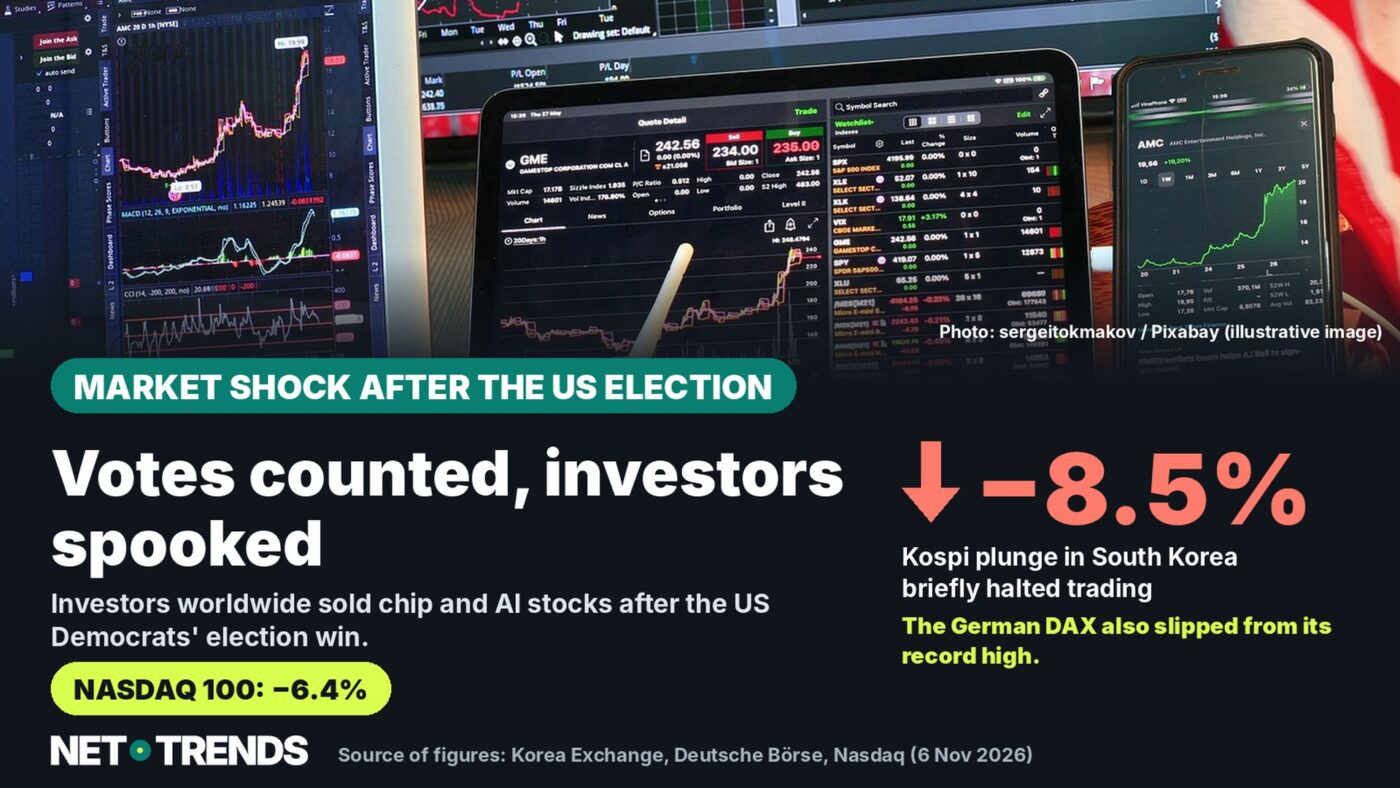
Samsung and SK Hynix fell by double digits, the Nasdaq 100 dropped 6.4% and Germany’s DAX slipped from its record high
Key points
- After sizeable gains for the Democratic Party in the 3 November 2026 US midterm elections, investors worldwide sold chip and AI stocks.
- The Nasdaq 100 fell 6.4% on Thursday and the Philadelphia semiconductor index SOX dropped more than 12%; on Friday South Korea’s Kospi briefly plunged 8.52% and triggered a twenty-minute trading halt.
- Germany’s DAX had hit a record high on Thursday before closing 0.4% lower, with futures markets pointing to a further decline on Friday; several UK-listed chip and tech-exposed stocks also came under pressure, while the FTSE 100’s lower weighting in technology shares cushioned the broader index.
A sell-off in chip and AI stocks swept global markets after the US Democrats’ election win. In South Korea, a circuit breaker briefly halted share trading on Friday morning. The sell-off was driven by investor concern that a strengthened opposition in the US Congress could tighten or delay the regulatory approval of new AI data centres.
The fallout reaches well beyond US technology companies: South Korean memory-chip makers, Japanese electronics groups and, via European and UK indices, the roughly one in five UK adults who hold shares or investment funds either directly or through workplace and personal pensions.
The trigger: fear of a halt to AI expansion
At the 3 November 2026 US congressional midterm elections, the Democratic Party recorded sizeable vote gains. For financial markets, that was not a neutral result: a stronger Democratic presence in Congress is seen on Wall Street as a risk to the largely unchecked approval process for new AI data centres, whose electricity and land use have become an increasingly contested political issue in the US.
US markets reacted accordingly on Thursday: the broad S&P 500 had its weakest day since April 2025 according to New York Stock Exchange price data, and the Dow Jones Industrial Average fell 3.4%. Technology stocks were hit hardest: the Nasdaq 100 dropped 6.4%, and the Philadelphia semiconductor index SOX, which includes Nvidia, Broadcom and Micron, lost more than 12%.
The losses at a glance
The table below summarises the main index movements from Thursday and Friday morning. Percentage changes for Asian markets refer to the day’s intraday low compared with the previous close.
| Index or stock | Market | Change |
|---|---|---|
| Nasdaq 100 | United States | −6.4% |
| Philadelphia SOX (semiconductors) | United States | −12.0% |
| S&P 500 | United States | −4.4% |
| Dow Jones Industrial Average | United States | −3.4% |
| Kospi (intraday low) | South Korea | −8.52% |
| Kosdaq | South Korea | −6.30% |
| Samsung Electronics (intraday low) | South Korea | −9.98% |
| SK Hynix (intraday low) | South Korea | −11.71% |
| Nikkei 225 | Japan | −6.0% |
| DAX (futures indication, Friday) | Germany | −0.8% |
Price data from the respective home exchanges (Nasdaq, NYSE, Korea Exchange, Tokyo Stock Exchange, Deutsche Börse) and futures-market indication from IG Markets for the DAX. Nasdaq 100 and S&P 500: Thursday close, 5 November 2026. Asian markets: Friday-morning intraday low, 6 November 2026, local time. As of: 6 November 2026, morning.
Kospi crash triggers a circuit breaker in South Korea
The sell-off hit South Korea’s stock exchange hardest. The Kospi opened Friday already 2.24% lower and accelerated its fall within minutes: at 9:03am local time it dropped 8.52% in a single minute to 4,924.61 points. Under the trading rules of the Korea Exchange in Seoul, such a drop automatically triggers a twenty-minute trading halt, known as a circuit breaker — the eleventh on South Korea’s main market this year, the previous one having been triggered on 15 October. The exchange also activated a five-minute “sidecar” sell-programme curb on the Kosdaq and shortly afterwards on the Kospi, which slows automated sell orders.
After trading resumed, the Kospi stood 7.71% below the previous close at around 10:15am local time, at just under 4,969 points — the first time it had fallen below the 5,000-point mark since 2 February 2026. For comparison: the index had started 2025 at 4,214.17 points and reached a record high of 9,114.55 points on 22 June 2026; after the sell-off it stands at a little over half that peak.
The two South Korean memory-chip makers Samsung Electronics and SK Hynix, both major beneficiaries of the global AI boom, were hit particularly hard. Samsung shares fell as much as 9.98% to around 181,400 won (roughly $133), and SK Hynix shares dropped as much as 11.71% to around 1,116,000 won. On Wall Street, too, Korean and US memory-chip stocks fell sharply: Sandisk lost 22.26%, Micron 17.46% and New York-listed SK Hynix depositary receipts (ADRs) 13.4%.
In Japan, the Nikkei 225 fell around 6% to its April 2026 level; Japanese power-semiconductor maker Rohm lost 17% according to Tokyo Stock Exchange price data.
What it means for UK investors
The sell-off has not stayed confined to the US and Asia. The FTSE 100 was comparatively less exposed to the turbulence than tech-heavy indices elsewhere, reflecting its smaller weighting towards technology and semiconductor stocks, though several UK-listed companies with chip or AI supply-chain exposure still came under pressure, while lower oil prices weighed on the index’s heavyweight energy producers.
Many more people in the UK are directly affected than the headline figures might suggest. According to the Financial Conduct Authority’s (FCA) Financial Lives 2024 survey (fieldwork February to June 2024), 20% of UK adults — around 10.0 million people — held shares or equities directly, and 39% (around 21.2 million) held some form of investment product, including the 17% (around 9.3 million) who held a stocks and shares ISA. Many savers hold money in broadly diversified index funds such as the MSCI World, which tracks several thousand companies worldwide but carries a significant overweight in a handful of US technology stocks.
Worked example: how much tech concentration sits in an MSCI World portfolio?
- Index weighting: according to MSCI’s index factsheet (as of 30 September 2026), the ten largest individual stocks made up around 27.85% of the MSCI World.
- For a £10,000 portfolio, roughly £2,785 would, on paper, sit in those ten stocks — including around £581 in Nvidia shares (5.81% index weight), around £541 in Apple (5.41%) and around £400 in Microsoft (4.00%).
- Amazon, Meta, Broadcom, Micron and Tesla together made up a further 8.64% of the index — around £864 of a £10,000 portfolio.
- The technology sector overall made up around 31.78% of the World index, with US stocks close to 73%, according to MSCI.
Method: portfolio value × the relevant MSCI index weighting as of 30 September 2026. Weightings move constantly with prices and are a snapshot, not a forecast. A specific MSCI World figure for 5 or 6 November 2026 was not available at the time of writing; this is explicitly not investment advice, but an illustration of index composition.
How far the MSCI World itself fell over the past two trading sessions cannot be read off from this example — the World index is more broadly diversified than the pure-technology Nasdaq 100 and is likely to have reacted more moderately. The example does show, though, why a sell-off in a handful of US technology stocks can still be felt in a fund that looks “broadly diversified” at first glance.
How analysts are reading the situation
Jochen Stanzl, chief analyst at Consorsbank, sees the current fall chiefly as a structural problem: a concentration risk from a small number of technology heavyweights that have driven a disproportionate share of major indices’ gains in recent years.
“Fears of a halt to AI expansion under the Democrats are weighing on sentiment.”
Jochen Stanzl, Chief Analyst, Consorsbank
That assessment lines up with the price reaction: companies that benefited most from the build-out of new AI data centres — memory-chip makers such as Samsung, SK Hynix and Micron, as well as suppliers such as Sandisk — fell considerably more than the broader market. Whether the fear of tighter AI rules actually turns into concrete legislation remains an open question at this stage; the newly elected Congress does not convene until early January 2027.
What anyone with a pension or investment account can take from this
- A single sharp trading day does not automatically change the long-term performance of a pension or investment held for years — in either direction.
- Anyone wanting to know how concentrated their own holdings are in individual technology stocks can check the current weightings in the relevant index or fund provider’s published factsheet.
- A circuit breaker like the one triggered on the Kospi is a technical safeguard against panic selling, not a signal about the financial health of the companies involved.
- This overview is not a substitute for individual financial advice from a bank, independent financial adviser, or a free service such as MoneyHelper.
What happens next
US non-farm payrolls data for October was due for release in the US on Friday; economists had expected a modest increase before the figures were published, following a weak September reading. Whether the sell-off in technology stocks continues or gives way to a rebound — not unusual on financial markets after sharp falls — was an open question at the time this article was published. The newly elected US Congress, with its changed composition, does not convene until early January 2027; until then, the stricter AI regulation feared by investors remains an expectation, not a decided measure.
Frequently asked questions
Why did chip stocks fall so much more than the wider market?
Semiconductor makers such as Samsung, SK Hynix, Micron and Sandisk have benefited disproportionately in recent years from demand for memory chips and processors for AI data centres. When fears grow about tighter regulation or a slowdown in that build-out, these are the stocks sold first.
What is a circuit breaker, and why was one triggered in South Korea?
A circuit breaker is an automatic, time-limited trading halt that an exchange triggers when a benchmark index falls extremely sharply in a short period — in South Korea, from a drop of 8% within one minute. It is designed to give panic selling time to settle. This was the eleventh circuit breaker on the Kospi in 2026.
Does this mean my pension or investment fund is now worth less?
A fund invested heavily in technology stocks is likely to have lost value over these two trading sessions. How much depends on the fund’s exact composition. A globally diversified index fund such as the MSCI World also holds sectors outside technology and typically reacts more moderately than a pure technology index.
Is it already clear whether the US will actually tighten regulation of AI data centres?
No. The newly elected Congress, with its changed balance of power, does not convene until early January 2027. At this stage, it is an expectation among market participants, not a concrete legislative proposal.
Sources and status
- Korea Exchange: Kospi and Kosdaq price data, trading halt (circuit breaker), 6 November 2026.
- Tokyo Stock Exchange: price data for the Nikkei 225 and Rohm, 6 November 2026.
- Nasdaq, NYSE: closing prices for the Nasdaq 100, S&P 500, Dow Jones Industrial Average and Philadelphia SOX, 5 November 2026.
- Deutsche Börse / IG Markets: DAX price data and futures-market indication, 5–6 November 2026.
- Jochen Stanzl, Chief Analyst, Consorsbank: market commentary, 6 November 2026.
- Financial Conduct Authority (FCA): Financial Lives 2024 survey — key findings, fieldwork February–June 2024.
- MSCI: MSCI World Index, index factsheet weightings, as of 30 September 2026.
- Net Trends (in German): Memory crisis 2026: RAM and flash storage set to get more expensive again before year-end.
Research and data as of: 6 November 2026, morning.
Transparency note: AI-assisted tools were used in researching, structuring and writing this article. The sources used are listed in the article. Publication takes place only after manual editorial approval. Country edition based on an article from Net Trends, researched for the United Kingdom. Cover image: illustrative stock-market photo, unchanged from the German original (photo credit in the caption).
Share this article