Tesla still sells more EVs than every other brand combined, while BYD remains locked out of US dealerships by tariffs
Key points
- Electric vehicles made up 6.4 percent of new-vehicle sales in the US in the third quarter of 2026, up from 5.8 percent in Q2, according to the Cox Automotive/Kelley Blue Book Q3 2026 EV Sales Report.
- US EV sales were down 39.5 percent year over year because Q3 2025 was inflated by buyers rushing to use the federal EV tax credit before it expired on September 30, 2025.
- Germany’s EV share hit a record 37.0 percent in October 2026, driven partly by Chinese brands such as BYD, Leapmotor and Xpeng — none of which can currently be sold as passenger cars in the US because of tariffs.
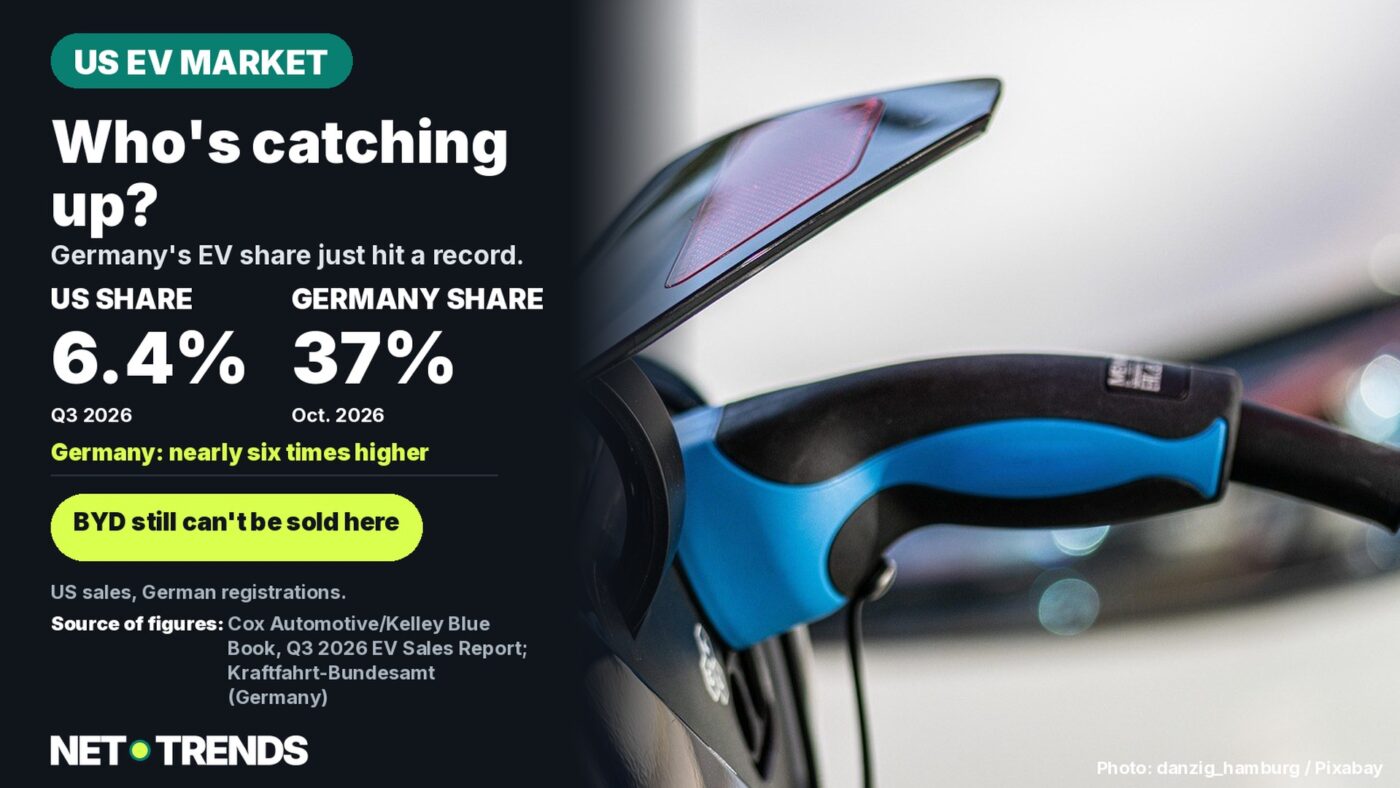
Electric vehicles reached a 6.4 percent share of new-vehicle sales in the US in the third quarter of 2026. Germany, by comparison, just reported a record 37.0 percent EV share for October 2026.
The gap is not just about demand. In Germany, Chinese automakers such as BYD, Leapmotor and Xpeng are among the fastest-growing EV brands. In the US, BYD passenger cars cannot be bought at all: tariffs imposed under Section 301 of the Trade Act and restrictions on Chinese connected-vehicle technology keep the world’s top-selling EV maker out of American showrooms.
US EV sales in Q3 2026: the numbers
According to the Q3 2026 Kelley Blue Book EV Sales Report from Cox Automotive, an estimated 262,649 electric vehicles were sold in the US in the third quarter of 2026. That is the highest quarterly total since the third quarter of 2025, and a 6.1 percent increase from Q2 2026. EVs accounted for 6.4 percent of all new-vehicle sales in the quarter, up from 5.8 percent in Q2.
For the first nine months of 2026, Cox Automotive counts 725,888 EV sales, down 30.3 percent from the same period in 2025. Including hybrids and plug-in hybrids, Cox Automotive estimates that nearly a quarter of all new-vehicle sales in Q3 2026 were electrified in some form.
Why the year-over-year comparison is misleading
Measured against Q3 2025, US EV sales look like they collapsed: down 39.5 percent, from 434,279 units to 262,649. But Q3 2025 was not a normal quarter. The federal EV tax credit of up to $7,500 for new vehicles — created under the Inflation Reduction Act — expired on September 30, 2025, under the tax and spending law known as the One Big Beautiful Bill Act. Buyers rushed to close deals before the deadline, pulling forward demand that would otherwise have landed in later quarters.
The sequential gain from Q2 to Q3 2026 — plus the rising share of new-vehicle sales — points to a market adjusting to life without the federal credit rather than one still in free fall.
“What we’re seeing now is a market finding its footing again.”
Stephanie Valdez Streaty, Director of Industry Insights, Cox Automotive
Tesla still dominates, Toyota and Rivian gain ground
Tesla remains by far the largest EV seller in the US. The company sold an estimated 144,094 vehicles in Q3 2026, down 19.7 percent year over year but still good for a 54.0 percent share of the entire US EV market — more than every other brand combined. Year to date, Tesla holds a 52.9 percent share with 386,194 units sold.
Behind Tesla, the picture is mixed. Rivian grew 45.7 percent to 19,239 units (7.2 percent share), and Toyota grew 328.0 percent to 12,904 units, though from a small base. Subaru was up 31.5 percent. Several established EV sellers fell sharply from their Q3 2025 tax-credit rush: Ford dropped 80.2 percent, Honda fell 75.9 percent, and Hyundai declined 57.7 percent. General Motors’ combined EV brands — Cadillac, Chevrolet and GMC — sold roughly 25,500 vehicles for a combined share of about 9.6 percent, down from a year earlier.
Why BYD still can’t be sold in the US
Germany’s October 2026 EV boom is partly a China story: BYD alone added 5,173 new registrations in the month, up 54.3 percent year over year, with Leapmotor and Xpeng growing even faster. None of that is happening in the US — because BYD passenger cars are not available there at all.
Two separate barriers are keeping BYD and other Chinese EV brands out. First, tariffs: the Biden administration raised the Section 301 tariff on Chinese-made EVs from 25 percent to 100 percent in 2024, a rate the Trump administration has kept in place. Second, the US Commerce Department finalized rules in January 2025 restricting Chinese-linked connected-vehicle software (effective for model year 2027) and hardware (model year 2029) on national-security grounds — a separate hurdle that would not disappear even if tariffs were lowered.
BYD has pushed back through the courts rather than through showrooms. On January 26, 2026, four BYD US subsidiaries filed suit at the US Court of International Trade, challenging tariffs imposed under the International Emergency Economic Powers Act and seeking refunds of duties paid since April 2025. BYD does have a US footprint outside passenger cars: it builds electric buses in California, employing roughly 750 people there, and sells batteries and energy-storage systems to American customers. A BYD executive, Stella Li, has said the company is not pursuing a near-term US launch for passenger vehicles, citing a lack of policy stability.
California’s EV mandate under federal pressure
State rules add another layer US car shoppers don’t see in Germany’s nationwide market. California’s Advanced Clean Cars II regulation set rising zero-emission-vehicle sales targets for automakers doing business in the state. In mid-2025, Congress passed House Joint Resolution 88 under the Congressional Review Act, revoking the Environmental Protection Agency’s Clean Air Act waiver that let California set those stricter-than-federal rules; California has sued the federal government over the move. That leaves automakers doing business in California — normally the state that leads US EV adoption — without a clear answer on which state EV sales targets, if any, still apply.
US EV brands at a glance, Q3 2026
The table below shows estimated US EV unit sales and market share for selected brands in the third quarter of 2026, with the year-over-year change, according to Cox Automotive’s Kelley Blue Book EV Sales Report.
| Brand | Q3 2026 units | Share | Vs. Q3 2025 |
|---|---|---|---|
| Tesla | 144,094 | 54.0% | -19.7% |
| Rivian | 19,239 | 7.2% | +45.7% |
| Cadillac | 12,358 | 4.6% | -32.8% |
| Toyota | 12,904 | 4.8% | +328.0% |
| Hyundai | 12,185 | 4.6% | -57.7% |
| Chevrolet | 10,031 | 3.8% | -74.6% |
| Kia | 9,575 | 3.6% | -35.3% |
| Ford | 6,047 | 2.3% | -80.2% |
| Subaru | 4,566 | 1.7% | +31.5% |
| BYD | not sold | 0.0% | — |
Source: Cox Automotive, Q3 2026 Kelley Blue Book EV Sales Report, estimates as of October 13, 2026. Change versus Q3 2025. BYD row added by Net Trends to show that BYD passenger cars are not available for purchase in the US.
What this means for US car shoppers
With the $7,500 federal tax credit gone, the math on buying an EV changed overnight for most American buyers. Some states still offer their own incentives, and electricity costs vary widely by state and utility, so the real cost comparison against a gasoline vehicle now depends much more on where a buyer lives. Shoppers comparing an EV against a gas or hybrid vehicle should check current state-level incentives, local electricity rates and public charging access before assuming the EV is the cheaper option — none of that can be read off the national sales figures above.
Checklist before buying an EV in the US
- State incentives: Check your state’s own EV rebate or tax credit program now that the federal credit is gone — availability and amounts vary widely by state.
- Charging access: Confirm home charging is realistic (garage, driveway, or workplace charging) and check the density of public DC fast chargers on routes you actually drive.
- Battery warranty: Compare warranty length, mileage limits and capacity-retention guarantees across brands individually.
- Resale value: Brands with a short US track record, or ones exiting a segment, carry more resale-value uncertainty than established nameplates.
- Insurance cost: Get an insurance quote before buying — EV premiums can run higher than for a comparable gas vehicle.
None of these factors show up in the national EV-share figures from Cox Automotive. They describe how many vehicles were sold, not whether a given model fits a specific buyer’s driveway, commute or budget. Independent reviews and a test drive remain the best way to check how a model performs in daily use.
Frequently asked questions
Why did US EV sales drop 39.5 percent compared with a year ago?
According to Cox Automotive, Q3 2025 was unusually strong because buyers rushed to purchase EVs before the federal $7,500 tax credit expired on September 30, 2025. Q3 2026 sales of 262,649 units are being compared against that inflated base, which makes the year-over-year decline look steeper than the underlying trend. Sales actually rose 6.1 percent from Q2 to Q3 2026.
Can I buy a BYD car in the US?
No. BYD passenger cars are not sold through US dealerships. Tariffs on Chinese-made EVs (raised to 100 percent under Section 301 in 2024) and separate federal restrictions on Chinese connected-vehicle technology keep BYD out of the US passenger-car market, even though BYD builds electric buses in California and is suing the US government over other tariffs.
What share of new cars sold in the US are electric?
Cox Automotive estimates EVs made up 6.4 percent of new-vehicle sales in Q3 2026, up from 5.8 percent in Q2 2026. That is far below Germany’s October 2026 record of 37.0 percent, a difference driven by market size, incentive structures and which brands are actually available for sale in each country.
Is Tesla still the top-selling EV brand in the US?
Yes. Tesla sold an estimated 144,094 EVs in Q3 2026, a 54.0 percent share of the entire US EV market — more than every other brand combined, according to Cox Automotive. That share has fallen from roughly 75 percent several years earlier as rivals such as Rivian and Toyota have grown.
Your take: Would you consider an EV from a brand with a short US track record, or do you stick with an established automaker until Chinese brands are actually allowed to compete here? Let us know in the comments.
Sources and status
- Cox Automotive: Q3 2026 Kelley Blue Book EV Sales Report, estimates as of October 13, 2026
- Cox Automotive: Q3 2026 EV Sales Report commentary, October 12, 2026
- Congress.gov: H.R. 1, One Big Beautiful Bill Act, 119th Congress
- Congress.gov: H.J.Res. 88, disapproval of EPA’s Clean Air Act waiver for California’s Advanced Clean Cars II rule, 119th Congress
- BYD US Court of International Trade filing against IEEPA tariffs, reported February 9, 2026
- Kraftfahrt-Bundesamt (Germany): Pressemitteilung Nr. 44/2026, vehicle registrations October 2026 (in German)
Research and data as of: November 5, 2026.
Transparency note: AI-assisted tools were used in researching, structuring and writing this article. The sources used are listed in the article. Publication takes place only after manual editorial approval.
Country edition based on an article from Net Trends, researched for the United States.
Share this article