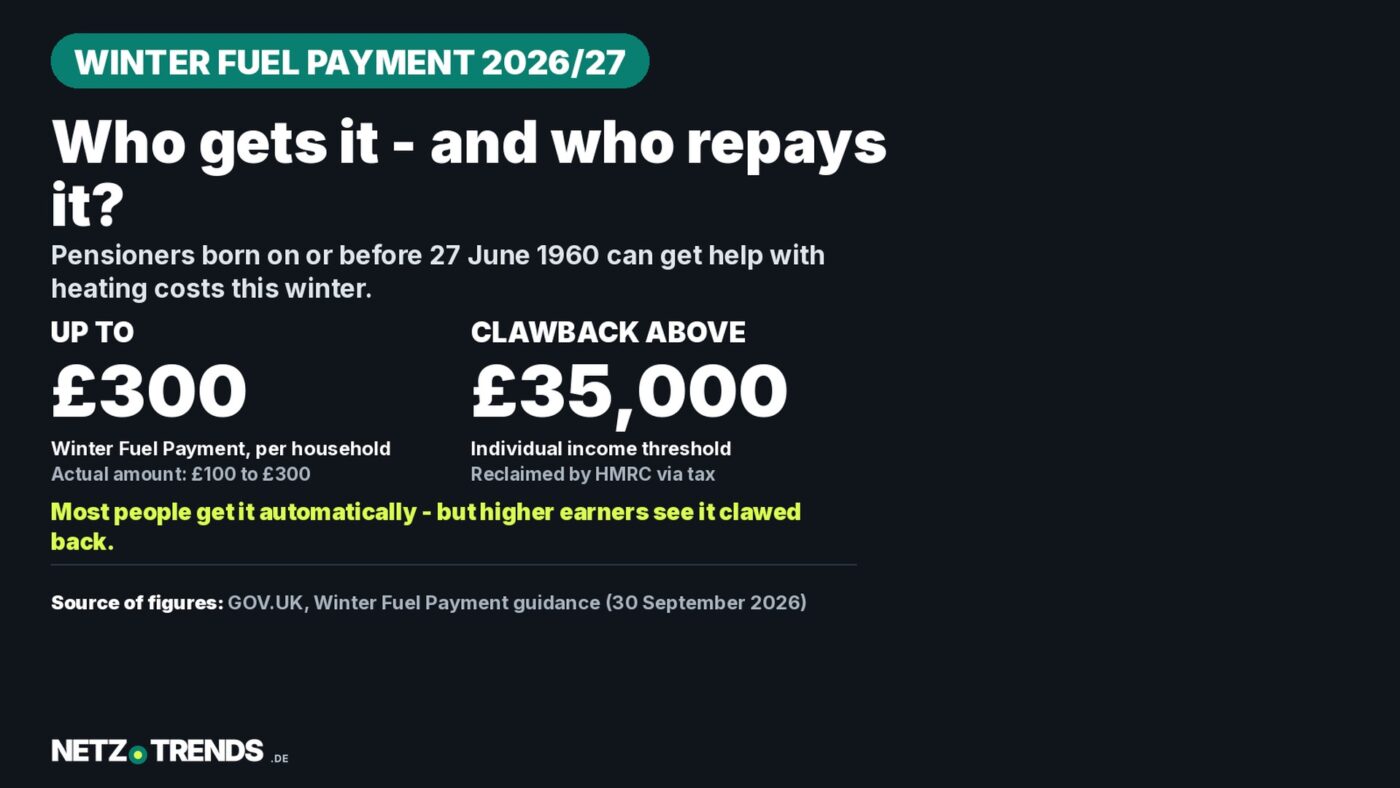
Winter Fuel Payment letters are going out this winter – between £100 and £300, but anyone earning over £35,000 can be asked to pay it back through their tax.
Key points
- For winter 2026 to 2027, eligible pensioners in England and Wales can get between £100 and £300 towards their heating costs through the Winter Fuel Payment.
- You qualify if you were born on or before 27 June 1960. Most eligible people are paid automatically, with letters going out in October and November 2026.
- If your own income is over £35,000 a year, HMRC claws the payment back through your tax. Your partner’s income does not count towards your total – only yours does.
UK pensioners born on or before 27 June 1960 can receive between £100 and £300 towards heating costs this winter under the Winter Fuel Payment, according to the Department for Work and Pensions. Most payments land automatically in November or December 2026 – but anyone whose own income tops £35,000 a year will have it reclaimed through HMRC.
Unlike Germany’s Wohngeld, which is a means-tested housing benefit topped up with a heating-cost component, the UK’s equivalent instrument for the 2026/27 winter is the Winter Fuel Payment: a one-off, largely age-based payment administered by the Department for Work and Pensions (DWP) rather than a means-tested monthly housing subsidy. The comparison matters because Germany is currently debating cuts to its own heating-cost support (see our report on the Wohngeld reform), while the UK runs an entirely separate system tied to pension age rather than housing costs.
What applies this winter
According to the official GOV.UK guidance, eligible people will receive a letter in October or November 2026 stating exactly how much they will get. Most payments are made automatically in November or December 2026. People in Scotland do not receive the Winter Fuel Payment, as Scotland runs its own separate Pension Age Winter Heating Payment.
The £35,000 income threshold is applied individually: HMRC reclaims the payment from anyone whose own taxable income exceeds that amount in the relevant tax year, usually through a change to their tax code or a self-assessment return. A partner’s income is not combined with the recipient’s for this purpose, so a couple can have a combined income well above £35,000 and still keep the payment, as long as each person individually stays under the threshold.
How this differs from Germany’s Wohngeld debate
In Germany, the Bundestag is currently examining a bill that would freeze the regular Wohngeld increase for 2027 and halve the heating-cost component within that benefit – a change aimed at low-income tenant households. The UK’s Winter Fuel Payment, by contrast, is not tied to rent or housing costs at all; it is a flat, age-triggered payment that was reintroduced on a wider basis after the means-testing row of 2024/25, now paired with the income-based clawback described above as a middle path between universal and fully means-tested support.
Frequently asked questions
Who is eligible for the Winter Fuel Payment in 2026/27?
Anyone born on or before 27 June 1960 who meets the other residency and benefit conditions set out by the DWP. Most eligible people receive it automatically without having to apply.
How much will I get?
Between £100 and £300, depending on individual circumstances such as age and living situation. GOV.UK does not publish a single flat amount for every household.
Do I have to pay it back if I earn too much?
If your own income is over £35,000 in the relevant tax year, HMRC will reclaim the payment, usually through your tax code or self-assessment. You do not need to take any action yourself beforehand.
Sources and status
- GOV.UK: Winter Fuel Payment – overview, as of 30 September 2026 (amount, eligibility, income threshold, payment dates).
- For comparison: NETZ-TRENDS: Germany’s 2027 Wohngeld reform and the Bundestag hearing on 4 November (in German).
Research and data as of: 1 November 2026. Figures are taken from the official GOV.UK guidance as published; amounts and thresholds may be updated by the DWP during the winter.
Transparency note: AI-assisted tools were used in researching, structuring and writing this article. The sources used are listed in the article. Publication takes place only after manual editorial approval. Country edition based on a NETZ-TRENDS.de article, researched for the United Kingdom.