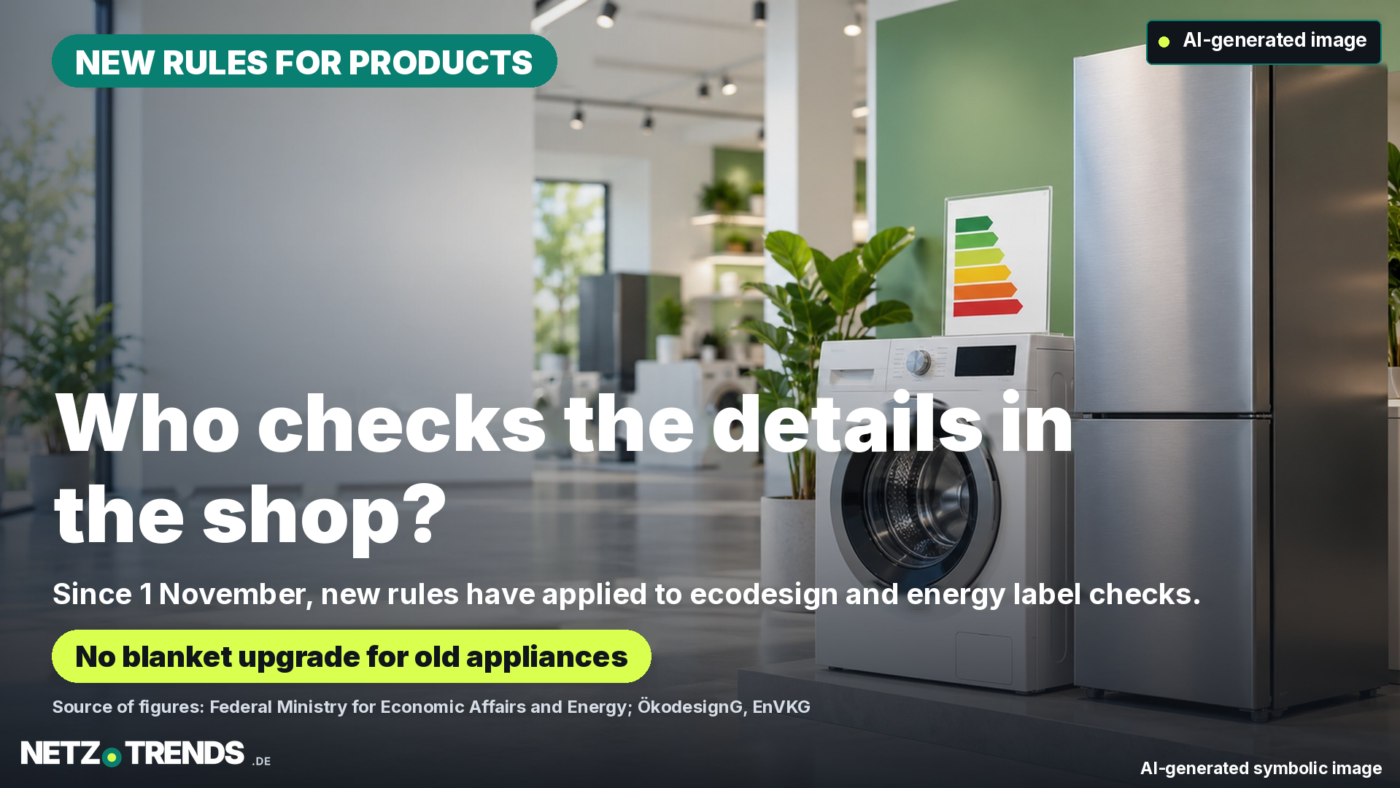
Since 1 November, new requirements for ecodesign and energy label checks have applied in Germany. For buyers, the practical change lies mainly in stronger market surveillance.
Key points
- The Ecodesign Act and amendments to the Energy Consumption Labelling Act have applied since 1 November 2026.
- The focus is on requirements for efficiency, reparability and durability as well as correct product information and energy labels.
- This does not create a blanket obligation for buyers to replace existing household appliances.
Anyone buying a new household appliance should still be able to rely on the stated product data and energy labels. Since 1 November, a new Ecodesign Act (Ökodesign-Gesetz) and amended rules on energy consumption labelling have applied for this purpose. The focus is on checks and enforcement – not on an immediate replacement of older appliances.
The German Federal Ministry for Economic Affairs and Energy (BMWE) names efficiency, reparability and durability as properties that manufacturers must comply with and retailers must present correctly. The new rules are intended to enable the market surveillance authorities to pursue infringements more consistently. What a specific product has to achieve still depends on the product regulations applicable in each case.
What has applied since November
According to its entry-into-force provision, the Ecodesign Act has been in force since 1 November 2026. On 30 October, the BMWE announced that amendments to the Energy Consumption Labelling Act (EnVKG) would take effect at the same time.
The laws form the national framework for requirements for products and their labelling. The EnVKG already requires that mandatory information be made visible to consumers when a product is offered or displayed. In accordance with the relevant EU rules in each case, this also applies to offers in mail order and on the internet. According to the BMWE, the new amendments are primarily intended to support uniform application of the European requirements and more effective checks.
What buyers notice when purchasing appliances
For buyers, the energy label remains an important point of comparison. It shows the mandatory information for a product; in the cases provided for by law, retailers and manufacturers must also provide additional information on consumption and properties. In an online offer, the labelling must be accessible even though the appliance is not displayed in a shop.
The new rules do not automatically promise lower electricity costs or a new energy class for all appliances. Rather, they strengthen the reliability of product information and the ability to examine infringements. Consumers should therefore continue to compare the model, consumption values and specific running costs instead of concluding from the entry into force of the law alone that products are better.
Do older appliances have to be replaced?
No. The entry into force does not result in a general obligation to replace washing machines, refrigerators or other appliances already in use. The EnVKG expressly excludes used products from its scope. The labelling obligations mainly concern the offering of products newly placed on the market. Separate EU regulations may apply to individual products; this must be checked in each case on the basis of the specific rule and the product.
For manufacturers and retailers, on the other hand, market surveillance may become more noticeable. The competent authorities can check documents and, where there is reasonable suspicion, also order product tests. Where infringements are found, labelling law provides for corrections and – in the case of continuing infringements – further measures. The BMWE also refers to newly worded rules on fines.
Frequently asked questions
Do I have to replace an old appliance because of the new Ecodesign Act?
No. The entry into force does not establish a blanket obligation to replace household appliances already in use. The labelling rules mainly relate to newly offered products; the EnVKG expressly excludes used products.
What specifically changes for buyers?
The rules are intended to strengthen checks on product requirements and labelling. Buyers can continue to compare energy labels and mandatory product information. The law alone does not guarantee an immediate price or consumption advantage.
Which products are affected?
That depends on the applicable product and EU regulations. Among other things, the EnVKG covers energy-related products as well as certain information on passenger cars and tyres. Specific requirements do not automatically apply equally to every product.
Which information on energy labels or product pages matters most for your purchasing decision? Share your view in the comments.
Sources and status
- German Federal Ministry for Economic Affairs and Energy (BMWE): New rules on ecodesign and energy consumption labelling enter into force, 30 October 2026.
- Ecodesign Act (ÖkodesignG), in particular entry into force and authorisations.
- Energy Consumption Labelling Act (EnVKG), in particular Sections 1, 3 and 8.
Research and data as of: 1 November 2026.
Transparency: This article was researched and written with the support of artificial intelligence and is intended for human editorial review.