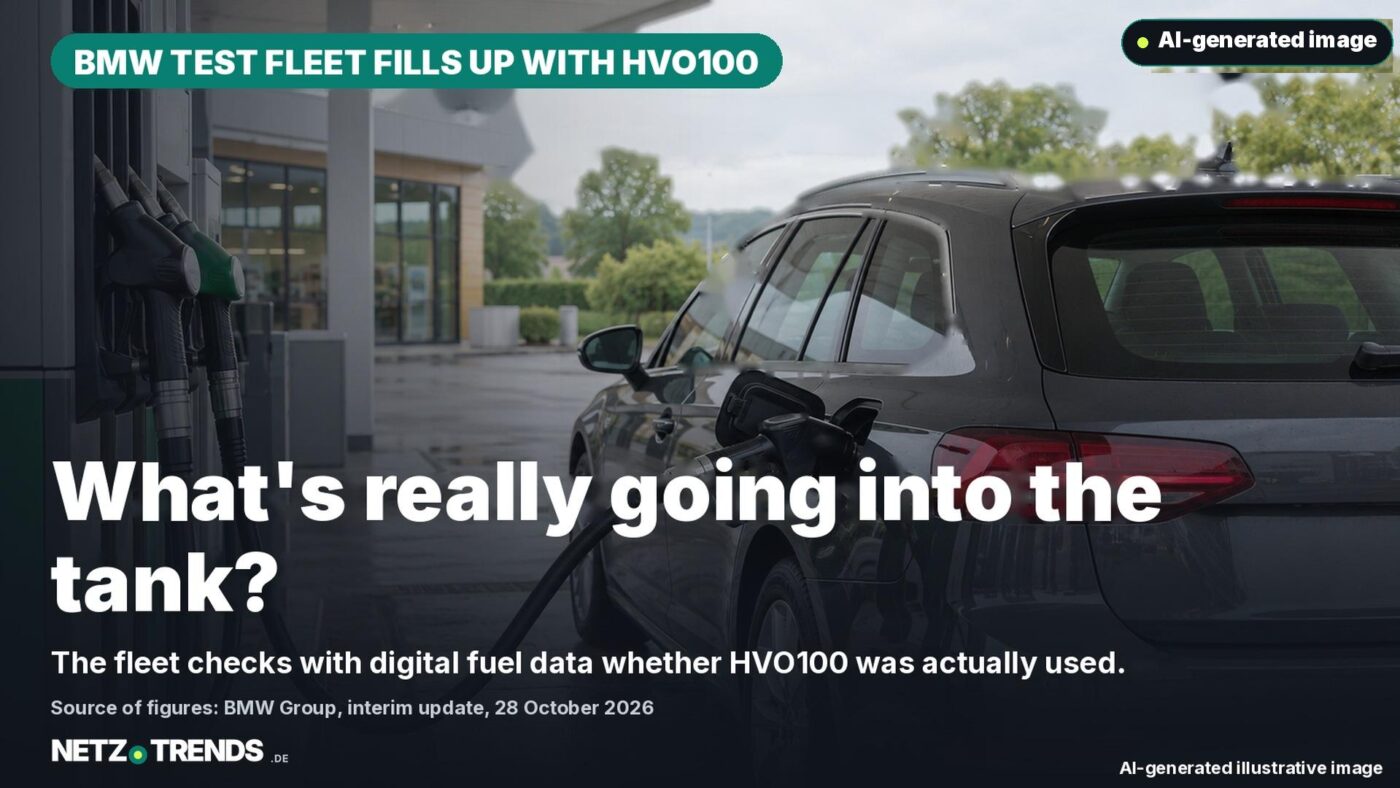
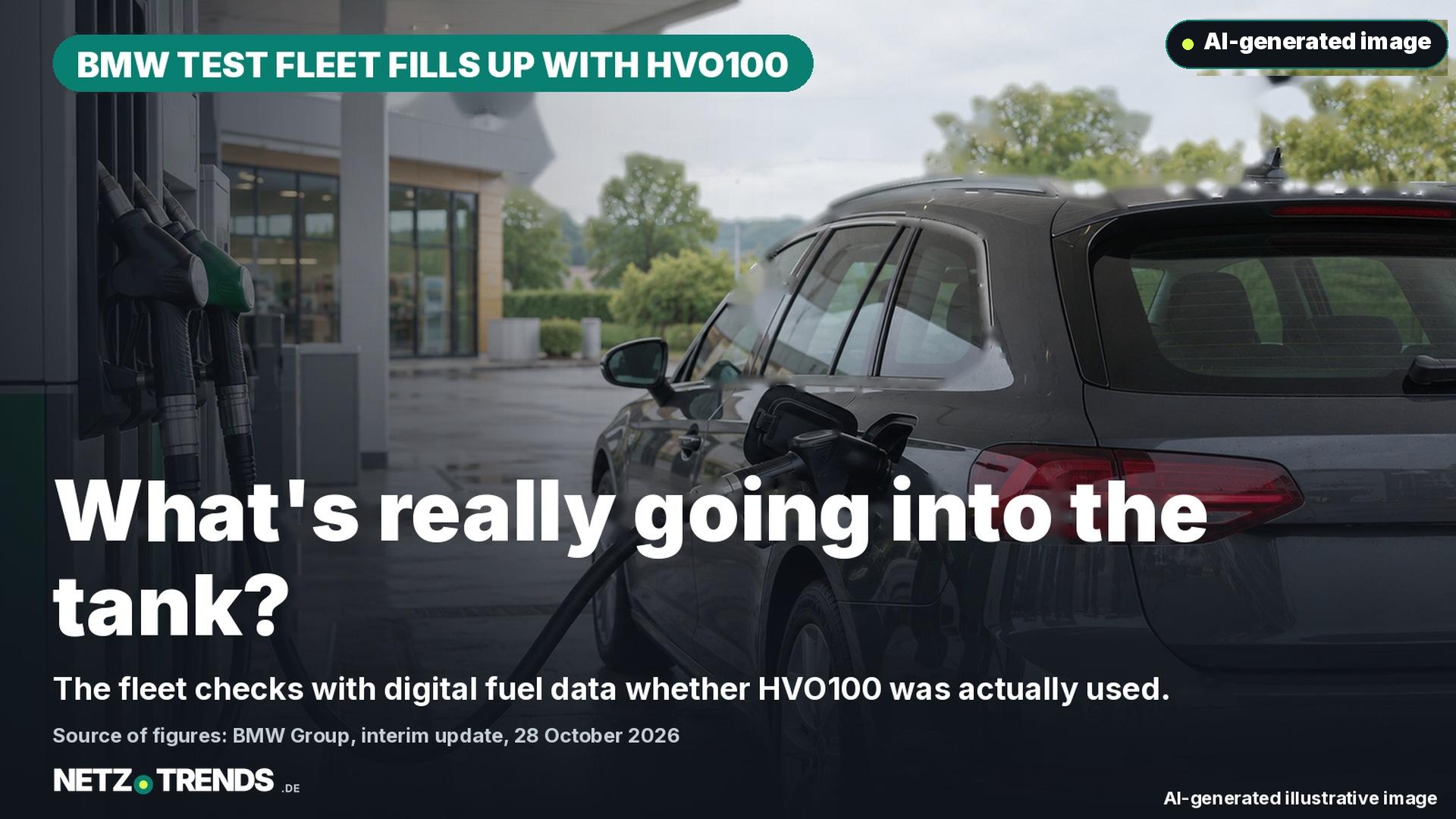
More than 5,500 refuelling events were logged – the BMW figure measures fuel data, not the CO₂ footprint of individual vehicles.
Key points
- BMW reports more than 5,500 logged refuelling events and around 235,000 litres of HVO from a test and demonstration fleet of over 600 BMW and MINI diesel vehicles across four countries.
- For more than 80 percent of the logged refuelling events, HVO fuelling was verifiable according to BMW. That means events, not 80 percent of all vehicles or a measured emissions reduction.
- HVO100 is approved for sale at public filling stations in Germany and several other European countries, but it is not available everywhere. Drivers must check their vehicle’s specific approval before filling up.
For more than 80 percent of the logged refuelling events in a BMW test fleet, fuelling with HVO was verifiable according to the manufacturer. The figure describes how well digital vehicle and fuel data capture the fuel used – it is not the result of a CO₂ measurement and does not apply to BMW’s entire fleet.
The BMW Group published an interim update on its HVO test and demonstration project on 28 October 2026. Since the project started in October 2025, more than 600 BMW and MINI diesel vehicles in four countries have taken part. In total, the company cites more than 5,500 refuelling events and around 235,000 litres of HVO. For more than four-fifths of the logged events, fuel use could be verified through the digital tracking system used.
In this article
What the trial actually measures
According to BMW, the project links refuelling data with information from the fuel and payment providers involved. For part of the fleet, a “Digital Fuel Twin” developed by Bosch is also used. This is intended to track which fuel went into a vehicle. BMW describes this as technical proof of whether HVO was used in an individual refuelling event.
This distinction matters: the 80-percent figure is a share of logged refuelling events, not a claim that four-fifths of the fleet’s vehicles ran exclusively on HVO. The cited fuel throughput is also not a comparison with a control group. The interim update does not cite any independently measured CO₂ or pollutant figures for the vehicles involved.
The trial is therefore primarily a test of data capture and fuel traceability. It shows that HVO refuelling can be documented digitally across a fleet. Whether a given vehicle produces fewer greenhouse gases over its full life cycle as a result depends additionally on where the fuel comes from, how it was produced, and what it is compared against.
What HVO100 means for drivers
HVO stands for hydrotreated vegetable oil. Sold undiluted, it is marketed as HVO100, a paraffinic diesel fuel labelled XTL at the pump. Germany’s Federal Ministry of Transport (Bundesverkehrsministerium) states that sale at public filling stations is permitted in Germany; several other European countries, including the UK, also allow HVO100 sales under the EN 15940 fuel standard, though availability varies by country and by filling-station operator. Whether a given station stocks it is a commercial decision, so availability differs regionally everywhere it is sold.
Technical compatibility cannot be assumed just because a vehicle runs on “diesel” or because the nozzle fits. According to the German Federal Ministry of Transport, approval rests with the vehicle manufacturer and can vary by model, engine and model year – the same principle applies to manufacturer approvals outside Germany. Before filling up for the first time, drivers should check their owner’s manual, the fuel-filler cap, and the manufacturer’s explicit approval for HVO or EN 15940.
Compatibility can also vary within a single brand, by engine, model line and model year. BMW’s fleet trial is not a blanket approval for all diesels of other makes.
What can be said about the climate impact
HVO can be produced from different feedstocks. For its climate footprint, it therefore matters whether residues and waste materials or other raw materials are used, and what emissions arise during processing and transport. A blanket savings rate cannot be derived from refuelling-event statistics.
Germany’s Federal Ministry for the Environment describes the economic use of sustainable paraffinic fuels as currently tied to the national greenhouse-gas quota mechanism. Without that mechanism, the ministry estimates costs would be a multiple of conventional diesel. That is a general statement about economic viability in Germany, not a current price comparison at individual filling stations, and mechanisms supporting such fuels vary by country.
A 2026 study published by the Karlsruhe Institute of Technology (KIT) and commissioned by the BMW Group models possible pathways to renewable fuels in EU road transport through 2040. It is a scenario analysis, not evidence about the effect of this particular test fleet.
Before filling up, what matters is the specific vehicle approval, local availability and price. The 80-percent figure does not answer the climate question.
Frequently asked questions
Does the 80 percent figure prove a lower CO₂ footprint?
No. According to BMW, the figure denotes the share of logged refuelling events for which HVO fuelling could be digitally verified. The interim update does not publish a CO₂ measurement of the vehicles.
Can every diesel car run on HVO100?
No. Approval depends on the specific vehicle. What matters is the owner’s manual and an explicit manufacturer approval for HVO or EN 15940. At the pump, pure HVO is labelled XTL.
Is HVO100 available at every filling station?
No. Sale is permitted in Germany and several other European countries, but filling-station operators decide for themselves whether to offer HVO100. Availability therefore differs by location.
Your view
Would you use HVO100 if your vehicle is approved for it – and what information about the fuel’s origin would matter most for your decision? Share your view in the comments.
Sources and status
- BMW Group: interim update on the HVO test and demonstration fleet, 28 October 2026 (in German; company data on fleet, refuelling events, fuel volume and tracking).
- German Federal Ministry of Transport: FAQ on HVO100 (in German; approval, XTL labelling, availability and manufacturer sign-off).
- German Federal Ministry for the Environment: economic viability of sustainable paraffinic diesel fuels (in German), as of 23 September 2026.
- Karlsruhe Institute of Technology: scenarios for renewable fuels in EU road transport, 2026 (study published by KIT, commissioned by the BMW Group).
Research and data as of: 31 October 2026. Company statements are identified as such; the climate impact of the test fleet cannot be derived from the published refuelling data.
Transparency note: AI-assisted tools were used in researching, structuring and writing this article. The sources used are listed in the article. Publication takes place only after manual editorial approval. Translation of the German original on NETZ-TRENDS.de.