Google reports on a robot prototype that could move a medical kit in a lab test. That does not yet prove it is ready for Moon or Mars missions.
Key points
- A joint project by Google Public Sector and NASA teams is testing a robot as a helper for logistics and possible medical tasks.
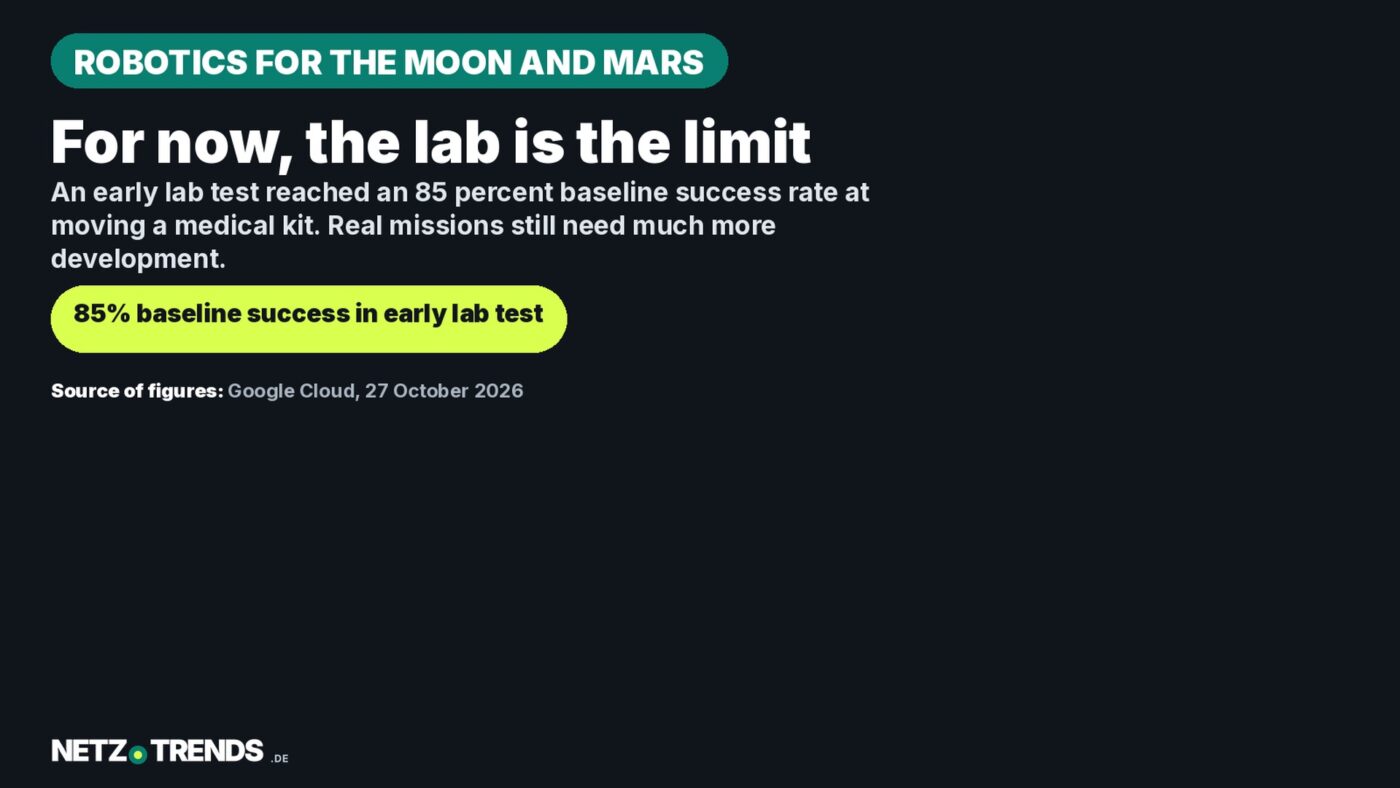
- In an early lab trial, the system reached what Google calls a baseline success rate of 85 percent at locating and moving a medical kit.
- The work is a proof of concept. The report does not demonstrate a flight test or a robot ready for deployment on a Moon or Mars mission.
A robot that fetches a medical device in space sounds like science fiction. Google has now described an early trial of such an assistance system: in a lab, a robotic arm was tasked with finding and moving a medical kit. The reported 85 percent success rate is a first measurement in a controlled environment – not proof that the system is safe to use on a space mission.
According to Google Cloud, Google Public Sector, NASA’s Human Research Program, the robotics team at Johnson Space Center and the Jet Propulsion Laboratory are working on a concept together. The robot is initially meant to handle cargo, equipment and tools. It could also conceivably prepare medical devices for a crew, so that a human medical point of contact can carry out the examination.
What was tested in the lab
Google places the demonstration at the iMETRO facility at Johnson Space Center. In a so-called pick-and-place trial, the system had to locate a medical bag and move it to another spot. According to the blog post, the team combined cameras for spatial orientation with the π0 (Pi0) model from Physical Intelligence and Google DeepMind’s MuJoCo physics simulator.
Google describes the 85 percent success rate as an initial baseline figure from early lab environments. The post does not state the number of runs or a comparison group. The percentage therefore cannot be read as a general reliability figure for the robot. It also says nothing about whether the system can cope with other objects, changing lighting, cramped spaces, or unexpected movement from a crew member.
The intended role is a supporting one. Under the concept, a robot could fetch and prepare an ultrasound device, for instance; a medically qualified person is meant to assess the examination and make decisions. Google describes a goal of astronauts instructing and directly supervising the system by voice. That is a planned feature, not an already-confirmed routine.
Why on-board computing power matters
A spacecraft cannot rely on a reliably fast connection to data centres on Earth at all times. Google cites communication delays of up to 44 minutes for a round trip on a possible Mars mission. For an immediate response, part of the processing would therefore need to happen on board.
Google reports that the team fine-tuned a four-billion-parameter version of Pi0 in 2.5 hours on Google Cloud G4 systems. The models could then reportedly run locally on compact edge devices. Over two years, the team says it examined around 15 devices for this purpose. These figures come from the project partner; the post does not include an independent performance or safety comparison.
The π0 model comes from Physical Intelligence. The company published the model’s code and weights as an experiment in 2025. That makes the approach easier to trace, but does not mean a model works on any robot without adaptation. Physical Intelligence itself notes that transferring it to other platforms will not necessarily succeed in every case.
Why this matters for readers
For consumers, the trial changes nothing for now: there is no announced product, no deployment date and no effect on space-related offerings. What is interesting instead is the technical approach of combining perception, language and movement, and processing tasks as close to the device as possible.
That could also be relevant for applications on Earth where connections fail or an on-the-spot response is needed – for example at remote facilities or during maintenance work. That is a possible transfer of the underlying principle, not a rollout Google has announced for businesses. Robust testing, safe limits and clear human oversight would be essential for that.
What the test does not show
Google’s post describes a proof of concept and the next development steps. It does not demonstrate a flight test, a certification, or autonomous medical care. For use in space, the system would, among other things, need to cope reliably with changing conditions, limited power, radiation, maintenance problems and proximity to people. The published single figure of 85 percent does not cover these questions.
The currently solid finding is narrower: a research team has demonstrated a specific grasping and movement task in a lab with a robotic system. Whether that becomes a reliable helper for a mission depends on further development and testing.
Frequently asked questions
Has the robot already been tested in space?
No. Google describes a proof of concept at a lab facility at Johnson Space Center. The report does not demonstrate a flight test or deployment on a Moon or Mars mission.
What does the 85 percent success rate mean?
Google states it as an initial baseline success rate in early lab environments for a trial in which the system had to find and move a medical kit. No number of runs or independent comparison is given.
Can the robot make medical decisions?
The described concept has the robot fetching or preparing devices. A medically qualified person is meant to assess the examination and make decisions; the intended operation remains under human supervision.
Your view
What tasks should a robot be allowed to take on during a space mission, and where should the decision always stay with a human? Share your view in the comments.
Sources and status
- Google Cloud: “Google Cloud and NASA: Testing robotic systems for deep space missions”, 27 October 2026. Source for the project description, lab test, baseline figure and technical details.
- Physical Intelligence: “Open Sourcing π0”, 4 February 2025. Source for the release of code and model weights and the experimental nature of π0.
Research and data as of 31 October 2026. The report on the project comes from the company involved, Google; the performance figures have not been independently verified. The assessment of relevance for readers is an editorial transfer of the described edge-computing approach.
Transparency note: AI-assisted tools were used in researching, structuring and writing this article. The sources used are listed in the article. Publication takes place only after manual editorial approval. Translation of the German original on NETZ-TRENDS.de.