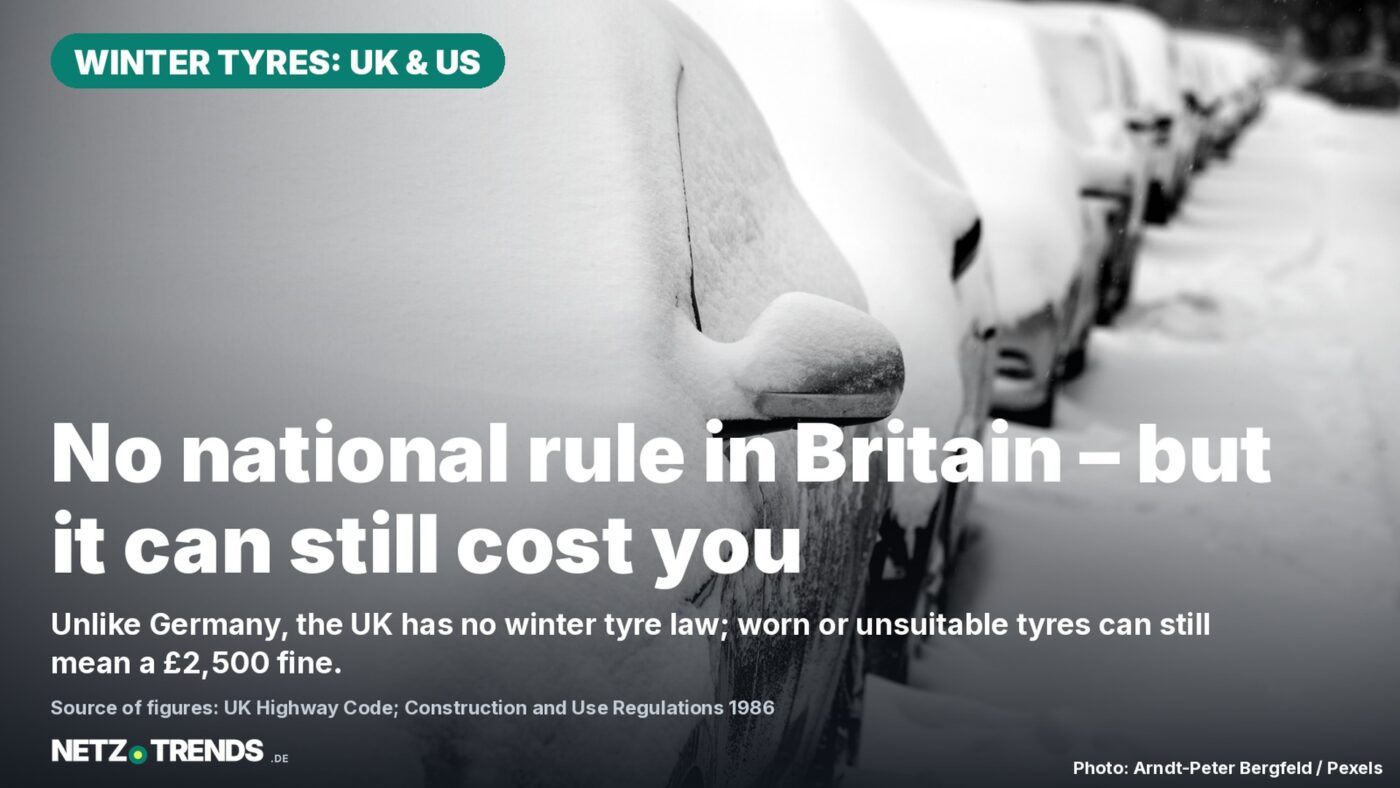
Britain has no nationwide winter tyre law, unlike Germany. But driving on tyres unsuitable for the conditions can still mean a fine – and some US states require chains or snow tyres on mountain routes.
Key points
- The UK has no legal requirement to fit winter tyres, even in snow or ice – unlike Germany’s situational winter tyre rule.
- Tyres must still have at least 1.6mm of tread and be suitable for the road and weather conditions; breaching this can bring a fine of up to £2,500 per tyre and three penalty points.
- In parts of the United States, state authorities can require snow tyres or chains on specific mountain routes, with their own fines for non-compliance.
Unlike Germany, where tyres unsuited to snow, ice or black ice are banned whenever conditions require it, Britain has no comparable nationwide rule for winter tyres. Drivers are not legally required to fit them. But general tyre law still applies all year round – and in parts of the United States, state and local authorities can order snow tyres or chains on specific roads.
What UK law actually requires
There is no British law that forces drivers to fit winter tyres once temperatures drop or snow falls, and no fixed date range comparable to Germany’s situational rule. The Highway Code’s guidance on adverse weather (rules 226 to 237) recommends only avoiding unnecessary journeys in snow and ice and carrying basic winter kit such as a scraper and de-icer; it does not mention tyre type.
What does apply all year is the general duty on tyre condition and suitability. Under the Road Vehicles (Construction and Use) Regulations 1986, tyres must have at least 1.6mm of tread across the central three-quarters of the tread and around the full circumference, must be correctly inflated, and must not be “unsuitable” for the vehicle or the circumstances in use. In icy or snowy conditions, badly worn summer tyres can fall foul of that suitability requirement even without a specific winter tyre law.
The fine that can still apply
A defective or unsuitable tyre is an offence under Regulation 27 of the 1986 regulations and Section 41A of the Road Traffic Act 1988. Police and the Driver and Vehicle Standards Agency (DVSA) can issue a fixed penalty, and a court can impose a fine of up to £2,500 and three penalty points – per tyre, so multiple affected tyres can multiply the penalty. This applies regardless of the season; it is simply more likely to be enforced when poor tread meets snow or ice.
The United States: a state-by-state patchwork
The US has no federal winter tyre law either. Instead, individual states and highway authorities can impose their own rules on specific roads, mainly in mountain regions. California’s Department of Transportation (Caltrans) operates a chain control system on mountain routes such as Interstate 80 over the Sierra Nevada: under its “R-1” requirement, chains are compulsory for most vehicles unless they carry snow tyres marked “M+S” or “Mud and Snow” on at least two drive wheels; under the stricter “R-2” and “R-3” levels, chains or traction devices are required for all vehicles, with limited or no exceptions even for four-wheel-drive vehicles on snow tyres. The California Highway Patrol can cite drivers who ignore an active chain control.
Colorado operates a comparable Traction Law on the Interstate 70 mountain corridor, requiring either four-wheel or all-wheel drive or tyres meeting a minimum tread depth during active conditions; a stricter Chain Law can follow when conditions worsen. Both systems are set and lifted road by road, not as a blanket seasonal rule for the whole state.
Germany, for comparison
Germany takes the broadest approach among the three: under the German Road Traffic Act (StVG), tyres must be suited to the prevailing winter conditions whenever snow, ice, slush, frost or black ice are present – not tied to a fixed calendar date. Driving with unsuitable tyres in such conditions can bring a fine starting at €60, rising to €80 if other traffic is obstructed, under the German road traffic regulations (StVO) fine catalogue.
Frequently asked questions
Do I legally need winter tyres to drive in the UK in snow?
No. There is no British law requiring winter tyres. General tyre-condition law still applies: tread must be at least 1.6mm and tyres must be suitable for the conditions, or you risk a fine and penalty points.
Can I be fined in the UK just for using summer tyres in winter?
Not for the tyre type itself. But if summer tyres are worn below the legal tread limit or are judged unsuitable for the conditions, that can be an offence under the Construction and Use Regulations, with a fine of up to £2,500 and three points per tyre.
Do I need snow tyres to drive in the US?
It depends on the state and the specific road. There is no federal requirement, but authorities such as Caltrans in California or Colorado’s transport department can mandate chains or snow tyres on designated mountain routes during active weather.
How does this compare with Germany?
Germany requires tyres suited to winter conditions whenever those conditions occur, with fines starting at €60. The UK and most of the US have no equivalent nationwide rule, relying instead on general tyre-safety law or road-specific orders.
Sources and status
- UK Government: the Highway Code, driving in adverse weather conditions (rules 226 to 237)
- Road Vehicles (Construction and Use) Regulations 1986, Regulation 27 (tyres), legislation.gov.uk
- Road Traffic Act 1988, Section 41A, legislation.gov.uk
- California Department of Transportation (Caltrans): chain controls
- German Road Traffic Act (StVG) (in German), for comparison
Research and data as of: 1 November 2026.
Transparency note: AI-assisted tools were used in researching, structuring and writing this article. The sources used are listed in the article. Publication takes place only after manual editorial approval. Country edition based on an article from NETZ-TRENDS.de, researched for the United Kingdom and the United States.