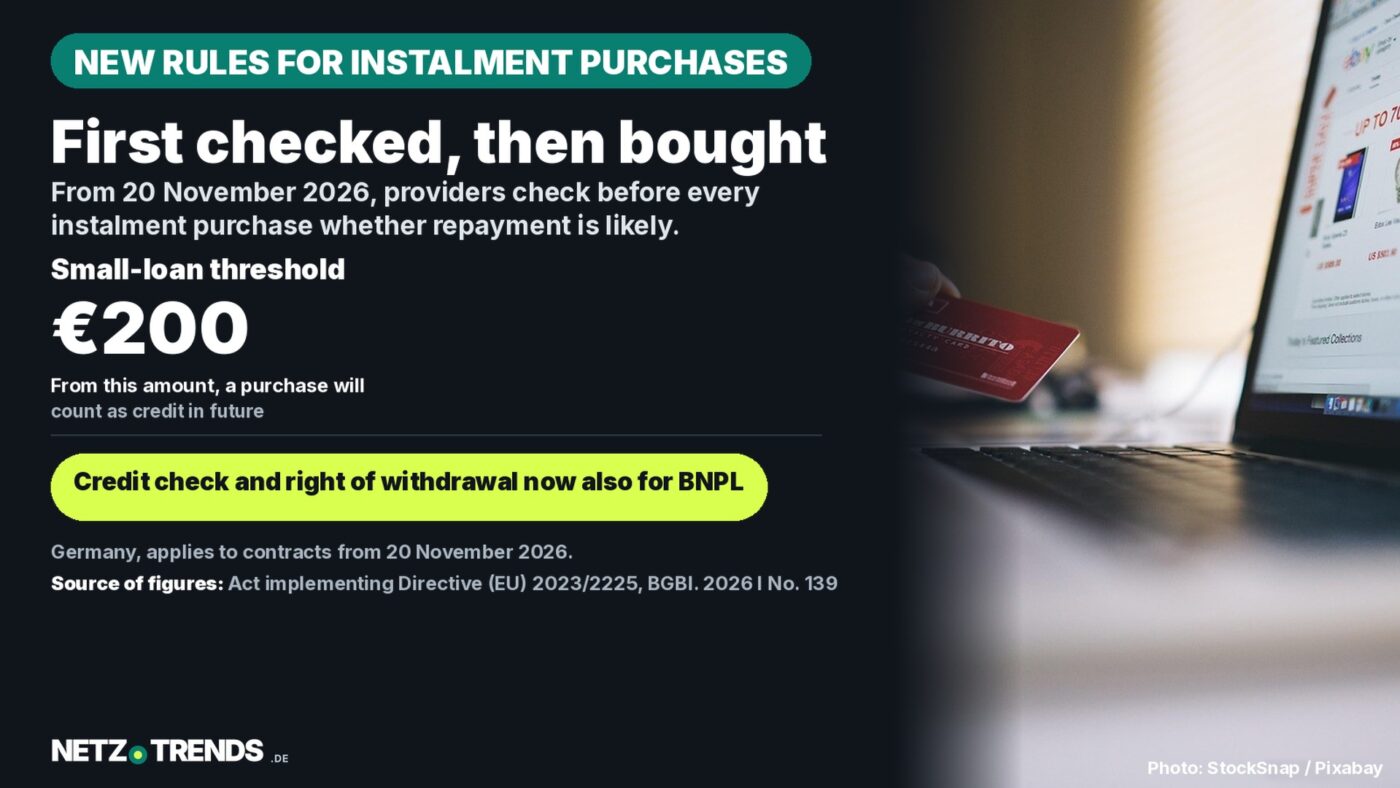
From this date, BNPL purchases, small loans under 200 euros and overdraft facilities are subject to new creditworthiness and withdrawal rules under German law.
Key points
- From 20 November 2026, Germany’s Act implementing the EU Consumer Credit Directive (EU) 2023/2225 applies: for the first time, it also covers small loans under 200 euros, short-term and interest-free loans, and “buy now, pay later” offers such as instalment purchases via external payment services.
- Providers will have to assess the borrower’s ability to repay, provide a standard European information sheet and grant a 14-day right of withdrawal; if mandatory information is incorrect, this period is extended to a maximum of twelve months and 14 days.
- Overdraft facilities will also be regulated more strictly: banks may no longer terminate them without notice, but must offer repayment in up to twelve equal monthly instalments before any enforcement action.
- Under the new Sales Financing Supervision Act, Germany’s financial supervisory authority BaFin receives, for the first time, its own supervisory powers over lenders in the instalment purchase business, with fines of up to 500,000 euros.
From 20 November 2026, German consumer credit law will for the first time also cover micro-loans and instalment purchases via services such as Klarna and PayPal. Buyers get more rights, providers more obligations.
The basis is Directive (EU) 2023/2225 of the European Parliament and of the Council of 18 October 2023, which replaces the previous EU Consumer Credit Directive from 2008. Germany should actually have transposed the new requirements into national law by 20 November 2025 – the corresponding act only passed the Bundestag and Bundesrat around six months later.
The German Bundestag adopted the implementing act on 17 April 2026, and the Bundesrat approved it on 8 May 2026. It was promulgated in the Federal Law Gazette (BGBl. 2026 I No. 139) on 12 May 2026 – with a transition period for the credit industry until the actual start of application on 20 November 2026.
Instalment purchases and BNPL become credit
At the heart of the reform is a significant extension of the scope of the German Civil Code (Bürgerliches Gesetzbuch, BGB). In future, the protective provisions for consumer loans will also apply to free-of-charge and short-term loans, to micro-loans under 200 euros and to deferred payments – precisely those “buy now, pay later” models with which online retailers offer instalment purchases via external payment services.
Until now, many of these offers were not considered credit in the legal sense because they were interest-free or had only short terms. That changes on the cut-off date: anyone who in future finances a purchase in instalments through a third-party provider legally enters into a consumer loan agreement.
Stricter checks, new scoring rules
Under the new law, lenders may only conclude an agreement if repayment appears likely. According to the draft bill, the creditworthiness assessment is thus brought more closely into line with the stricter rules for real estate loans.
Automated scoring is also newly regulated: scores may no longer be based on data from social networks or on health data, and scores are excluded altogether for minors. Consumers also gain the right to have a purely automated rejection reviewed by a human.
Overdraft: right of withdrawal and repayment plan
Those who overdraw their current account also get more rights. According to the draft bill, customers will in future have a right of withdrawal for the arranged overdraft facility, and banks can no longer terminate it overnight without notice.
Instead, before any enforcement action, the credit institution must offer repayment in up to twelve equal monthly instalments. Banks must also show forbearance towards customers in financial difficulty instead of immediately insisting on full repayment.
What remains exempt
Not every payment method falls under the new rules. The classic purchase on invoice from the retailer itself remains exempt as long as the payment term is no more than 50 days and no third party takes over the claim; for large online providers, this period is shortened to 14 days.
Debit cards with a short payment deferral also continue to fall outside credit law. In addition, text form will in future suffice for consumer loans as a whole instead of the previously required written form – a concession to online contracting that was criticised in the Bundestag by, among others, Alliance 90/The Greens as a step backwards for consumer protection.
BaFin gains new supervisory powers
The law also creates the Sales Financing Supervision Act (Absatzfinanzierungsaufsichtsgesetz, AbsFinAG). For the first time, it gives Germany’s financial supervisory authority BaFin its own legal basis to supervise lenders in the instalment purchase business, with powers to impose sanctions and publish measures.
Intermediaries of consumer loans and financial accommodations will in future need their own licence under Section 34k of the German Trade Regulation Act (Gewerbeordnung), supplemented by registration, expertise and continuing education requirements. Violations of the registration obligation can be punished with fines of up to 500,000 euros; transition periods running into 2027 apply for the changeover.
“The requirements for the creditworthiness assessment are being tightened.”
Sebastian Steineke, consumer protection commissioner of the CDU/CSU parliamentary group in the Bundestag, in the Bundestag debate on 17 April 2026
Criticism of the German implementation
In the Bundestag, the CDU/CSU and SPD voted for the law, while the AfD, Alliance 90/The Greens and Die Linke voted against it – albeit for opposing reasons. While the Greens and the Left in part called for stricter consumer protection rules, the AfD parliamentary group described the underlying EU directive as fundamentally going too far.
The German Banking Industry Committee (Deutsche Kreditwirtschaft, DK), the umbrella body of the German banking associations, welcomed the simplifications in concluding contracts but criticised the fact that the German implementation goes beyond the actual requirements of the EU directive in several places. In such cases, industry representatives speak of “gold-plating” – a national tightening beyond the EU minimum.
Example: smartphone for 600 euros in three instalments
- Until now: A provider could often activate instalment payment via an external payment service without a credit check and without the detailed mandatory information of a loan, because the contract was considered an interest- and fee-free payment facility.
- From 20 November 2026: Because the purchase price exceeds the 200-euro threshold for micro-loans and a third-party provider takes over the financing, the contract is considered a consumer loan. The provider must assess the ability to repay, provide the standard European information sheet and grant a 14-day right of withdrawal.
Calculation: a purchase price of 600 euros is above the 200-euro exemption threshold for micro-loans – the contract therefore falls entirely under the new consumer loan law, not just in part.
Anyone planning a larger purchase anyway can use the new assessment obligation as additional guidance: if a BNPL provider refuses financing in future, that is a sign that a classic instalment loan should also be examined critically.
What consumers should know now
- Contracts concluded before 20 November 2026 generally remain under the previous law – only open framework agreements may in part already fall under the new rules.
- Purchases on invoice from the retailer itself and payment by debit card with a short repayment period remain exempt from the new obligations.
- In the event of payment difficulties, lenders will in future have to show forbearance before terminating an overdraft facility without notice.
- Scoring procedures may not use data from social networks or health data and may not calculate scores for minors.
It is not only consumers who are affected: online retailers and BNPL providers must also adapt their checkout processes by the cut-off date, for example in credit advertising, which in future must include a warning about the cost of borrowing.
Frequently asked questions
What changes for instalment purchases via Klarna, PayPal & Co.?
From 20 November 2026, the same protective provisions apply to such “buy now, pay later” offers as to other consumer loans: the provider must assess the ability to repay, provide a standard information sheet and grant a right of withdrawal.
Does this also affect my overdraft?
Yes. According to the draft bill, customers will in future have a right of withdrawal for the arranged overdraft facility, and before any enforcement action the bank must offer repayment in up to twelve equal monthly instalments instead of terminating the overdraft without notice.
Which payment methods remain exempt?
The classic purchase on invoice from the retailer itself remains exempt if the payment term is no more than 50 days (14 days for large online providers) and no third party takes over the claim. Debit cards with a short payment deferral also continue to fall outside credit law.
Does this also apply to contracts I concluded before 20 November 2026?
For existing contracts, the previous law generally continues to apply. An exception is open framework agreements, to which the new provisions are already partly applied.
Sources and status
- German Bundestag, Committee on Legal Affairs and Consumer Protection: hib 296/2026, recommendation for a decision of 15 April 2026
- German Bundestag: Government draft, Bundestag printed paper 21/1851
- European Parliament and Council of the European Union: Directive (EU) 2023/2225 of 18 October 2023
- IHK Osnabrück-Emsland (Chamber of Industry and Commerce): Act implementing the Consumer Credit Directive (EU) 2023/2225 adopted
Research and data as of: 1 November 2026.
Transparency: This article was researched and written with the support of artificial intelligence and is intended for human editorial review.
Do you use instalment purchases or BNPL services when shopping online – and what do you think of the new assessment obligations? Let us know in the comments.