Commentary – Stuttgart, once the undisputed economic powerhouse of the Republic, stands before the ruins of years of policy-making that has lost touch with economic reality. The latest reports from the city treasury resemble a declaration of bankruptcy: mathematically, free liquidity will sink.
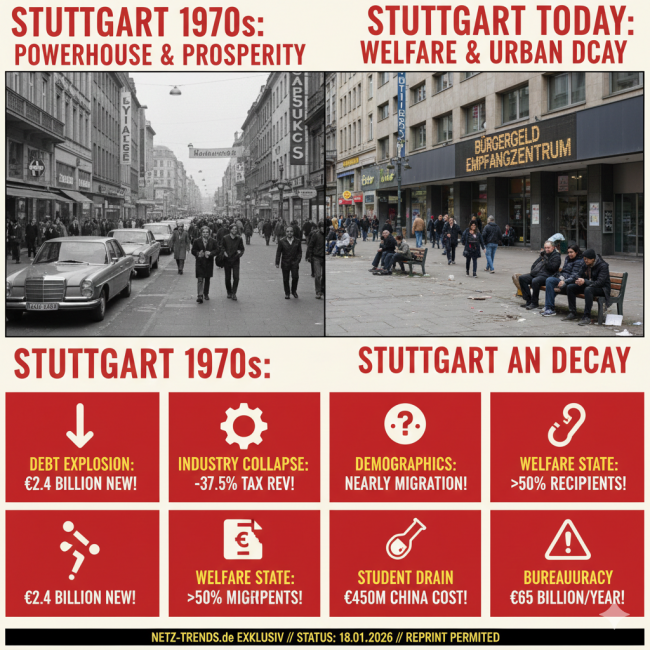


This means the proud "Car City" is officially insolvent from its own reserves. The fact that Lord Mayor Frank Nopper (CDU) must now announce massive new debts and loans amounting to 2.4 billion euros through 2030 is the result of profound political mismanagement.
A look at the city's statistics and information management reveals an interesting correlation. For decades, Stuttgart has seen itself as a pioneer of progressive social policy, reflected particularly in the composition of the City Council. As early as 2004, Stuttgart had the highest proportion of women in Baden-Württemberg at 43%, far exceeding the state average of only 21% at the time.
While the City Hall celebrated this role in representation and gender justice for years, styling Stuttgart as the "spearhead of social progress," it appears the core task of any municipal self-government—securing economic viability—was criminally neglected.
This socio-cultural transformation of the City Council went hand-in-hand with a political shift toward a left-wing eco-social block that dominated the agenda for two decades. Under the era of Green Mayor Fritz Kuhn (2013–2021) and supported by a Green-dominated council majority, a "feel-good biotope" was created, fed almost exclusively by the seemingly inexhaustible trade tax sources of the automotive industry.
From 2019 to 2024, the Greens were the strongest force in the council with 26.3%. Since the 2024 local elections, the CDU is the strongest force with 23.5%, but the Greens follow closely behind at 22.9%. This means nearly one in four voters in Stuttgart still votes Green. In contrast, many members of the long-established bourgeoisie increasingly stay away from the polls, instead retreating behind the high walls of their villa districts.

Prominent names like former Daimler CEO Edzard Reuter symbolize a form of aristocratic isolation that reached perfection in the Stuttgart "fat belt," which extends as far as Lake Constance. People here did not just own a vacation home; they possessed a mental and physical fortress against the outside world.
This retreat is by no means a cowardly flight from responsibility. It is, rather, the bitter consequence of an elite that had to painfully recognize its own limits. At the latest, with the draconian curfews in Baden-Württemberg during the Corona pandemic, it became clear to many—including many billionaire families—that even decades of commitment and economic relevance offered no protection against state arbitrariness and the suspension of fundamental rights.
A Look Back at the Era of Confidence: The publisher of NETZ-TRENDS.de associates Stuttgart with more than just professional observation—it is part of his own history. He spent formative years of his childhood here. A picture from the early 1980s documents an epoch when the Swabian metropolis was a synonym for stability and progress. It was a time when the world in the "Kessel" (the valley basin) was still in order—a stark contrast to today's reality. He himself no longer feels comfortable in the city, enduring it only in peripheral areas like the Botnang region or Killesberg.
When the Administrative Court in Mannheim finally intervened in 2021 to strike down nightly curfews as disproportionate (Case Ref: 1 S 321/21), many high-achievers saw the point where private sanctuary became more important than public discourse. They retreated—not out of disinterest, but as a final act of self-assertion against a system that lost the balance between freedom and state dictate.
This Stuttgart scenario is not a local isolated case, but a reflection of a nationwide agony. The economic elite and the sensible middle class have been pushed into a spectator role, watching the political "botch-up" of Berlin and EU actors in disbelief. Whether it is the craftmanship errors of the CDU/CSU and SPD in power or the ideological stubbornness of the Greens and Left in opposition—the result remains the same.
In a political climate that increasingly replaces technical expertise with ideological targets, those who once built the nation's wealth have chosen a form of inner emigration.
This longing for a protected refuge is as old as civilization itself. In Ancient Rome, a similar pattern was observed: when the senatorial elite felt oppressed by the arbitrariness of the Emperors, they retreated to their country estates. Figures like Pliny the Younger sought the "Vita Contemplativa" to escape the corrupt politics of the capital. Today, we experience a modern parallel: the deep alienation between productive "doers" and ideological "administrators" leads to an exit from the arena because the rules of discourse no longer provide for reason.
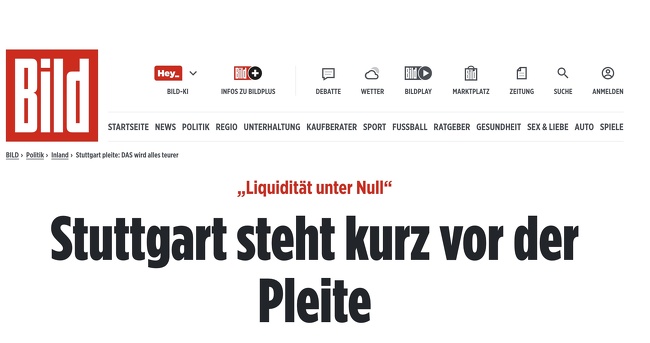
While the economic intelligence of the region dives into passivity, the city administration of this former powerhouse is in flames. Liquidity below zero and a looming debt mountain of 2.4 billion euros are the receipt for a policy that systematically drove critical warners into the private sphere.
While income from core industries sank, politicians indulged in an unprecedented expansion of social spending, distributed with open hands—often globally oriented. Simultaneously, enormous sums flowed into ideological prestige projects:
Academization of the Zeitgeist: Massive investments in gender and equality studies, while technical chairs and vocational training were neglected.
Regulatory Corset: Rigid female quotas for top positions and complex ESG ratings (Environmental, Social, and Governance), putting medium-sized businesses and large corporations under enormous administrative pressure.
Supply Chain Law (LkSG): Created an instrument perceived by many entrepreneurs as "socialist-dictatorial," harassing businesses with liability for global processes they can hardly control.
The domestic industry was no longer treated as a partner but stigmatized as a climate-policy obsolete model and nearly criminalized. Instead of technologically supporting the transformation, it was cornered by bureaucratic overload and moral condemnation.

Critical voices were defamed as "crackpots" for years. With almost religious zeal, the narrative was spread that every cut industrial job would be followed by three "green jobs"—a promise that has proven to be a dangerous illusion given today's unemployment figures and company bankruptcies.
While eco-social primacy ruled the Swabian capital for two decades, the industrial armies of China gathered in the Far East. While we debated cargo bikes, Asia overtook us technologically and socially by 20 years.
Currently, around 39,000 to 43,000 Chinese students are enrolled at German universities (Source: DAAD 2024/25), studying virtually for free. Estimated over 50% occupy STEM subjects like automotive business and mechanical engineering. Around 22,000 future experts soak up German know-how while the free liquidity of the city of Stuttgart drops below zero.

|
|
|
|
|
|
|
|
|
|
|
|
|
|
|
|
|
|
|
|
The Verdi wage settlements act as a financial strangulator. A medium-sized hospital faces 10 million euros in extra personnel expenses over three years. As the Stuttgarter Nachrichten (Jan 16, 2026) headline states: "Public sector wage round: Verdi calls for strike on Tuesday." The city, which proudly pointed to its debt-free status in 2018, is now a petitioner on the capital market.
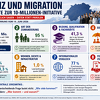
The former Königstraße has lost its character; today it resembles a focal point of global dislocations, similar to Frankfurt's Zeil. In certain migrant groups, welfare (Bürgergeld) rates exceed 50%. Particularly explosive: the new German citizenship law from June 27, 2024, allows for naturalization under wide-ranging exemptions, sometimes without permanent labor market integration after only 3 to 5 years.
According to the 2023 Microcensus, 48.8% of Stuttgart's population now has a migration background. The share of people with a foreign passport is around 26.7%.
This cultural transformation would likely be to the taste of Dr. Angela Merkel. In November 2024, on the "Hotel Matze" podcast and in her autobiography "Freiheit" (Freedom), she defended her line of defining "the people" simply as "everyone who lives in this country." Stuttgart serves as an involuntary laboratory for a policy that sacrificed the proven in favor of globalized arbitrariness.
To avert bankruptcy, citizens are shamelessly asked to pay: increases in dog tax, secondary residence tax, cemetery fees, and parking fees. A bed tax will be introduced, and a hiring freeze for city positions remains in effect until September 2026.
Stuttgart stands today as a cautionary tale of what happens when a political elite declares socio-political restructuring as the highest maxim while taking the economic base for granted. High quotas of progressive representatives may have counted as success in 2004, but in 2025/2026, it is clear that gender parity and a progressive agenda cannot repair bridges or replace missing industrial taxes.
Stuttgart is not just financially at an end—it has reached the end of an intellectual dead end. This Swabian stubbornness, paired with moral superiority, ensures that the impact on the hard ground of reality—financial ruin—is all the more painful.
Compiled by: NETZ-TRENDS.de with Gemini 3 / Google KI Data Status: 18.01.2026 Note: Reprinting and further use of the tables is permitted free of charge.