TP will take over the sites in 2027, subject to antitrust approval – Telefónica is cutting its own contact centres from five to three.
Key points
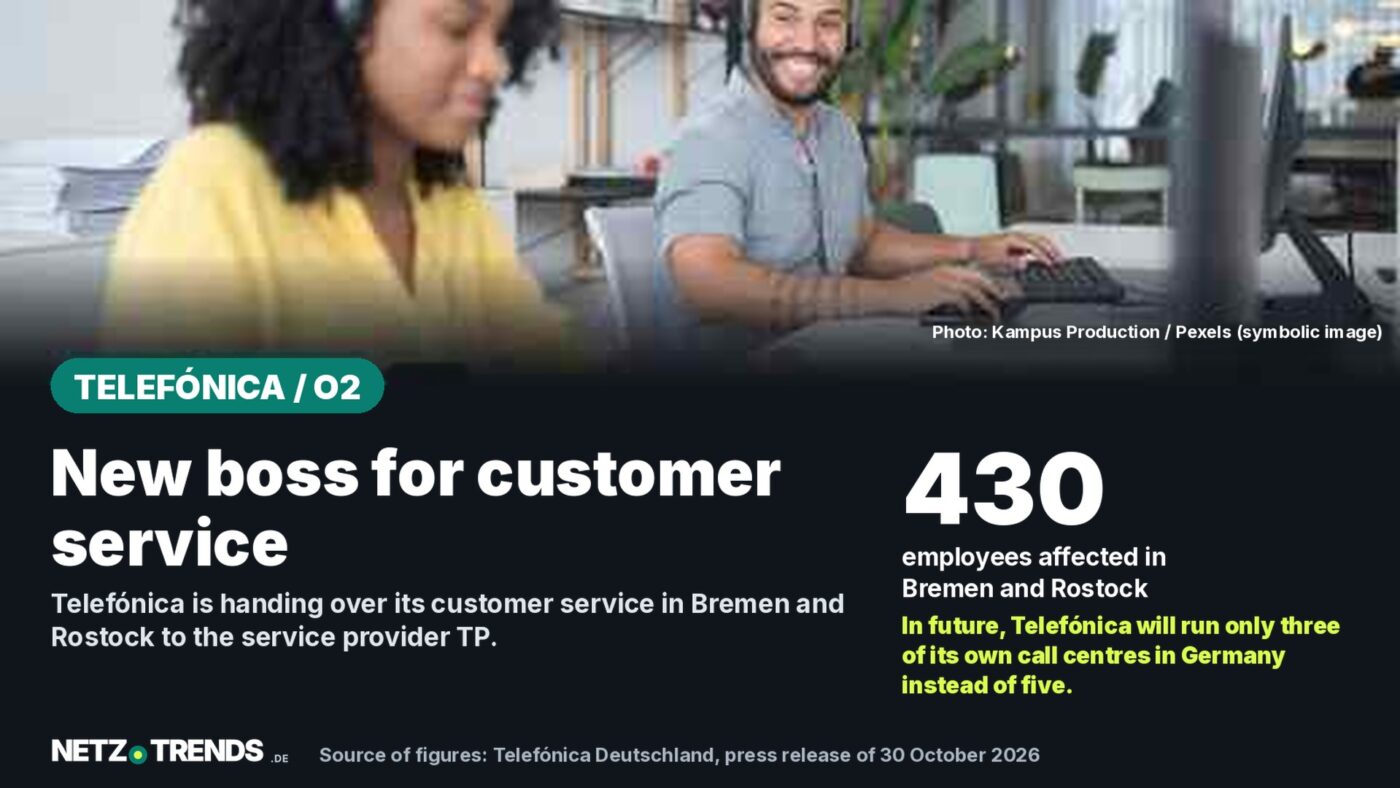
- Telefónica Deutschland is selling its customer service sites in Bremen and Rostock to the service provider TP (formerly Teleperformance); around 430 employees are affected.
- The transfer of ownership is to take effect on 1 January 2027 and is still subject to antitrust approval.
- Telefónica is reducing the number of its own contact centres in Germany from five to three, citing changing customer needs, market conditions and the impact of artificial intelligence as reasons.
Telefónica Deutschland is handing over its customer service sites in Bremen and Rostock to the service provider TP. The agreed takeover is to take effect on 1 January 2027 and depends on the approval of the antitrust authorities.
According to the company, around 430 employees at the two sites are affected. Until final clearance by the antitrust authorities, Bremen and Rostock remain under the control and responsibility of Telefónica.
What Telefónica and TP have agreed
Telefónica Deutschland and TP signed the agreement on 30 October 2026. TP is a company specialising in digital business services that operated under the name Teleperformance until 2025 and describes its own portfolio as “AI-powered”.
The announcement does not give a specific date for legal completion (closing). The target is 1 January 2027 – provided the competent antitrust authorities give their approval. Without this clearance, the transfer will not take place as things stand; Telefónica does not name an alternative date.
“Our priority is to find a sustainable solution for our employees.”
Mallik Rao, Chief Operating Officer of Telefónica Deutschland
What now applies to the 430 employees
Telefónica makes no specific commitments regarding site or job guarantees for the around 430 employees in Bremen and Rostock. The company speaks in general terms of seeking a “sustainable solution” for the employees and of opportunities that would arise for the teams at both sites.
TP managing director Rainer Majcen also commented on the plan: the aim, he said, is a smooth transition for employees and customers alike. The press release says nothing about an agreement with the works council or a trade union; it is not mentioned. Anyone working at one of the two sites will, as things stand, find no details on employment contracts, site commitments or deadlines in the official announcement.
Five call centres become three: the role of AI
According to its own information, Telefónica currently operates five of its own contact centres in Germany. After the transaction with TP, there are to be three. As reasons, the company cites changing customer needs, market conditions and “the impact of artificial intelligence on services” – that is, the influence of artificial intelligence on customer service.
The announcement does not name specific use cases for AI. According to Telefónica, the plan is a mix of in-house teams and automated technical solutions; external partners are to provide additional support where needed. TP itself markets its service portfolio as “AI-powered”, without the press release elaborating on this for the specific case of Bremen/Rostock.
What this means for O2 and Blau customers
For customers of the O2 and Blau brands, nothing changes for the time being as things stand: until antitrust clearance, Bremen and Rostock remain under Telefónica’s responsibility, and the company does not name a date from which customer service will visibly change.
Whether availability, waiting times or the quality of advice will improve, worsen or stay the same as a result of the switch to TP cannot be inferred from the press release. Telefónica names as its goals being able to respond more flexibly to fluctuating call volumes and strengthening availability and quality – but the text contains no explicit assurance that nothing will change for callers.
What O2 and Blau customers should know now
- The change of ownership has not yet been completed: it depends on the approval of the antitrust authorities and is to take effect on 1 January 2027.
- Until then, the Bremen and Rostock sites remain under the control and responsibility of Telefónica.
- The announcement says nothing about specific effects on waiting times or availability after the switch.
- TP (formerly Teleperformance) describes its own offering as “AI-powered” – the announcement gives no details for the transfer of the sites.
With this step, Telefónica is clearly also responding to cost pressure in the German mobile market, where AI-supported automation is increasingly taking over tasks in customer service. For those affected, this means above all: wait and follow the official announcements from Telefónica and TP until the antitrust condition is lifted.
Frequently asked questions
Who is TP, the buyer of the sites?
TP is a company specialising in digital business services that was known as Teleperformance until 2025. TP describes its own service portfolio as “AI-powered”.
Does anything change immediately for O2 and Blau customers?
Not immediately, as things stand: until antitrust clearance, the Bremen and Rostock sites remain under Telefónica’s responsibility. The press release does not specifically address changes after that.
What will happen to the around 430 employees?
They are to move to TP as part of the takeover. Telefónica does not name specific site or job guarantees in the press release; the company speaks in general terms of a “sustainable solution” for the employees.
Why is Telefónica reducing the number of its own contact centres?
As reasons, the company cites changing customer needs, market conditions and the impact of artificial intelligence on customer service. As a result, the number of its own sites in Germany falls from five to three.
What do you as an O2 or Blau customer expect from this restructuring? Share your assessment with us in the comments.
Sources and status
- Telefónica Deutschland: The future of customer service sites – TP is set to take over Telefónica Deutschland’s customer service sites in Bremen and Rostock, press release of 30 October 2026
Research and data as of: 1 November 2026.
Transparency: This article was researched and written with the support of artificial intelligence and is intended for human editorial review.