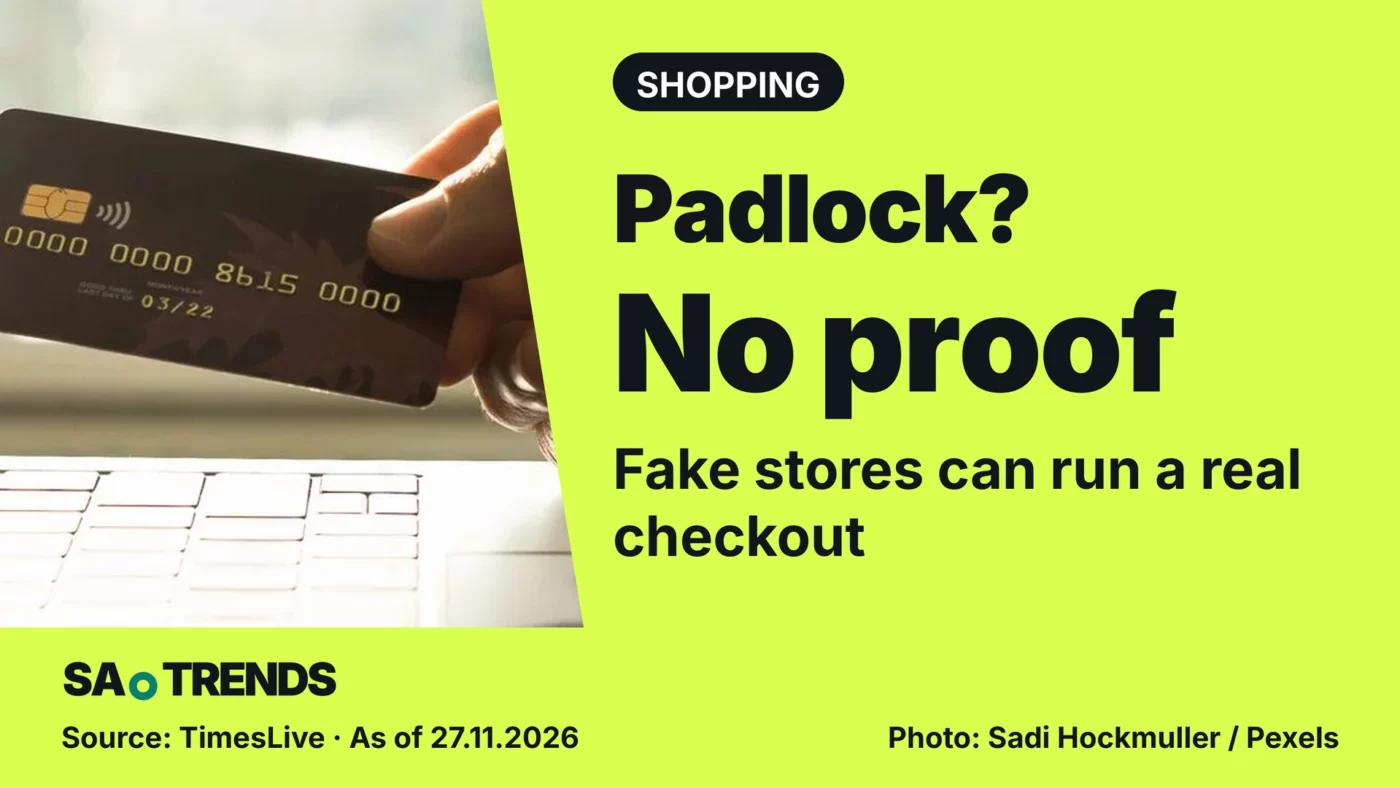
Cloned shops, bank-transfer traps and a seven-day cooling-off right: what South African shoppers should know on Black Friday.
Key points
- Fake stores copy a retailer’s branding and product photos and can run a working checkout, says Martin Potgieter of Integrity360 (TimesLive, 17 November 2026).
- A padlock or HTTPS in the address bar does not prove that a shop is honest.
- SABRIC puts gross card fraud in South Africa at R1.75 billion for 2025, up 18.0% on 2024.
- Under section 44 of the ECT Act you can cancel most online orders within seven days of receiving the goods, without giving a reason.
Fake online stores copy real retailers’ branding and can even run a working checkout, a security expert told TimesLive ahead of Black Friday on 27 November. If you have already paid, call your bank at once.
The warning comes as shoppers hunt for deals. Scammers know that, so they build shops that look like the real thing and push people towards a fast payment.
How fake stores pull you in
Martin Potgieter of security firm Integrity360 told TimesLive that fake shops copy a retailer’s branding and photos. They drive traffic with social media adverts and countdown clocks that make you feel you must buy now.
The web address is often the giveaway. Potgieter points to an extra word in the name, “.shop” instead of “.co.za”, a swapped letter, or “rn” in place of “m”. Some shops steer you to an EFT into an account you have never heard of.
A padlock does not help here. It only shows that the connection is encrypted, not that the seller is real. The safer route is to start at the retailer’s official site or app instead of clicking an advert.
What the fraud numbers show
The South African Banking Risk Information Centre (SABRIC) reports gross card fraud of R1,745,352,519 for 2025, up 18.0% from R1,479,082,576 a year earlier. On cards issued in South Africa the figure was R857,459,174, up 43.3%.
Card-not-present fraud, where the card is not physically used, fell on credit cards by 5.3% to R402,109,115 and on debit cards by 35.1% to R378,416,008. All figures are gross, before any money is recovered. SABRIC also lists marketplace scams, including payment for goods that never arrive.
Your rights if the shop is real
Under section 44 of the Electronic Communications and Transactions Act (ECT Act) you may cancel an online purchase without giving a reason or paying a penalty. The window is seven days from receiving the goods, or from the date of the agreement for services.
The seller may charge only the direct cost of returning the goods, and must refund you in full within 30 days of the cancellation. Section 16 of the Consumer Protection Act gives five business days for direct marketing, but it does not apply to transactions covered by section 44 of the ECT Act.
What to do if you have paid
Speed matters. Potgieter’s advice for anyone who has paid a fake shop is to contact the bank, block the card and dispute the payment.
If you paid a fake store
- Call your bank straight away
Use the official banking app or the fraud number on your card, not a number from the shop.
- Block the card and dispute the payment
Ask the bank to open a dispute on the transaction.
- Change reused passwords
Do this for any account that shares a password with the one you used on the fake site.
- Keep your evidence
Save screenshots of the advert, the shop and the order confirmation.
Next time, check the address letter by letter before you enter card details.
Frequently asked questions
Does the padlock in the browser mean a shop is safe?
No. According to Integrity360’s Martin Potgieter, a padlock or HTTPS proves nothing about whether the shop is honest.
How long do I have to cancel an online order in South Africa?
Section 44 of the ECT Act gives you seven days from receiving the goods. The seller must refund you in full within 30 days of the cancellation.
What should I do if I paid by EFT into an unfamiliar account?
Phone your bank through the official app or fraud line immediately, and ask it to help recover the payment. Change any password you reused on the fake site.
Your view: Have you ever landed on a fake shop that looked like a retailer you know, and what gave it away? Tell us your experience in the comments.
Sources and date
As of: 27 November 2026
- TimesLive: How to spot fake Black Friday stores (news article, 17 November 2026)
- SABRIC: Annual Crime Statistics Report 2025 (report)
- Electronic Communications and Transactions Act 25 of 2002: section 44, cooling-off period (statute)
- Consumer Protection Act 68 of 2008: section 16, cooling-off after direct marketing (statute)
Transparency note: AI-assisted tools were used in researching, structuring and writing this article. The sources used are listed in the article. Publication takes place only after manual editorial approval.
Share this article
Read next
Your curiosity
Our next story
Bring your ideas for AI and digital media
Discover open positions Research