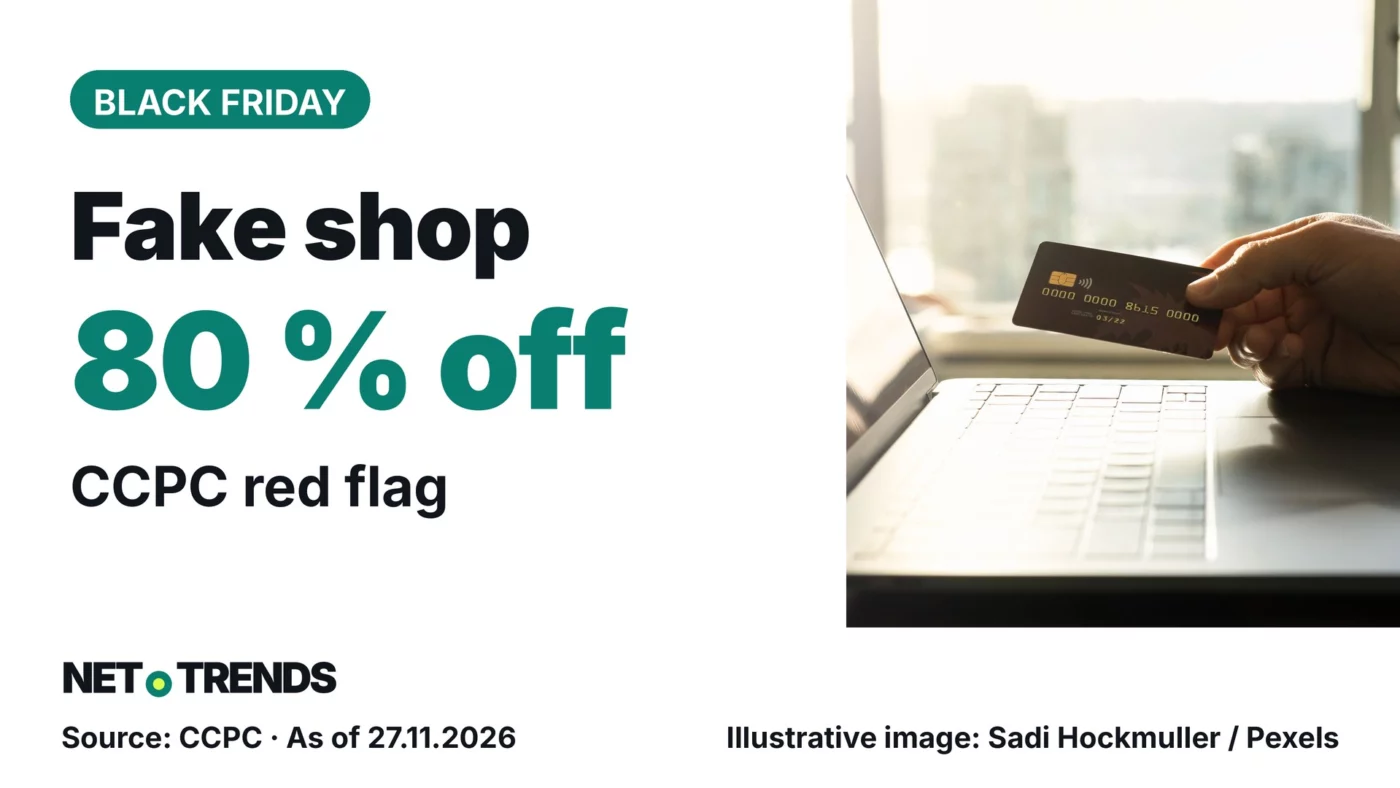
An Irish-sounding name or a .ie address proves nothing. The CCPC lists the checks to run before you pay a shop you do not know.
Key points
- The Competition and Consumer Protection Commission (CCPC) names big discounts, countdown timers and fake stock counters as typical signs of a fake online shop.
- An Irish-sounding name or a .ie web address does not show that a business is based in Ireland, the CCPC says.
- Paying by card or PayPal instead of bank transfer keeps a chargeback open as an option, the CCPC says.
- Payment fraud in Ireland rose 27.2% to €179.04 million in 2025, according to the Central Bank of Ireland.
Black Friday falls today, 27 November 2026, and fake online shops are built to catch shoppers in a hurry. The CCPC says a few checks before you pay can stop most of them.
The CCPC describes the typical fake shop on its page about fake online shops. Its press release from last year’s Black Friday, on 28 November 2025, said almost 40% of people surveyed expected to buy during the Black Friday and Cyber Monday sales. Grainne Griffin, the CCPC’s Director of Communications, said then: “Don’t let tactics like time-sensitive offers or countdown clocks pressure you into making a decision you might regret.”
Warning signs the CCPC lists
The first sign is the offer itself. The CCPC points to very large discounts, countdown timers, fake “live sale” pop-ups and fake stock counters. In last year’s release it gave “up to 80% off” as an example of an extreme discount. Sponsored social media ads with deals that look too good to be true are another warning.
The second sign is the shop’s history. The CCPC advises caution with newly created websites or social media profiles that have few posts or followers, with inconsistent branding, and with AI-generated product photos or testimonial videos. On reviews, it says to look for independent sources such as Trustpilot or Google reviews, and to be suspicious of many generic five-star ratings or reviewers who have posted only once.
The third sign is how the shop wants to be paid and contacted. Cryptocurrency or gift cards, pressure to move the conversation to a messaging app, and requests for sensitive data such as a PPS number, passport details or a video ID are all red flags, according to the CCPC.
An Irish-sounding name proves nothing
A shop with an Irish-sounding name or a .ie address may not be Irish at all, the CCPC warns. It advises you to look for a physical address, a phone number and an email address, and to check the location on Google Maps and Street View. You can also search for the company on the register of the Companies Registration Office (CRO).
The CCPC recommends buying from companies based in the EU, because EU consumer protection law applies more strongly to them. It also notes that some scam shops send tracking links showing a parcel shipped from far outside Ireland, and that the item may be poor quality or not what you ordered.
How you pay decides what you can get back
In its Black Friday release the CCPC advises paying by credit card, debit card or a trusted provider such as PayPal, and not by direct bank transfer. If something goes wrong, you should contact your bank or payment provider immediately: a chargeback “may” recover your money, and the bank may freeze your card to prevent further charges. A chargeback is a request through your bank or card issuer to reverse a card payment. The CCPC does not promise that it will succeed.
The scale of the problem is large. The Central Bank of Ireland reported on 4 September 2026 that payment fraud rose 27.2% to €179.04 million in 2025. Fraud in which the payer is manipulated into authorising a payment accounted for 45% of the value, or €74.86 million. These figures cover all payment fraud, not just fake shops, as we explained in our report on the 1Password incident.
If you have already paid
The CCPC’s advice is: “Act quickly – every minute counts.” Contact your bank or card issuer straight away, freeze your card if necessary, and report the matter to your local Garda station. If you believe a business is misleading consumers, you can also report it to the CCPC.
A genuine shop can still disappoint. For what happens to gifts bought today, see our explainer on the 14-day cancellation window.
What you can do now
Run the checks below before you enter card details on a site you have never used. If any of them fails, close the page and buy from a retailer you already know.
Before you pay a shop you do not know
- Find a real business behind the shop
Look for a physical address, phone number and email, check the location on Google Maps and search the CRO register.
- Read independent reviews
Use sites such as Trustpilot or Google reviews and be wary of many generic five-star ratings.
- Ignore the countdown clock
Timers, stock counters and "live sale" pop-ups are used to rush you.
- Pay by card or PayPal
Avoid bank transfers, gift cards and cryptocurrency so that a chargeback stays possible.
- Act at once if you are caught out
Call your bank or card issuer, freeze the card if needed and report it to the Gardaí.
Frequently asked questions
Does a .ie address mean a shop is Irish?
No. The CCPC says an Irish-sounding name or a .ie address does not prove that a business is Irish. Check for a physical address, phone number and email, and look the company up on the CRO register.
Can I get my money back if I paid by card?
You may be able to request a chargeback through your bank or card issuer, says the CCPC. It is not guaranteed, so contact your bank as soon as you suspect a scam.
What should I do first if I paid a fake shop?
Contact your bank or card issuer immediately, freeze your card if necessary and report the matter to your local Garda station, as the CCPC advises.
Are five-star reviews a good sign?
Not on their own. The CCPC lists many generic five-star ratings and reviewers who have posted only once as suspicious patterns, and advises checking independent review sites.
Your view: What is the one check you run before buying from a shop you have never used? Tell us in the comments.
Sources and date
- Competition and Consumer Protection Commission: Fake online shops (consumer guidance, accessed 27.11.2026)
- Competition and Consumer Protection Commission: CCPC warns of surge in online scams as Irish consumers enter busiest shopping season (press release, 28.11.2025)
- Central Bank of Ireland: Payment fraud increases by 27% to reach €179 million in 2025 (press release, 4.9.2026)
As of: 27.11.2026
Transparency note: AI-assisted tools were used in researching, structuring and writing this article. The sources used are listed in the article. Publication takes place only after manual editorial approval.
Share this article
Read next
Your curiosity
Our next story
Bring your ideas for AI and digital media
Discover open positions Research
 ▶ Reel