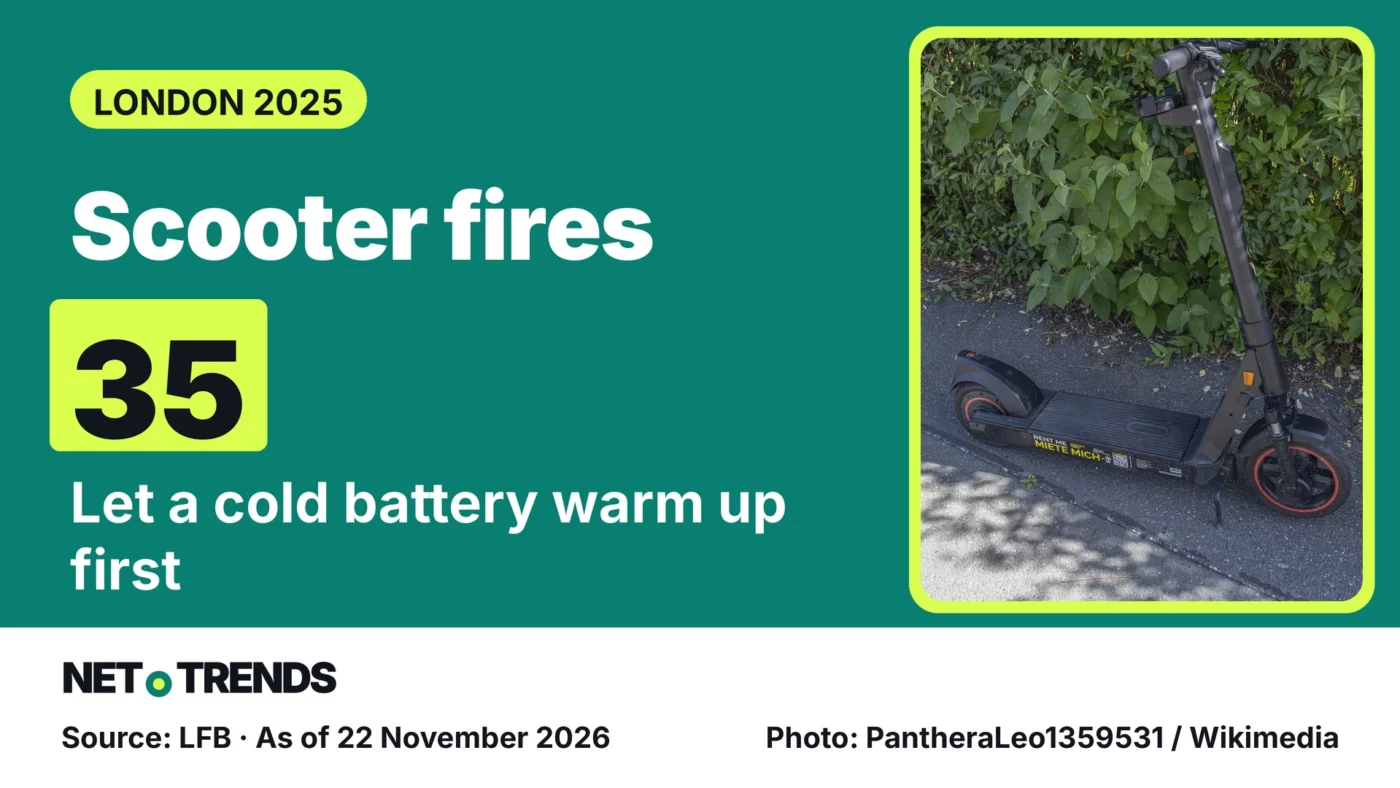
London Fire Brigade attended 35 e-scooter fires in 2025, and the government warns against charging in cold, damp places.
Key points
- London Fire Brigade recorded 206 e-bike and e-scooter fires in 2025, 35 of them involving e-scooters.
- The Department for Transport advises avoiding excessively hot, cold or damp areas, especially for charging.
- Segway allows its Ninebot F25 to be charged only between 0 and 40 °C, although it can be ridden down to −10 °C.
- Privately owned e-scooters may only be used legally on private land with the landowner’s permission.
A cold e-scooter battery should warm up before it goes on charge. Most fires involving e-bikes and e-scooters happen while the battery is charging, says London Fire Brigade.
Frost has arrived early this season. The Met Office reported on 16 November 2026 that Tulloch Bridge in Scotland had fallen to −7.7 °C, the coldest night of the season so far. Anyone bringing a scooter in from an unheated shed or garage should not plug it straight in.
206 fires in London last year
According to London Fire Brigade figures published on 28 January 2026, the brigade attended 206 e-bike and e-scooter fires in 2025, up from 171 in 2024. E-scooters accounted for 35 of them, compared with 29 a year earlier. Two people died in these fires in 2025.
Spencer Sutcliff, Deputy Commissioner at London Fire Brigade, said firefighters were attending such a fire every other day on average. The figures cover London only; there is no comparable national breakdown for e-scooters in this release.
Three temperature limits, not one
Being able to ride a scooter below freezing does not mean you can charge it at the same temperature. The manufacturer’s specification for the Ninebot F25 lists three separate ranges:
| Use | Temperature according to Segway |
|---|---|
| Riding | −10 to 40 °C |
| Charging | 0 to 40 °C |
| Storage | −10 to 50 °C |
There is no single waiting time in minutes that applies to every model. A few minutes in a warm hallway does not prove the battery has reached a safe charging temperature. Check the charging and storage figures in your own scooter’s manual.
What the government and firefighters advise
The Department for Transport’s battery safety guidance tells owners to avoid excessively hot, cold or damp areas, especially for charging. It also says to use only the charger supplied with the scooter or a replacement authorised by the manufacturer, not to cover chargers or batteries while charging, and never to leave a battery charging while you are asleep or away from home.
London Fire Brigade adds that batteries should be charged on hard, flat surfaces where heat can dissipate, away from a main through-route or exit. It recommends fitting a smoke alarm where you charge, and not charging a battery that has been dropped or damaged.
Where to keep the scooter over winter
The Department for Transport suggests storing and charging e-scooters in a shed or garage separate from the home where possible, and not on escape routes or in communal areas of shared buildings. For garages, fire and rescue services recommend heat alarms rather than smoke alarms.
That creates a winter trade-off: a detached shed is safer for fire, but it may be too cold for charging. Bring the battery or scooter somewhere above freezing to warm up first, and follow the manufacturer’s storage advice for long breaks.
One more UK detail: privately owned e-scooters are classed as powered transporters. According to the Department for Transport, they may only be used legally on private land with the landowner’s permission; only scooters in official rental trials may be ridden on roads.
What you can do before the next charge
A short routine means you will not have to look up the key details after a cold ride.
Before you charge after a cold ride
- Find your manual
Note the charging temperature and the advice on longer storage for your model.
- Let the battery warm up
Bring the scooter or battery somewhere above freezing before plugging it in.
- Use the right charger
Use only the supplied charger or a replacement authorised by the manufacturer, and check the cable for damage.
- Choose a safe spot
Charge on a hard, flat surface away from exits, and never while you are asleep or out.
- Check your alarms
Fit a smoke alarm where you charge indoors, or a heat alarm in a garage.
Battery temperature and road conditions are separate questions: a warm battery tells you nothing about whether the path is icy.
Frequently asked questions
How long should a cold e-scooter wait before charging?
There is no general figure in minutes. The battery should first warm up above freezing, and your manufacturer’s limits apply.
How many e-scooter fires were there in London in 2025?
London Fire Brigade attended 35 e-scooter fires in 2025, out of 206 e-bike and e-scooter fires in total.
Can I use a cheaper replacement charger?
The Department for Transport says to use only the supplied charger or a replacement authorised by the manufacturer.
Is it legal to ride my own e-scooter on UK roads?
No. According to the Department for Transport, privately owned e-scooters may only be used on private land with the landowner’s permission.
Your view: Where do you keep and charge your e-scooter in winter: indoors, in a shed or in a garage? Tell us about your experience in the comments.
Sources and date
- London Fire Brigade: Record number of e-bike and e-scooter fires across London in 2025 (press release, 28 January 2026).
- London Fire Brigade: How to charge e-bikes and e-scooters safely (safety advice, accessed 22 November 2026).
- Department for Transport: Battery safety for e-scooter users (guidance, 1 February 2024).
- Met Office: Snow warning in force as unsettled weather continues (news release, 16 November 2026).
- Segway: F25 – Specifications (manufacturer documentation, undated, accessed 22 November 2026).
As of: 22.11.2026
Transparency note: AI-assisted tools were used in researching, structuring and writing this article. The sources used are listed in the article. Publication takes place only after manual editorial approval.
Share this article