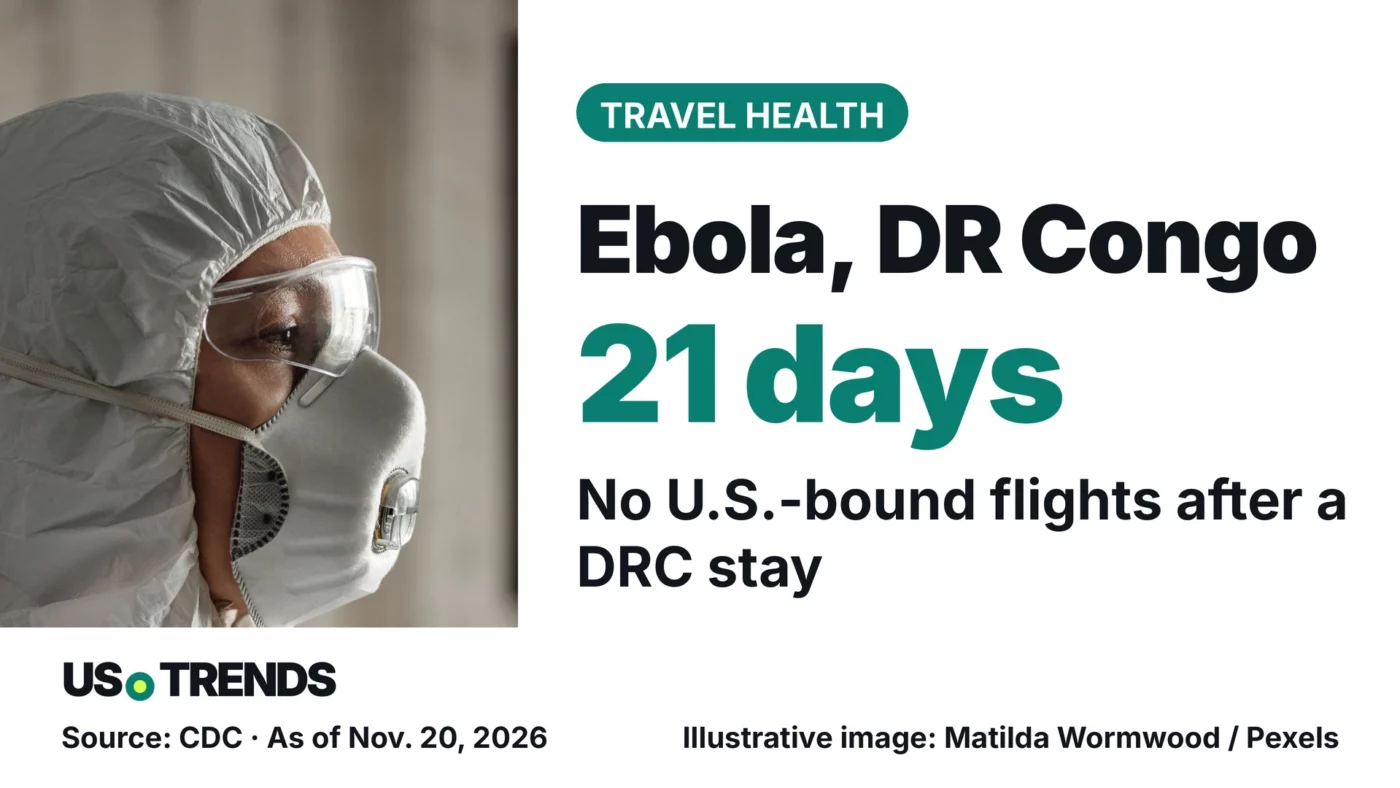
Anyone who was in DR Congo in the past 21 days cannot board a U.S.-bound flight, and no vaccine protects against this Ebola strain.
Key points
- CDC counts 11,680 confirmed Ebola cases and 5,715 confirmed deaths in the Democratic Republic of the Congo as of November 18, 2026.
- Travelers who were in the DRC within 21 days of their flight are not allowed to board commercial flights to the United States, Americans included.
- Since November 3, 2026, all passengers on international flights to the U.S. must attest that they have not been in the DRC in the prior 21 days.
- CDC reports no Ebola cases linked to this outbreak in the United States and rates the risk to the American public as low.
CDC counts 11,680 confirmed Ebola cases in DR Congo, and 5,715 people have died. Anyone who was in the country in the past 21 days cannot fly to the U.S., and there is no approved vaccine against the Bundibugyo strain.
The outbreak was reported in May 2026 and is caused by Bundibugyo virus, one of the Ebola viruses. The Centers for Disease Control and Prevention (CDC) published its latest situation summary on November 20, 2026, with data as of November 18. The World Health Organization (WHO) confirmed on November 18 that the outbreak remains a public health emergency of international concern.
11,680 confirmed cases in DR Congo
CDC lists 11,712 confirmed cases across all affected countries. Almost all of them are in the DRC. Uganda reported 20 confirmed cases but has no active cases, Kenya 9, Nigeria 1 and France 1. CDC’s count excludes probable and suspected cases.
In its outbreak report of November 20, WHO says most cases are in the northeastern provinces of Ituri and North Kivu. Only 81 percent of contacts were followed up, below the 95 percent target.
Nearly every confirmed case is in DR Congo
Data table
| Period | Confirmed cases |
|---|---|
| DR Congo | 11680 |
| Uganda | 20 |
| Kenya | 9 |
| Nigeria | 1 |
| France | 1 |
The chart shows CDC’s confirmed cases by country as of November 18. The United States does not appear on the list.
What the U.S. entry rules say
Under a CDC order based on 42 CFR 71.40, travelers who have been in the DRC within 21 days of their flight “will not be allowed to board commercial flights with U.S. destinations.” This applies to U.S. citizens as well. CDC says Americans coming from the DRC should plan to remain outside the country for 21 days before entering the United States.
U.S. citizens and nationals who were in Uganda or South Sudan, but not in the DRC, within 21 days must enter only through designated airports for enhanced screening. Since November 3, 2026, every passenger on an international flight to the U.S. must attest to not having been in the DRC in the prior 21 days, regardless of where the flight departs.
WHO takes a different line: it advises against restrictions on travel to or trade with affected countries.
How high is the risk for Americans?
CDC states that “the overall risk to the American public and travelers remains low” and rates the likelihood of spread to the United States as very low. No Ebola cases associated with this outbreak have been reported in the country.
There is no approved vaccine or specific treatment for Bundibugyo virus disease, according to WHO. Two candidate vaccines have joined a trial, but none is approved.
CDC travel notices by province
In its travel health notice, CDC recommends avoiding all travel to Ituri and North Kivu unless you are going for humanitarian aid or emergency response. For Haut-Uélé and Tshopo, CDC advises avoiding nonessential travel. In the rest of the DRC, travelers should practice enhanced precautions.
Anyone who still travels to the region should avoid sick people, body fluids, dead bodies and contact with bats, forest antelopes and nonhuman primates. CDC also recommends travel insurance that covers medical evacuation.
If you have been in the region
- Monitor yourself for symptoms while in the DRC and for 21 days after leaving.
- If you develop fever or unexplained bleeding, isolate and do not travel.
- Call a health care facility or the local health authority before going in person.
WHO has announced updated recommendations in the coming days. They may change parts of this picture, so check CDC’s travel notices again shortly before any trip.
Frequently asked questions
Can I fly to the U.S. after visiting DR Congo?
Not within 21 days. CDC says travelers who were in the DRC within 21 days of their flight cannot board commercial flights to the United States, Americans included.
Is there a vaccine against Bundibugyo Ebola?
No. WHO says there are no approved vaccines or specific treatments for this disease.
Have there been Ebola cases in the U.S.?
No. CDC reports no cases associated with this outbreak in the United States.
What is the attestation requirement?
Since November 3, 2026, all passengers on international flights to the U.S. must attest that they have not been in the DRC during the prior 21 days.
Your view: Would you postpone a planned trip to a country bordering DR Congo right now? Share your experience in the comments.
Sources and date
- CDC: Ebola situation summary (situation summary, November 20, 2026)
- CDC: Ebola Bundibugyo Virus Disease in Ituri and Nord-Kivu Provinces (travel health notice, accessed November 22, 2026)
- WHO: Ebola disease caused by Bundibugyo virus – Democratic Republic of the Congo, Kenya and Nigeria (Disease Outbreak News, November 20, 2026)
As of: November 22, 2026
Transparency note: AI-assisted tools were used in researching, structuring and writing this article. The sources used are listed in the article. Publication takes place only after manual editorial approval.
Share this article